Hua Zhang , Yang Luo , Guanrong Li , Zeming Hu , Rong Xu , Tong Zhu , Xu Cao , Yudong Yao , Wei Jian , Jun Chen , Gordon G. Wallace , Jun Fu
{"title":"胶束促进凝胶动力学和动态透明质酸水凝胶的粘弹性用于生物打印模拟结构和组织修复","authors":"Hua Zhang , Yang Luo , Guanrong Li , Zeming Hu , Rong Xu , Tong Zhu , Xu Cao , Yudong Yao , Wei Jian , Jun Chen , Gordon G. Wallace , Jun Fu","doi":"10.1016/j.compositesb.2025.112151","DOIUrl":null,"url":null,"abstract":"<div><div>Engineered tissues created through cell-laden hydrogel bioprinting offer a promising therapeutic approach for tissue regeneration. However, considerable challenges persist in the development of hydrogels that possess optimal gelling kinetics and viscoelastic properties, and sufficient stability to facilitate both the printing of biomimetic structures and the formation of engineered tissues. Herein, we present a rapidly gelling and long-term dynamic hyaluronate hydrogel achieved through the introduction of self-assembled F127 diacrylate (F127DA) micelles to modulate the kinetics of hydrazone crosslinking and the extent of dual-crosslinking network formation. The investigation demonstrates that the introduction of F127DA strengthens the interactions among the hyaluronate components, significantly accelerating gelation and increasing the mechanical stability of the optimal hydrogels. The rapidly formed ink permits low-shear mixing-injection printing, facilitating the construction of precise structures with high cell viability. The viscoelastic microenvironment fosters fibroblast spreading within the bioprinted matrices and supports the development of a biomimetic skin construct characterized by multilayer keratinocytes on the surface. Application of this dynamic hydrogel in a full-thickness mouse skin wound model accelerates tissue healing by inflammation suppression, angiogenesis and extracellular matrix promotion. This study demonstrates innovative modulation of gelation kinetics and viscoelasticity of dynamic hyaluronic hydrogels using block copolymer micelles for tissue engineering.</div></div>","PeriodicalId":10660,"journal":{"name":"Composites Part B: Engineering","volume":"294 ","pages":"Article 112151"},"PeriodicalIF":14.0000,"publicationDate":"2025-04-01","publicationTypes":"Journal Article","fieldsOfStudy":null,"isOpenAccess":false,"openAccessPdf":"","citationCount":"0","resultStr":"{\"title\":\"Micelle-facilitated gelation kinetics and viscoelasticity of dynamic hyaluronan hydrogels for bioprinting of mimetic constructs and tissue repair\",\"authors\":\"Hua Zhang , Yang Luo , Guanrong Li , Zeming Hu , Rong Xu , Tong Zhu , Xu Cao , Yudong Yao , Wei Jian , Jun Chen , Gordon G. Wallace , Jun Fu\",\"doi\":\"10.1016/j.compositesb.2025.112151\",\"DOIUrl\":null,\"url\":null,\"abstract\":\"<div><div>Engineered tissues created through cell-laden hydrogel bioprinting offer a promising therapeutic approach for tissue regeneration. However, considerable challenges persist in the development of hydrogels that possess optimal gelling kinetics and viscoelastic properties, and sufficient stability to facilitate both the printing of biomimetic structures and the formation of engineered tissues. Herein, we present a rapidly gelling and long-term dynamic hyaluronate hydrogel achieved through the introduction of self-assembled F127 diacrylate (F127DA) micelles to modulate the kinetics of hydrazone crosslinking and the extent of dual-crosslinking network formation. The investigation demonstrates that the introduction of F127DA strengthens the interactions among the hyaluronate components, significantly accelerating gelation and increasing the mechanical stability of the optimal hydrogels. The rapidly formed ink permits low-shear mixing-injection printing, facilitating the construction of precise structures with high cell viability. The viscoelastic microenvironment fosters fibroblast spreading within the bioprinted matrices and supports the development of a biomimetic skin construct characterized by multilayer keratinocytes on the surface. Application of this dynamic hydrogel in a full-thickness mouse skin wound model accelerates tissue healing by inflammation suppression, angiogenesis and extracellular matrix promotion. This study demonstrates innovative modulation of gelation kinetics and viscoelasticity of dynamic hyaluronic hydrogels using block copolymer micelles for tissue engineering.</div></div>\",\"PeriodicalId\":10660,\"journal\":{\"name\":\"Composites Part B: Engineering\",\"volume\":\"294 \",\"pages\":\"Article 112151\"},\"PeriodicalIF\":14.0000,\"publicationDate\":\"2025-04-01\",\"publicationTypes\":\"Journal Article\",\"fieldsOfStudy\":null,\"isOpenAccess\":false,\"openAccessPdf\":\"\",\"citationCount\":\"0\",\"resultStr\":null,\"platform\":\"Semanticscholar\",\"paperid\":null,\"PeriodicalName\":\"Composites Part B: Engineering\",\"FirstCategoryId\":\"5\",\"ListUrlMain\":\"https://www.sciencedirect.com/science/article/pii/S1359836825000411\",\"RegionNum\":1,\"RegionCategory\":\"材料科学\",\"ArticlePicture\":[],\"TitleCN\":null,\"AbstractTextCN\":null,\"PMCID\":null,\"EPubDate\":\"2025/1/22 0:00:00\",\"PubModel\":\"Epub\",\"JCR\":\"Q1\",\"JCRName\":\"ENGINEERING, MULTIDISCIPLINARY\",\"Score\":null,\"Total\":0}","platform":"Semanticscholar","paperid":null,"PeriodicalName":"Composites Part B: Engineering","FirstCategoryId":"5","ListUrlMain":"https://www.sciencedirect.com/science/article/pii/S1359836825000411","RegionNum":1,"RegionCategory":"材料科学","ArticlePicture":[],"TitleCN":null,"AbstractTextCN":null,"PMCID":null,"EPubDate":"2025/1/22 0:00:00","PubModel":"Epub","JCR":"Q1","JCRName":"ENGINEERING, MULTIDISCIPLINARY","Score":null,"Total":0}
Micelle-facilitated gelation kinetics and viscoelasticity of dynamic hyaluronan hydrogels for bioprinting of mimetic constructs and tissue repair
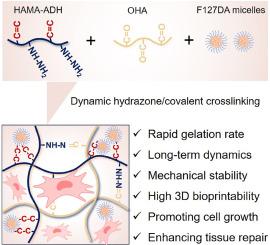
Engineered tissues created through cell-laden hydrogel bioprinting offer a promising therapeutic approach for tissue regeneration. However, considerable challenges persist in the development of hydrogels that possess optimal gelling kinetics and viscoelastic properties, and sufficient stability to facilitate both the printing of biomimetic structures and the formation of engineered tissues. Herein, we present a rapidly gelling and long-term dynamic hyaluronate hydrogel achieved through the introduction of self-assembled F127 diacrylate (F127DA) micelles to modulate the kinetics of hydrazone crosslinking and the extent of dual-crosslinking network formation. The investigation demonstrates that the introduction of F127DA strengthens the interactions among the hyaluronate components, significantly accelerating gelation and increasing the mechanical stability of the optimal hydrogels. The rapidly formed ink permits low-shear mixing-injection printing, facilitating the construction of precise structures with high cell viability. The viscoelastic microenvironment fosters fibroblast spreading within the bioprinted matrices and supports the development of a biomimetic skin construct characterized by multilayer keratinocytes on the surface. Application of this dynamic hydrogel in a full-thickness mouse skin wound model accelerates tissue healing by inflammation suppression, angiogenesis and extracellular matrix promotion. This study demonstrates innovative modulation of gelation kinetics and viscoelasticity of dynamic hyaluronic hydrogels using block copolymer micelles for tissue engineering.
期刊介绍:
Composites Part B: Engineering is a journal that publishes impactful research of high quality on composite materials. This research is supported by fundamental mechanics and materials science and engineering approaches. The targeted research can cover a wide range of length scales, ranging from nano to micro and meso, and even to the full product and structure level. The journal specifically focuses on engineering applications that involve high performance composites. These applications can range from low volume and high cost to high volume and low cost composite development.
The main goal of the journal is to provide a platform for the prompt publication of original and high quality research. The emphasis is on design, development, modeling, validation, and manufacturing of engineering details and concepts. The journal welcomes both basic research papers and proposals for review articles. Authors are encouraged to address challenges across various application areas. These areas include, but are not limited to, aerospace, automotive, and other surface transportation. The journal also covers energy-related applications, with a focus on renewable energy. Other application areas include infrastructure, off-shore and maritime projects, health care technology, and recreational products.




 京公网安备 11010802042870号
京ICP备2023020795号-1
京公网安备 11010802042870号
京ICP备2023020795号-1

 分享
分享
 求助内容:
求助内容: 应助结果提醒方式:
 扫码关注我们
