{"title":"优化掺铈Nd-Fe-B磁体促进Tb-Fe合金晶界高效扩散","authors":"Xuhang Zhang , Chaochao Zeng , Xuefeng Liao , Qing Zhou , Wanqi Qiu , Zhongwu Liu","doi":"10.1016/j.materresbull.2025.113302","DOIUrl":null,"url":null,"abstract":"<div><div>The grain boundary diffusion (GBD) efficiencies of heavy rare earth (HRE) elements are strongly influenced by the composition of the initial Nd-Fe-B magnets. Here we reported the significant variation of terbium (Tb) diffusion efficiency in the Nd-Fe-B magnets with various cerium (Ce) contents. The magnets with 0 wt. %, 3.71 wt. %, and 8.45 wt. % Ce in the total rare earth content, denoted as Ce0, Ce4, and Ce8 magnets, were employed as the initial magnets. After diffusion by Tb<sub>66</sub>Fe<sub>34</sub> alloy, the coercivity of the Ce0, Ce4, and Ce8 magnets increased from 1196 kA/m, 958 kA/m, and 986 kA/m to 1689 kA/m, 1305 kA/m, and 1711 kA/m, respectively. The Ce8 magnet demonstrated the highest diffusion efficiency of Tb with an increase of 1209 kA·m<sup>-1</sup> by 1 wt. % Tb. The diffused Ce8 magnet also exhibits excellent hysteresis loop squareness due to the superior diffusion behavior of Tb. In the Ce-free magnet, the presence of bulk rare earth (RE) oxides and a fully Tb<sub>2</sub>Fe<sub>14</sub>B structure leads to the wastage of Tb. Microstructure analysis revealed that the formation of a thick grain boundary (GB) layer and the cubic RE<sub>2</sub>O<sub>3</sub> phase contribute to the coercivity enhancement of the Ce8 magnet. In contrast, the GB layer in Ce-free magnet is too thin to isolate the Nd<sub>2</sub>Fe<sub>14</sub>B hard magnetic grains effectively. Therefore, to achieve high GBD efficiency for Tb, the Ce8 initial magnet is effective. These findings suggest that the careful selection of initial magnet is crucial for maximizing property enhancement through GBD treatment and ensuring the efficient use of RE resources.</div></div>","PeriodicalId":18265,"journal":{"name":"Materials Research Bulletin","volume":"185 ","pages":"Article 113302"},"PeriodicalIF":5.8000,"publicationDate":"2025-05-01","publicationTypes":"Journal Article","fieldsOfStudy":null,"isOpenAccess":false,"openAccessPdf":"","citationCount":"0","resultStr":"{\"title\":\"Optimizing Ce-doped Nd-Fe-B magnets for high-efficient grain boundary diffusion of Tb-Fe alloy\",\"authors\":\"Xuhang Zhang , Chaochao Zeng , Xuefeng Liao , Qing Zhou , Wanqi Qiu , Zhongwu Liu\",\"doi\":\"10.1016/j.materresbull.2025.113302\",\"DOIUrl\":null,\"url\":null,\"abstract\":\"<div><div>The grain boundary diffusion (GBD) efficiencies of heavy rare earth (HRE) elements are strongly influenced by the composition of the initial Nd-Fe-B magnets. Here we reported the significant variation of terbium (Tb) diffusion efficiency in the Nd-Fe-B magnets with various cerium (Ce) contents. The magnets with 0 wt. %, 3.71 wt. %, and 8.45 wt. % Ce in the total rare earth content, denoted as Ce0, Ce4, and Ce8 magnets, were employed as the initial magnets. After diffusion by Tb<sub>66</sub>Fe<sub>34</sub> alloy, the coercivity of the Ce0, Ce4, and Ce8 magnets increased from 1196 kA/m, 958 kA/m, and 986 kA/m to 1689 kA/m, 1305 kA/m, and 1711 kA/m, respectively. The Ce8 magnet demonstrated the highest diffusion efficiency of Tb with an increase of 1209 kA·m<sup>-1</sup> by 1 wt. % Tb. The diffused Ce8 magnet also exhibits excellent hysteresis loop squareness due to the superior diffusion behavior of Tb. In the Ce-free magnet, the presence of bulk rare earth (RE) oxides and a fully Tb<sub>2</sub>Fe<sub>14</sub>B structure leads to the wastage of Tb. Microstructure analysis revealed that the formation of a thick grain boundary (GB) layer and the cubic RE<sub>2</sub>O<sub>3</sub> phase contribute to the coercivity enhancement of the Ce8 magnet. In contrast, the GB layer in Ce-free magnet is too thin to isolate the Nd<sub>2</sub>Fe<sub>14</sub>B hard magnetic grains effectively. Therefore, to achieve high GBD efficiency for Tb, the Ce8 initial magnet is effective. These findings suggest that the careful selection of initial magnet is crucial for maximizing property enhancement through GBD treatment and ensuring the efficient use of RE resources.</div></div>\",\"PeriodicalId\":18265,\"journal\":{\"name\":\"Materials Research Bulletin\",\"volume\":\"185 \",\"pages\":\"Article 113302\"},\"PeriodicalIF\":5.8000,\"publicationDate\":\"2025-05-01\",\"publicationTypes\":\"Journal Article\",\"fieldsOfStudy\":null,\"isOpenAccess\":false,\"openAccessPdf\":\"\",\"citationCount\":\"0\",\"resultStr\":null,\"platform\":\"Semanticscholar\",\"paperid\":null,\"PeriodicalName\":\"Materials Research Bulletin\",\"FirstCategoryId\":\"88\",\"ListUrlMain\":\"https://www.sciencedirect.com/science/article/pii/S0025540825000108\",\"RegionNum\":3,\"RegionCategory\":\"材料科学\",\"ArticlePicture\":[],\"TitleCN\":null,\"AbstractTextCN\":null,\"PMCID\":null,\"EPubDate\":\"2025/1/9 0:00:00\",\"PubModel\":\"Epub\",\"JCR\":\"Q2\",\"JCRName\":\"MATERIALS SCIENCE, MULTIDISCIPLINARY\",\"Score\":null,\"Total\":0}","platform":"Semanticscholar","paperid":null,"PeriodicalName":"Materials Research Bulletin","FirstCategoryId":"88","ListUrlMain":"https://www.sciencedirect.com/science/article/pii/S0025540825000108","RegionNum":3,"RegionCategory":"材料科学","ArticlePicture":[],"TitleCN":null,"AbstractTextCN":null,"PMCID":null,"EPubDate":"2025/1/9 0:00:00","PubModel":"Epub","JCR":"Q2","JCRName":"MATERIALS SCIENCE, MULTIDISCIPLINARY","Score":null,"Total":0}
Optimizing Ce-doped Nd-Fe-B magnets for high-efficient grain boundary diffusion of Tb-Fe alloy
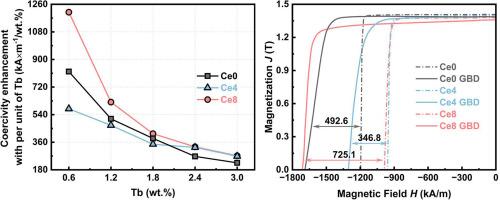
The grain boundary diffusion (GBD) efficiencies of heavy rare earth (HRE) elements are strongly influenced by the composition of the initial Nd-Fe-B magnets. Here we reported the significant variation of terbium (Tb) diffusion efficiency in the Nd-Fe-B magnets with various cerium (Ce) contents. The magnets with 0 wt. %, 3.71 wt. %, and 8.45 wt. % Ce in the total rare earth content, denoted as Ce0, Ce4, and Ce8 magnets, were employed as the initial magnets. After diffusion by Tb66Fe34 alloy, the coercivity of the Ce0, Ce4, and Ce8 magnets increased from 1196 kA/m, 958 kA/m, and 986 kA/m to 1689 kA/m, 1305 kA/m, and 1711 kA/m, respectively. The Ce8 magnet demonstrated the highest diffusion efficiency of Tb with an increase of 1209 kA·m-1 by 1 wt. % Tb. The diffused Ce8 magnet also exhibits excellent hysteresis loop squareness due to the superior diffusion behavior of Tb. In the Ce-free magnet, the presence of bulk rare earth (RE) oxides and a fully Tb2Fe14B structure leads to the wastage of Tb. Microstructure analysis revealed that the formation of a thick grain boundary (GB) layer and the cubic RE2O3 phase contribute to the coercivity enhancement of the Ce8 magnet. In contrast, the GB layer in Ce-free magnet is too thin to isolate the Nd2Fe14B hard magnetic grains effectively. Therefore, to achieve high GBD efficiency for Tb, the Ce8 initial magnet is effective. These findings suggest that the careful selection of initial magnet is crucial for maximizing property enhancement through GBD treatment and ensuring the efficient use of RE resources.
期刊介绍:
Materials Research Bulletin is an international journal reporting high-impact research on processing-structure-property relationships in functional materials and nanomaterials with interesting electronic, magnetic, optical, thermal, mechanical or catalytic properties. Papers purely on thermodynamics or theoretical calculations (e.g., density functional theory) do not fall within the scope of the journal unless they also demonstrate a clear link to physical properties. Topics covered include functional materials (e.g., dielectrics, pyroelectrics, piezoelectrics, ferroelectrics, relaxors, thermoelectrics, etc.); electrochemistry and solid-state ionics (e.g., photovoltaics, batteries, sensors, and fuel cells); nanomaterials, graphene, and nanocomposites; luminescence and photocatalysis; crystal-structure and defect-structure analysis; novel electronics; non-crystalline solids; flexible electronics; protein-material interactions; and polymeric ion-exchange membranes.




 京公网安备 11010802042870号
京ICP备2023020795号-1
京公网安备 11010802042870号
京ICP备2023020795号-1

 分享
分享
 求助内容:
求助内容: 应助结果提醒方式:
 扫码关注我们
