{"title":"高性能、阻燃凝胶聚合物电解质来源于PMMA侧链接枝P(VDF-HFP)基锂离子电池纳米复合膜","authors":"Rittik Parui, Subhratanu Bhattacharya","doi":"10.1016/j.materresbull.2024.113286","DOIUrl":null,"url":null,"abstract":"<div><div>We report on high-performance gel polymer electrolytes (GPEs) with outstanding physical, electrical, electrochemical, and fire-resistant characteristics. Highly porous copolymer membranes are developed by grafting PMMA side chains onto the P(VDF-HFP) copolymer backbone, followed by blending with variable percentages of imidazolium ionic liquid (IL) functionalized SiO<sub>2</sub> nanoparticles. Finally, the GPEs are obtained by submerging the porous membrane in an organic electrolyte solution. The GPE exhibits outstanding ion conductivity of 6.09 mS cm<sup>–1</sup> with an appreciable lithium ion transference number (0.57) at room temperature and excellent compatibility with Li electrodes. The Li/LiFePO<sub>4</sub> cell comprising the optimized GPE delivers a high reversible capacity of ∼132 mAh g<sup>−1</sup> at 2C and high discharge capacities of 155.9 and 141.2 mAh g<sup>−1</sup> after consecutive 40 and 60 cycles at C/3 and 1C rates, respectively. With its improved electrochemical performances and high level of safety, the as-developed GPE has a lot of promise for use in LMBs.</div></div>","PeriodicalId":18265,"journal":{"name":"Materials Research Bulletin","volume":"185 ","pages":"Article 113286"},"PeriodicalIF":5.7000,"publicationDate":"2025-05-01","publicationTypes":"Journal Article","fieldsOfStudy":null,"isOpenAccess":false,"openAccessPdf":"","citationCount":"0","resultStr":"{\"title\":\"High-performing, flame-resistant gel polymer electrolytes derived from PMMA side chain grafted P(VDF-HFP) based nanocomposite membranes for lithium-ion batteries\",\"authors\":\"Rittik Parui, Subhratanu Bhattacharya\",\"doi\":\"10.1016/j.materresbull.2024.113286\",\"DOIUrl\":null,\"url\":null,\"abstract\":\"<div><div>We report on high-performance gel polymer electrolytes (GPEs) with outstanding physical, electrical, electrochemical, and fire-resistant characteristics. Highly porous copolymer membranes are developed by grafting PMMA side chains onto the P(VDF-HFP) copolymer backbone, followed by blending with variable percentages of imidazolium ionic liquid (IL) functionalized SiO<sub>2</sub> nanoparticles. Finally, the GPEs are obtained by submerging the porous membrane in an organic electrolyte solution. The GPE exhibits outstanding ion conductivity of 6.09 mS cm<sup>–1</sup> with an appreciable lithium ion transference number (0.57) at room temperature and excellent compatibility with Li electrodes. The Li/LiFePO<sub>4</sub> cell comprising the optimized GPE delivers a high reversible capacity of ∼132 mAh g<sup>−1</sup> at 2C and high discharge capacities of 155.9 and 141.2 mAh g<sup>−1</sup> after consecutive 40 and 60 cycles at C/3 and 1C rates, respectively. With its improved electrochemical performances and high level of safety, the as-developed GPE has a lot of promise for use in LMBs.</div></div>\",\"PeriodicalId\":18265,\"journal\":{\"name\":\"Materials Research Bulletin\",\"volume\":\"185 \",\"pages\":\"Article 113286\"},\"PeriodicalIF\":5.7000,\"publicationDate\":\"2025-05-01\",\"publicationTypes\":\"Journal Article\",\"fieldsOfStudy\":null,\"isOpenAccess\":false,\"openAccessPdf\":\"\",\"citationCount\":\"0\",\"resultStr\":null,\"platform\":\"Semanticscholar\",\"paperid\":null,\"PeriodicalName\":\"Materials Research Bulletin\",\"FirstCategoryId\":\"88\",\"ListUrlMain\":\"https://www.sciencedirect.com/science/article/pii/S0025540824006147\",\"RegionNum\":3,\"RegionCategory\":\"材料科学\",\"ArticlePicture\":[],\"TitleCN\":null,\"AbstractTextCN\":null,\"PMCID\":null,\"EPubDate\":\"2024/12/28 0:00:00\",\"PubModel\":\"Epub\",\"JCR\":\"Q2\",\"JCRName\":\"MATERIALS SCIENCE, MULTIDISCIPLINARY\",\"Score\":null,\"Total\":0}","platform":"Semanticscholar","paperid":null,"PeriodicalName":"Materials Research Bulletin","FirstCategoryId":"88","ListUrlMain":"https://www.sciencedirect.com/science/article/pii/S0025540824006147","RegionNum":3,"RegionCategory":"材料科学","ArticlePicture":[],"TitleCN":null,"AbstractTextCN":null,"PMCID":null,"EPubDate":"2024/12/28 0:00:00","PubModel":"Epub","JCR":"Q2","JCRName":"MATERIALS SCIENCE, MULTIDISCIPLINARY","Score":null,"Total":0}
引用次数: 0
摘要
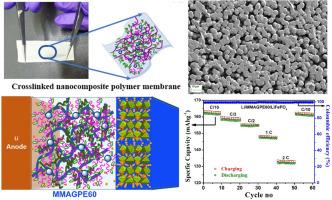
我们报道了高性能凝胶聚合物电解质(GPEs)具有出色的物理,电学,电化学和耐火特性。通过将PMMA侧链接枝到P(VDF-HFP)共聚物骨架上,然后与不同百分比的咪唑离子液体(IL)功能化SiO2纳米颗粒共混,制备了高孔共聚物膜。最后,通过将多孔膜浸入有机电解质溶液中获得gpe。GPE具有优异的离子电导率,室温下为6.09 mS cm-1,锂离子转移数为0.57,与锂电极具有良好的相容性。包含优化GPE的Li/LiFePO4电池在2C时具有高达132 mAh g - 1的高可逆容量,在C/3和1C速率下连续循环40和60次后分别具有155.9和141.2 mAh g - 1的高放电容量。开发的GPE具有良好的电化学性能和较高的安全性,在lmb中具有广阔的应用前景。
High-performing, flame-resistant gel polymer electrolytes derived from PMMA side chain grafted P(VDF-HFP) based nanocomposite membranes for lithium-ion batteries
We report on high-performance gel polymer electrolytes (GPEs) with outstanding physical, electrical, electrochemical, and fire-resistant characteristics. Highly porous copolymer membranes are developed by grafting PMMA side chains onto the P(VDF-HFP) copolymer backbone, followed by blending with variable percentages of imidazolium ionic liquid (IL) functionalized SiO2 nanoparticles. Finally, the GPEs are obtained by submerging the porous membrane in an organic electrolyte solution. The GPE exhibits outstanding ion conductivity of 6.09 mS cm–1 with an appreciable lithium ion transference number (0.57) at room temperature and excellent compatibility with Li electrodes. The Li/LiFePO4 cell comprising the optimized GPE delivers a high reversible capacity of ∼132 mAh g−1 at 2C and high discharge capacities of 155.9 and 141.2 mAh g−1 after consecutive 40 and 60 cycles at C/3 and 1C rates, respectively. With its improved electrochemical performances and high level of safety, the as-developed GPE has a lot of promise for use in LMBs.
期刊介绍:
Materials Research Bulletin is an international journal reporting high-impact research on processing-structure-property relationships in functional materials and nanomaterials with interesting electronic, magnetic, optical, thermal, mechanical or catalytic properties. Papers purely on thermodynamics or theoretical calculations (e.g., density functional theory) do not fall within the scope of the journal unless they also demonstrate a clear link to physical properties. Topics covered include functional materials (e.g., dielectrics, pyroelectrics, piezoelectrics, ferroelectrics, relaxors, thermoelectrics, etc.); electrochemistry and solid-state ionics (e.g., photovoltaics, batteries, sensors, and fuel cells); nanomaterials, graphene, and nanocomposites; luminescence and photocatalysis; crystal-structure and defect-structure analysis; novel electronics; non-crystalline solids; flexible electronics; protein-material interactions; and polymeric ion-exchange membranes.




 京公网安备 11010802042870号
京ICP备2023020795号-1
京公网安备 11010802042870号
京ICP备2023020795号-1

 分享
分享
 求助内容:
求助内容: 应助结果提醒方式:
 扫码关注我们
