A.Z. Arsad , A.W. Mahmood Zuhdi , A.D. Azhar , C.F. Chau , A. Ghazali
{"title":"太阳能充电控制器最大功率点跟踪的研究进展","authors":"A.Z. Arsad , A.W. Mahmood Zuhdi , A.D. Azhar , C.F. Chau , A. Ghazali","doi":"10.1016/j.rser.2024.115208","DOIUrl":null,"url":null,"abstract":"<div><div>Solar power has gained popularity as an alternative to tackling global energy and environmental issues. However, concerns about the unpredictable nature of renewable energy sources, irregular behavior, and partial shading of solar panels hinder photovoltaic (PV) system stability and efficiency. Utilization of a solar charge controller (SCC) with pulse width modulation (PWM) and maximum power point tracking (MPPT) functionality is imperative to enhance the effectiveness and reliability of PV systems. Fluctuating external conditions make MPPT challenging, particularly under non-ideal operating conditions such as partial shading or temperature variations. Advanced MPPT control methods have been proposed to address these challenges, outperforming conventional algorithms. This study provides a comprehensive review and analysis of the control strategies employed in PWM and MPPT for PV systems. Each MPPT technique has pros and cons, but a streamlined approach considers cost, accuracy, complexity, speed, analog/digital, and efficiency. The intent is to contribute to the widespread adoption of the MPPT technology and address the challenges associated with PV system implementation. Through diligent research efforts, MPPT systems improved efficiency in managing renewable power generation intricacies. Utilizing advancements in SCC with PWM and MPPT enhances energy harvest, increases system reliability, prolongs battery life, and improves solar energy system performance. The fundamental discoveries are condensed in advancing progressively resilient controllers for enhanced efficiency, reliability, stability, protection, and nations. This work aids the transition to clean energy systems and provides a foundation for selecting the most effective MPPT controller for future research direction toward sustainable development.</div></div>","PeriodicalId":418,"journal":{"name":"Renewable and Sustainable Energy Reviews","volume":"210 ","pages":"Article 115208"},"PeriodicalIF":16.3000,"publicationDate":"2025-03-01","publicationTypes":"Journal Article","fieldsOfStudy":null,"isOpenAccess":false,"openAccessPdf":"","citationCount":"0","resultStr":"{\"title\":\"Advancements in maximum power point tracking for solar charge controllers\",\"authors\":\"A.Z. Arsad , A.W. Mahmood Zuhdi , A.D. Azhar , C.F. Chau , A. Ghazali\",\"doi\":\"10.1016/j.rser.2024.115208\",\"DOIUrl\":null,\"url\":null,\"abstract\":\"<div><div>Solar power has gained popularity as an alternative to tackling global energy and environmental issues. However, concerns about the unpredictable nature of renewable energy sources, irregular behavior, and partial shading of solar panels hinder photovoltaic (PV) system stability and efficiency. Utilization of a solar charge controller (SCC) with pulse width modulation (PWM) and maximum power point tracking (MPPT) functionality is imperative to enhance the effectiveness and reliability of PV systems. Fluctuating external conditions make MPPT challenging, particularly under non-ideal operating conditions such as partial shading or temperature variations. Advanced MPPT control methods have been proposed to address these challenges, outperforming conventional algorithms. This study provides a comprehensive review and analysis of the control strategies employed in PWM and MPPT for PV systems. Each MPPT technique has pros and cons, but a streamlined approach considers cost, accuracy, complexity, speed, analog/digital, and efficiency. The intent is to contribute to the widespread adoption of the MPPT technology and address the challenges associated with PV system implementation. Through diligent research efforts, MPPT systems improved efficiency in managing renewable power generation intricacies. Utilizing advancements in SCC with PWM and MPPT enhances energy harvest, increases system reliability, prolongs battery life, and improves solar energy system performance. The fundamental discoveries are condensed in advancing progressively resilient controllers for enhanced efficiency, reliability, stability, protection, and nations. This work aids the transition to clean energy systems and provides a foundation for selecting the most effective MPPT controller for future research direction toward sustainable development.</div></div>\",\"PeriodicalId\":418,\"journal\":{\"name\":\"Renewable and Sustainable Energy Reviews\",\"volume\":\"210 \",\"pages\":\"Article 115208\"},\"PeriodicalIF\":16.3000,\"publicationDate\":\"2025-03-01\",\"publicationTypes\":\"Journal Article\",\"fieldsOfStudy\":null,\"isOpenAccess\":false,\"openAccessPdf\":\"\",\"citationCount\":\"0\",\"resultStr\":null,\"platform\":\"Semanticscholar\",\"paperid\":null,\"PeriodicalName\":\"Renewable and Sustainable Energy Reviews\",\"FirstCategoryId\":\"1\",\"ListUrlMain\":\"https://www.sciencedirect.com/science/article/pii/S1364032124009341\",\"RegionNum\":1,\"RegionCategory\":\"工程技术\",\"ArticlePicture\":[],\"TitleCN\":null,\"AbstractTextCN\":null,\"PMCID\":null,\"EPubDate\":\"2024/12/19 0:00:00\",\"PubModel\":\"Epub\",\"JCR\":\"Q1\",\"JCRName\":\"ENERGY & FUELS\",\"Score\":null,\"Total\":0}","platform":"Semanticscholar","paperid":null,"PeriodicalName":"Renewable and Sustainable Energy Reviews","FirstCategoryId":"1","ListUrlMain":"https://www.sciencedirect.com/science/article/pii/S1364032124009341","RegionNum":1,"RegionCategory":"工程技术","ArticlePicture":[],"TitleCN":null,"AbstractTextCN":null,"PMCID":null,"EPubDate":"2024/12/19 0:00:00","PubModel":"Epub","JCR":"Q1","JCRName":"ENERGY & FUELS","Score":null,"Total":0}
Advancements in maximum power point tracking for solar charge controllers
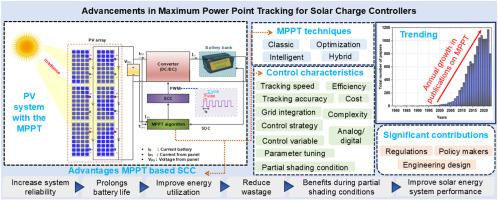
Solar power has gained popularity as an alternative to tackling global energy and environmental issues. However, concerns about the unpredictable nature of renewable energy sources, irregular behavior, and partial shading of solar panels hinder photovoltaic (PV) system stability and efficiency. Utilization of a solar charge controller (SCC) with pulse width modulation (PWM) and maximum power point tracking (MPPT) functionality is imperative to enhance the effectiveness and reliability of PV systems. Fluctuating external conditions make MPPT challenging, particularly under non-ideal operating conditions such as partial shading or temperature variations. Advanced MPPT control methods have been proposed to address these challenges, outperforming conventional algorithms. This study provides a comprehensive review and analysis of the control strategies employed in PWM and MPPT for PV systems. Each MPPT technique has pros and cons, but a streamlined approach considers cost, accuracy, complexity, speed, analog/digital, and efficiency. The intent is to contribute to the widespread adoption of the MPPT technology and address the challenges associated with PV system implementation. Through diligent research efforts, MPPT systems improved efficiency in managing renewable power generation intricacies. Utilizing advancements in SCC with PWM and MPPT enhances energy harvest, increases system reliability, prolongs battery life, and improves solar energy system performance. The fundamental discoveries are condensed in advancing progressively resilient controllers for enhanced efficiency, reliability, stability, protection, and nations. This work aids the transition to clean energy systems and provides a foundation for selecting the most effective MPPT controller for future research direction toward sustainable development.
期刊介绍:
The mission of Renewable and Sustainable Energy Reviews is to disseminate the most compelling and pertinent critical insights in renewable and sustainable energy, fostering collaboration among the research community, private sector, and policy and decision makers. The journal aims to exchange challenges, solutions, innovative concepts, and technologies, contributing to sustainable development, the transition to a low-carbon future, and the attainment of emissions targets outlined by the United Nations Framework Convention on Climate Change.
Renewable and Sustainable Energy Reviews publishes a diverse range of content, including review papers, original research, case studies, and analyses of new technologies, all featuring a substantial review component such as critique, comparison, or analysis. Introducing a distinctive paper type, Expert Insights, the journal presents commissioned mini-reviews authored by field leaders, addressing topics of significant interest. Case studies undergo consideration only if they showcase the work's applicability to other regions or contribute valuable insights to the broader field of renewable and sustainable energy. Notably, a bibliographic or literature review lacking critical analysis is deemed unsuitable for publication.




 京公网安备 11010802042870号
京ICP备2023020795号-1
京公网安备 11010802042870号
京ICP备2023020795号-1

 分享
分享
 求助内容:
求助内容: 应助结果提醒方式:
 扫码关注我们
