Juan Moreno , Martha Cobo , Felipe Buendia , Nestor Sánchez
{"title":"加强蒸汽气化的预测模型:化学计量学、平衡、数据驱动和混合方法的比较研究","authors":"Juan Moreno , Martha Cobo , Felipe Buendia , Nestor Sánchez","doi":"10.1016/j.rser.2024.115151","DOIUrl":null,"url":null,"abstract":"<div><div>Steam gasification offers a pathway to generate synthesis gas (syngas) rich in hydrogen (H<sub>2</sub>), a crucial element in efforts to decarbonize and mitigate greenhouse gas emissions. However, the intricate web of reactions involved in the process demands predictive tools to enable its large-scale application. While models based on stoichiometry, chemical equilibrium, and data algorithms have made strides, previous works lack comprehensive comparative studies on their efficacy and adaptability. This study addresses this gap by developing and juxtaposing four models: stoichiometric, equilibrium-based, data-driven, and a hybrid approach to forecast steam gasification products against experimental data gleaned from a systematic literature review. Among these models, the hybrid variant emerges as the most accurate in predicting syngas composition, boasting an average root mean square error (RMSE) of 5.63 and an average R<sup>2</sup> of 0.59. Moreover, it yields predictions for tar, char, and gas with respective RMSEs of 42.79 g/Nm<sup>3</sup> syngas, 72.99 g/kg biomass, and 0.33 Nm<sup>3</sup> syngas/kg biomass. Notably, the robust validation process of this model enhances its versatility while maintaining commendable prediction accuracy compared to the existing literature. Future enhancements could entail integrating advanced kinetic and equilibrium expressions and incorporating fresh experimental data into the training phases of data-driven models.</div></div>","PeriodicalId":418,"journal":{"name":"Renewable and Sustainable Energy Reviews","volume":"210 ","pages":"Article 115151"},"PeriodicalIF":16.3000,"publicationDate":"2025-03-01","publicationTypes":"Journal Article","fieldsOfStudy":null,"isOpenAccess":false,"openAccessPdf":"","citationCount":"0","resultStr":"{\"title\":\"Enhancing predictive models for steam gasification: A comparative study of stoichiometric, equilibrium, data-driven, and hybrid approaches\",\"authors\":\"Juan Moreno , Martha Cobo , Felipe Buendia , Nestor Sánchez\",\"doi\":\"10.1016/j.rser.2024.115151\",\"DOIUrl\":null,\"url\":null,\"abstract\":\"<div><div>Steam gasification offers a pathway to generate synthesis gas (syngas) rich in hydrogen (H<sub>2</sub>), a crucial element in efforts to decarbonize and mitigate greenhouse gas emissions. However, the intricate web of reactions involved in the process demands predictive tools to enable its large-scale application. While models based on stoichiometry, chemical equilibrium, and data algorithms have made strides, previous works lack comprehensive comparative studies on their efficacy and adaptability. This study addresses this gap by developing and juxtaposing four models: stoichiometric, equilibrium-based, data-driven, and a hybrid approach to forecast steam gasification products against experimental data gleaned from a systematic literature review. Among these models, the hybrid variant emerges as the most accurate in predicting syngas composition, boasting an average root mean square error (RMSE) of 5.63 and an average R<sup>2</sup> of 0.59. Moreover, it yields predictions for tar, char, and gas with respective RMSEs of 42.79 g/Nm<sup>3</sup> syngas, 72.99 g/kg biomass, and 0.33 Nm<sup>3</sup> syngas/kg biomass. Notably, the robust validation process of this model enhances its versatility while maintaining commendable prediction accuracy compared to the existing literature. Future enhancements could entail integrating advanced kinetic and equilibrium expressions and incorporating fresh experimental data into the training phases of data-driven models.</div></div>\",\"PeriodicalId\":418,\"journal\":{\"name\":\"Renewable and Sustainable Energy Reviews\",\"volume\":\"210 \",\"pages\":\"Article 115151\"},\"PeriodicalIF\":16.3000,\"publicationDate\":\"2025-03-01\",\"publicationTypes\":\"Journal Article\",\"fieldsOfStudy\":null,\"isOpenAccess\":false,\"openAccessPdf\":\"\",\"citationCount\":\"0\",\"resultStr\":null,\"platform\":\"Semanticscholar\",\"paperid\":null,\"PeriodicalName\":\"Renewable and Sustainable Energy Reviews\",\"FirstCategoryId\":\"1\",\"ListUrlMain\":\"https://www.sciencedirect.com/science/article/pii/S1364032124008773\",\"RegionNum\":1,\"RegionCategory\":\"工程技术\",\"ArticlePicture\":[],\"TitleCN\":null,\"AbstractTextCN\":null,\"PMCID\":null,\"EPubDate\":\"2024/12/4 0:00:00\",\"PubModel\":\"Epub\",\"JCR\":\"Q1\",\"JCRName\":\"ENERGY & FUELS\",\"Score\":null,\"Total\":0}","platform":"Semanticscholar","paperid":null,"PeriodicalName":"Renewable and Sustainable Energy Reviews","FirstCategoryId":"1","ListUrlMain":"https://www.sciencedirect.com/science/article/pii/S1364032124008773","RegionNum":1,"RegionCategory":"工程技术","ArticlePicture":[],"TitleCN":null,"AbstractTextCN":null,"PMCID":null,"EPubDate":"2024/12/4 0:00:00","PubModel":"Epub","JCR":"Q1","JCRName":"ENERGY & FUELS","Score":null,"Total":0}
Enhancing predictive models for steam gasification: A comparative study of stoichiometric, equilibrium, data-driven, and hybrid approaches
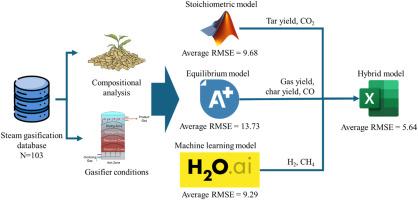
Steam gasification offers a pathway to generate synthesis gas (syngas) rich in hydrogen (H2), a crucial element in efforts to decarbonize and mitigate greenhouse gas emissions. However, the intricate web of reactions involved in the process demands predictive tools to enable its large-scale application. While models based on stoichiometry, chemical equilibrium, and data algorithms have made strides, previous works lack comprehensive comparative studies on their efficacy and adaptability. This study addresses this gap by developing and juxtaposing four models: stoichiometric, equilibrium-based, data-driven, and a hybrid approach to forecast steam gasification products against experimental data gleaned from a systematic literature review. Among these models, the hybrid variant emerges as the most accurate in predicting syngas composition, boasting an average root mean square error (RMSE) of 5.63 and an average R2 of 0.59. Moreover, it yields predictions for tar, char, and gas with respective RMSEs of 42.79 g/Nm3 syngas, 72.99 g/kg biomass, and 0.33 Nm3 syngas/kg biomass. Notably, the robust validation process of this model enhances its versatility while maintaining commendable prediction accuracy compared to the existing literature. Future enhancements could entail integrating advanced kinetic and equilibrium expressions and incorporating fresh experimental data into the training phases of data-driven models.
期刊介绍:
The mission of Renewable and Sustainable Energy Reviews is to disseminate the most compelling and pertinent critical insights in renewable and sustainable energy, fostering collaboration among the research community, private sector, and policy and decision makers. The journal aims to exchange challenges, solutions, innovative concepts, and technologies, contributing to sustainable development, the transition to a low-carbon future, and the attainment of emissions targets outlined by the United Nations Framework Convention on Climate Change.
Renewable and Sustainable Energy Reviews publishes a diverse range of content, including review papers, original research, case studies, and analyses of new technologies, all featuring a substantial review component such as critique, comparison, or analysis. Introducing a distinctive paper type, Expert Insights, the journal presents commissioned mini-reviews authored by field leaders, addressing topics of significant interest. Case studies undergo consideration only if they showcase the work's applicability to other regions or contribute valuable insights to the broader field of renewable and sustainable energy. Notably, a bibliographic or literature review lacking critical analysis is deemed unsuitable for publication.




 京公网安备 11010802042870号
京ICP备2023020795号-1
京公网安备 11010802042870号
京ICP备2023020795号-1

 分享
分享
 求助内容:
求助内容: 应助结果提醒方式:
 扫码关注我们
