L. Ruiz-Valero , A. Arceo , T. Kesik , M. Touchie , W. O'Brien
{"title":"住房和社区的生命周期评估:系统回顾","authors":"L. Ruiz-Valero , A. Arceo , T. Kesik , M. Touchie , W. O'Brien","doi":"10.1016/j.rser.2024.115249","DOIUrl":null,"url":null,"abstract":"<div><div>Housing accounts for a high proportion of our anthropogenic greenhouse gas (GHG) emissions and represents a large environmental footprint, particularly when supporting infrastructure and transportation are included. This review introduces three housing life cycle assessment (LCA) frameworks, which are distinguished by the spatial scope of analysis and built environment elements included. The choice of housing LCA framework has possible tradeoffs affecting the environmental impact quantification and selection of lower impact housing built form or housing development type. The objective of this systematic review is to compare previous standard housing LCAs, holistic housing LCAs, and neighborhoods LCAs related to the four stages of LCA (goal and scope definition, life cycle inventory, impact assessment, and interpretation). This paper presents quantitative analyses of housing GHG emissions from the reviewed studies which indicate that standard housing LCA underestimates average GHG emissions by 43 % due to exclusion of mobility, and by 11 % due to exclusion of open spaces, and networks. The interpretation of which housing built form has lower GHG emissions switches between standard and holistic housing LCAs. This review recommends the use of holistic housing and neighborhood LCAs to fully assess the environmental impacts of early-stage housing and neighborhood planning. However, these frameworks require standardization, including functional unit definition, scoping of system boundary, and treatment of temporal uncertainty and variability in housing contexts.</div></div>","PeriodicalId":418,"journal":{"name":"Renewable and Sustainable Energy Reviews","volume":"210 ","pages":"Article 115249"},"PeriodicalIF":18.0000,"publicationDate":"2025-03-01","publicationTypes":"Journal Article","fieldsOfStudy":null,"isOpenAccess":false,"openAccessPdf":"","citationCount":"0","resultStr":"{\"title\":\"Life cycle assessment of housing and neighbourhoods: A systematic review\",\"authors\":\"L. Ruiz-Valero , A. Arceo , T. Kesik , M. Touchie , W. O'Brien\",\"doi\":\"10.1016/j.rser.2024.115249\",\"DOIUrl\":null,\"url\":null,\"abstract\":\"<div><div>Housing accounts for a high proportion of our anthropogenic greenhouse gas (GHG) emissions and represents a large environmental footprint, particularly when supporting infrastructure and transportation are included. This review introduces three housing life cycle assessment (LCA) frameworks, which are distinguished by the spatial scope of analysis and built environment elements included. The choice of housing LCA framework has possible tradeoffs affecting the environmental impact quantification and selection of lower impact housing built form or housing development type. The objective of this systematic review is to compare previous standard housing LCAs, holistic housing LCAs, and neighborhoods LCAs related to the four stages of LCA (goal and scope definition, life cycle inventory, impact assessment, and interpretation). This paper presents quantitative analyses of housing GHG emissions from the reviewed studies which indicate that standard housing LCA underestimates average GHG emissions by 43 % due to exclusion of mobility, and by 11 % due to exclusion of open spaces, and networks. The interpretation of which housing built form has lower GHG emissions switches between standard and holistic housing LCAs. This review recommends the use of holistic housing and neighborhood LCAs to fully assess the environmental impacts of early-stage housing and neighborhood planning. However, these frameworks require standardization, including functional unit definition, scoping of system boundary, and treatment of temporal uncertainty and variability in housing contexts.</div></div>\",\"PeriodicalId\":418,\"journal\":{\"name\":\"Renewable and Sustainable Energy Reviews\",\"volume\":\"210 \",\"pages\":\"Article 115249\"},\"PeriodicalIF\":18.0000,\"publicationDate\":\"2025-03-01\",\"publicationTypes\":\"Journal Article\",\"fieldsOfStudy\":null,\"isOpenAccess\":false,\"openAccessPdf\":\"\",\"citationCount\":\"0\",\"resultStr\":null,\"platform\":\"Semanticscholar\",\"paperid\":null,\"PeriodicalName\":\"Renewable and Sustainable Energy Reviews\",\"FirstCategoryId\":\"1\",\"ListUrlMain\":\"https://www.sciencedirect.com/science/article/pii/S1364032124009754\",\"RegionNum\":1,\"RegionCategory\":\"工程技术\",\"ArticlePicture\":[],\"TitleCN\":null,\"AbstractTextCN\":null,\"PMCID\":null,\"EPubDate\":\"2024/12/19 0:00:00\",\"PubModel\":\"Epub\",\"JCR\":\"Q1\",\"JCRName\":\"ENERGY & FUELS\",\"Score\":null,\"Total\":0}","platform":"Semanticscholar","paperid":null,"PeriodicalName":"Renewable and Sustainable Energy Reviews","FirstCategoryId":"1","ListUrlMain":"https://www.sciencedirect.com/science/article/pii/S1364032124009754","RegionNum":1,"RegionCategory":"工程技术","ArticlePicture":[],"TitleCN":null,"AbstractTextCN":null,"PMCID":null,"EPubDate":"2024/12/19 0:00:00","PubModel":"Epub","JCR":"Q1","JCRName":"ENERGY & FUELS","Score":null,"Total":0}
Life cycle assessment of housing and neighbourhoods: A systematic review
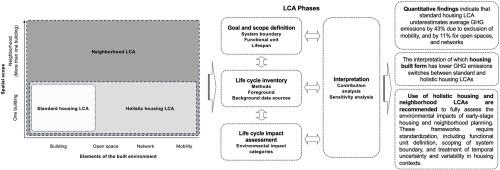
Housing accounts for a high proportion of our anthropogenic greenhouse gas (GHG) emissions and represents a large environmental footprint, particularly when supporting infrastructure and transportation are included. This review introduces three housing life cycle assessment (LCA) frameworks, which are distinguished by the spatial scope of analysis and built environment elements included. The choice of housing LCA framework has possible tradeoffs affecting the environmental impact quantification and selection of lower impact housing built form or housing development type. The objective of this systematic review is to compare previous standard housing LCAs, holistic housing LCAs, and neighborhoods LCAs related to the four stages of LCA (goal and scope definition, life cycle inventory, impact assessment, and interpretation). This paper presents quantitative analyses of housing GHG emissions from the reviewed studies which indicate that standard housing LCA underestimates average GHG emissions by 43 % due to exclusion of mobility, and by 11 % due to exclusion of open spaces, and networks. The interpretation of which housing built form has lower GHG emissions switches between standard and holistic housing LCAs. This review recommends the use of holistic housing and neighborhood LCAs to fully assess the environmental impacts of early-stage housing and neighborhood planning. However, these frameworks require standardization, including functional unit definition, scoping of system boundary, and treatment of temporal uncertainty and variability in housing contexts.
期刊介绍:
The mission of Renewable and Sustainable Energy Reviews is to disseminate the most compelling and pertinent critical insights in renewable and sustainable energy, fostering collaboration among the research community, private sector, and policy and decision makers. The journal aims to exchange challenges, solutions, innovative concepts, and technologies, contributing to sustainable development, the transition to a low-carbon future, and the attainment of emissions targets outlined by the United Nations Framework Convention on Climate Change.
Renewable and Sustainable Energy Reviews publishes a diverse range of content, including review papers, original research, case studies, and analyses of new technologies, all featuring a substantial review component such as critique, comparison, or analysis. Introducing a distinctive paper type, Expert Insights, the journal presents commissioned mini-reviews authored by field leaders, addressing topics of significant interest. Case studies undergo consideration only if they showcase the work's applicability to other regions or contribute valuable insights to the broader field of renewable and sustainable energy. Notably, a bibliographic or literature review lacking critical analysis is deemed unsuitable for publication.




 京公网安备 11010802042870号
京ICP备2023020795号-1
京公网安备 11010802042870号
京ICP备2023020795号-1

 分享
分享
 求助内容:
求助内容: 应助结果提醒方式:
 扫码关注我们
