P. Meejitpaisan , Ramachari Doddoji , S. Kothan , H.J. Kim , Vasudeva Reddy Minnam Reddy , Salh Alhammadi , J. Kaewkhao
{"title":"用于LED和闪烁体应用的Eu3+和Tb3+单掺杂和双掺杂磷硅酸盐玻璃的紫外光和x射线诱导发光特性","authors":"P. Meejitpaisan , Ramachari Doddoji , S. Kothan , H.J. Kim , Vasudeva Reddy Minnam Reddy , Salh Alhammadi , J. Kaewkhao","doi":"10.1016/j.materresbull.2025.113295","DOIUrl":null,"url":null,"abstract":"<div><div>Eu<sup>3+</sup> and Tb<sup>3+</sup> single-doped and co-doped phosposilicate (P<sub>2</sub>O<sub>5</sub> +SiO<sub>2</sub>) glasses with the insertion of fluorides (NaF+BaF<sub>2</sub>+AlF<sub>3</sub>) were fabricated. Absorption and excitation spectra of glasses were studied. With two different (218 and 378 nm) excitations of Eu<sup>3+</sup> and Tb<sup>3+</sup>, the visible emission spectra (450˗750 nm) consisting of RGB (red-green-blue) colors were obtained. The multipolar interactions involved in the energy transfer (ET) between Eu<sup>3+</sup> and Tb<sup>3+</sup> were analyzed through Reisfeld and Dexter's theory. The lifetimes of the co-doped glasses for the <sup>5</sup>D<sub>0</sub> emission (λ<sub>ex</sub>=378 nm) of Eu<sup>3+</sup> and the <sup>5</sup>D<sub>4</sub> emission (λ<sub>ex</sub>=218 nm) of Tb<sup>3+</sup> ions were obtained. Further, the asymmetric ratios, integrated intensities, R/G ratios, and ET efficiencies were also evaluated. The scintillation efficiency of glasses determined from radio luminescence (X-ray) was found to be 62%. The color coordinates of the glasses were moved to yellowish-green zone with the CCT (correlative color temperatures) of ≤ 4037 K.</div></div>","PeriodicalId":18265,"journal":{"name":"Materials Research Bulletin","volume":"185 ","pages":"Article 113295"},"PeriodicalIF":5.8000,"publicationDate":"2025-05-01","publicationTypes":"Journal Article","fieldsOfStudy":null,"isOpenAccess":false,"openAccessPdf":"","citationCount":"0","resultStr":"{\"title\":\"UV light and X-ray induced luminescence properties of Eu3+ and Tb3+ single-doped and double-doped phosphosilicate glasses for LED and scintillator applications\",\"authors\":\"P. Meejitpaisan , Ramachari Doddoji , S. Kothan , H.J. Kim , Vasudeva Reddy Minnam Reddy , Salh Alhammadi , J. Kaewkhao\",\"doi\":\"10.1016/j.materresbull.2025.113295\",\"DOIUrl\":null,\"url\":null,\"abstract\":\"<div><div>Eu<sup>3+</sup> and Tb<sup>3+</sup> single-doped and co-doped phosposilicate (P<sub>2</sub>O<sub>5</sub> +SiO<sub>2</sub>) glasses with the insertion of fluorides (NaF+BaF<sub>2</sub>+AlF<sub>3</sub>) were fabricated. Absorption and excitation spectra of glasses were studied. With two different (218 and 378 nm) excitations of Eu<sup>3+</sup> and Tb<sup>3+</sup>, the visible emission spectra (450˗750 nm) consisting of RGB (red-green-blue) colors were obtained. The multipolar interactions involved in the energy transfer (ET) between Eu<sup>3+</sup> and Tb<sup>3+</sup> were analyzed through Reisfeld and Dexter's theory. The lifetimes of the co-doped glasses for the <sup>5</sup>D<sub>0</sub> emission (λ<sub>ex</sub>=378 nm) of Eu<sup>3+</sup> and the <sup>5</sup>D<sub>4</sub> emission (λ<sub>ex</sub>=218 nm) of Tb<sup>3+</sup> ions were obtained. Further, the asymmetric ratios, integrated intensities, R/G ratios, and ET efficiencies were also evaluated. The scintillation efficiency of glasses determined from radio luminescence (X-ray) was found to be 62%. The color coordinates of the glasses were moved to yellowish-green zone with the CCT (correlative color temperatures) of ≤ 4037 K.</div></div>\",\"PeriodicalId\":18265,\"journal\":{\"name\":\"Materials Research Bulletin\",\"volume\":\"185 \",\"pages\":\"Article 113295\"},\"PeriodicalIF\":5.8000,\"publicationDate\":\"2025-05-01\",\"publicationTypes\":\"Journal Article\",\"fieldsOfStudy\":null,\"isOpenAccess\":false,\"openAccessPdf\":\"\",\"citationCount\":\"0\",\"resultStr\":null,\"platform\":\"Semanticscholar\",\"paperid\":null,\"PeriodicalName\":\"Materials Research Bulletin\",\"FirstCategoryId\":\"88\",\"ListUrlMain\":\"https://www.sciencedirect.com/science/article/pii/S0025540825000030\",\"RegionNum\":3,\"RegionCategory\":\"材料科学\",\"ArticlePicture\":[],\"TitleCN\":null,\"AbstractTextCN\":null,\"PMCID\":null,\"EPubDate\":\"2025/1/3 0:00:00\",\"PubModel\":\"Epub\",\"JCR\":\"Q2\",\"JCRName\":\"MATERIALS SCIENCE, MULTIDISCIPLINARY\",\"Score\":null,\"Total\":0}","platform":"Semanticscholar","paperid":null,"PeriodicalName":"Materials Research Bulletin","FirstCategoryId":"88","ListUrlMain":"https://www.sciencedirect.com/science/article/pii/S0025540825000030","RegionNum":3,"RegionCategory":"材料科学","ArticlePicture":[],"TitleCN":null,"AbstractTextCN":null,"PMCID":null,"EPubDate":"2025/1/3 0:00:00","PubModel":"Epub","JCR":"Q2","JCRName":"MATERIALS SCIENCE, MULTIDISCIPLINARY","Score":null,"Total":0}
UV light and X-ray induced luminescence properties of Eu3+ and Tb3+ single-doped and double-doped phosphosilicate glasses for LED and scintillator applications
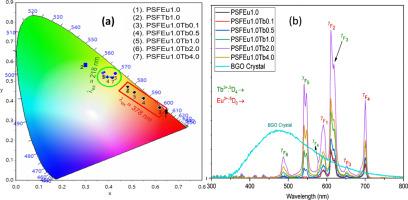
Eu3+ and Tb3+ single-doped and co-doped phosposilicate (P2O5 +SiO2) glasses with the insertion of fluorides (NaF+BaF2+AlF3) were fabricated. Absorption and excitation spectra of glasses were studied. With two different (218 and 378 nm) excitations of Eu3+ and Tb3+, the visible emission spectra (450˗750 nm) consisting of RGB (red-green-blue) colors were obtained. The multipolar interactions involved in the energy transfer (ET) between Eu3+ and Tb3+ were analyzed through Reisfeld and Dexter's theory. The lifetimes of the co-doped glasses for the 5D0 emission (λex=378 nm) of Eu3+ and the 5D4 emission (λex=218 nm) of Tb3+ ions were obtained. Further, the asymmetric ratios, integrated intensities, R/G ratios, and ET efficiencies were also evaluated. The scintillation efficiency of glasses determined from radio luminescence (X-ray) was found to be 62%. The color coordinates of the glasses were moved to yellowish-green zone with the CCT (correlative color temperatures) of ≤ 4037 K.
期刊介绍:
Materials Research Bulletin is an international journal reporting high-impact research on processing-structure-property relationships in functional materials and nanomaterials with interesting electronic, magnetic, optical, thermal, mechanical or catalytic properties. Papers purely on thermodynamics or theoretical calculations (e.g., density functional theory) do not fall within the scope of the journal unless they also demonstrate a clear link to physical properties. Topics covered include functional materials (e.g., dielectrics, pyroelectrics, piezoelectrics, ferroelectrics, relaxors, thermoelectrics, etc.); electrochemistry and solid-state ionics (e.g., photovoltaics, batteries, sensors, and fuel cells); nanomaterials, graphene, and nanocomposites; luminescence and photocatalysis; crystal-structure and defect-structure analysis; novel electronics; non-crystalline solids; flexible electronics; protein-material interactions; and polymeric ion-exchange membranes.




 京公网安备 11010802042870号
京ICP备2023020795号-1
京公网安备 11010802042870号
京ICP备2023020795号-1

 分享
分享
 求助内容:
求助内容: 应助结果提醒方式:
 扫码关注我们
