Xiuling Yan, Cunying Xu, Tongjiang Tian, Anan Song
{"title":"用ChCl-EG深共晶溶剂在低碳钢表面电化学制备过饱和固溶体ZnFe合金防腐涂层","authors":"Xiuling Yan, Cunying Xu, Tongjiang Tian, Anan Song","doi":"10.1016/j.surfcoat.2025.131880","DOIUrl":null,"url":null,"abstract":"<div><div>The Zn<img>Fe alloy coating on mild steel was produced through electrodeposition from a choline chloride-ethylene glycol (ChCl-EG) deep eutectic solvent (DES) containing ZnCl<sub>2</sub> and FeCl<sub>2</sub> at a temperature of 343 K. Although the reduction potential of Zn(II) is more negative than of Fe(II), but the presence of Fe(II) ions facilitates the under-potential deposition of Zn. A dense and uniform Zn<img>Fe alloy coating devoid of hydrogen brittleness can be achieved at low current density (3–5 mA cm<sup>−2</sup>) with a modest <em>C</em><sub>Zn(II)</sub>/<em>C</em><sub>Fe(II)</sub> ratio, specifically between 3:1 and 5:1. Increasing the <em>C</em><sub>Zn(II)</sub>/<em>C</em><sub>Fe(II)</sub> ratio in the bath while increasing the current density leads to a decrease in the iron content of the Zn<img>Fe alloy coating. The crystal structure and corrosion resistance of these coatings on mild steel are contingent upon deposition condition and their composition. At moderately high current density (≥5 mA cm<sup>−2</sup>), Zn<img>Fe alloy with an iron content between 8.5 at.% to 14.0 at.% exhibits a supersaturated solid solution phase (η-phase), whereas an increase in Fe content to 18.2 at.% leads to a mixed phase comprising η, FeZn<sub>15</sub> and Fe<sub>4</sub>Zn<sub>9</sub> phases. Additionally, as current density decreases, similar iron contents (14.2 ∼ 14.7 at.%) yield mixtures including η, Γ<sub>1</sub>,and FeZn<sub>15</sub> phase within the resultant alloys. Notably, a Zn<img>Fe alloy containing approximately 14.0 at.% Fe on mild steel demonstrates optimal corrosion resistance in 3.5 wt% NaCl solution due to its dense microstructure coupled with appropriate iron content levels. These results offer a promising approach for fabricating dense Zn<img>Fe alloy coating owing to its simplicity, non-polluting nature, efficiency, and absence of hydrogen evolution.</div></div>","PeriodicalId":22009,"journal":{"name":"Surface & Coatings Technology","volume":"499 ","pages":"Article 131880"},"PeriodicalIF":6.1000,"publicationDate":"2025-03-01","publicationTypes":"Journal Article","fieldsOfStudy":null,"isOpenAccess":false,"openAccessPdf":"","citationCount":"0","resultStr":"{\"title\":\"Electrochemical preparation of supersaturated solid solution ZnFe alloy coating on mild steel from ChCl-EG deep eutectic solvents for corrosion protection\",\"authors\":\"Xiuling Yan, Cunying Xu, Tongjiang Tian, Anan Song\",\"doi\":\"10.1016/j.surfcoat.2025.131880\",\"DOIUrl\":null,\"url\":null,\"abstract\":\"<div><div>The Zn<img>Fe alloy coating on mild steel was produced through electrodeposition from a choline chloride-ethylene glycol (ChCl-EG) deep eutectic solvent (DES) containing ZnCl<sub>2</sub> and FeCl<sub>2</sub> at a temperature of 343 K. Although the reduction potential of Zn(II) is more negative than of Fe(II), but the presence of Fe(II) ions facilitates the under-potential deposition of Zn. A dense and uniform Zn<img>Fe alloy coating devoid of hydrogen brittleness can be achieved at low current density (3–5 mA cm<sup>−2</sup>) with a modest <em>C</em><sub>Zn(II)</sub>/<em>C</em><sub>Fe(II)</sub> ratio, specifically between 3:1 and 5:1. Increasing the <em>C</em><sub>Zn(II)</sub>/<em>C</em><sub>Fe(II)</sub> ratio in the bath while increasing the current density leads to a decrease in the iron content of the Zn<img>Fe alloy coating. The crystal structure and corrosion resistance of these coatings on mild steel are contingent upon deposition condition and their composition. At moderately high current density (≥5 mA cm<sup>−2</sup>), Zn<img>Fe alloy with an iron content between 8.5 at.% to 14.0 at.% exhibits a supersaturated solid solution phase (η-phase), whereas an increase in Fe content to 18.2 at.% leads to a mixed phase comprising η, FeZn<sub>15</sub> and Fe<sub>4</sub>Zn<sub>9</sub> phases. Additionally, as current density decreases, similar iron contents (14.2 ∼ 14.7 at.%) yield mixtures including η, Γ<sub>1</sub>,and FeZn<sub>15</sub> phase within the resultant alloys. Notably, a Zn<img>Fe alloy containing approximately 14.0 at.% Fe on mild steel demonstrates optimal corrosion resistance in 3.5 wt% NaCl solution due to its dense microstructure coupled with appropriate iron content levels. These results offer a promising approach for fabricating dense Zn<img>Fe alloy coating owing to its simplicity, non-polluting nature, efficiency, and absence of hydrogen evolution.</div></div>\",\"PeriodicalId\":22009,\"journal\":{\"name\":\"Surface & Coatings Technology\",\"volume\":\"499 \",\"pages\":\"Article 131880\"},\"PeriodicalIF\":6.1000,\"publicationDate\":\"2025-03-01\",\"publicationTypes\":\"Journal Article\",\"fieldsOfStudy\":null,\"isOpenAccess\":false,\"openAccessPdf\":\"\",\"citationCount\":\"0\",\"resultStr\":null,\"platform\":\"Semanticscholar\",\"paperid\":null,\"PeriodicalName\":\"Surface & Coatings Technology\",\"FirstCategoryId\":\"88\",\"ListUrlMain\":\"https://www.sciencedirect.com/science/article/pii/S0257897225001549\",\"RegionNum\":2,\"RegionCategory\":\"材料科学\",\"ArticlePicture\":[],\"TitleCN\":null,\"AbstractTextCN\":null,\"PMCID\":null,\"EPubDate\":\"2025/2/4 0:00:00\",\"PubModel\":\"Epub\",\"JCR\":\"Q1\",\"JCRName\":\"MATERIALS SCIENCE, COATINGS & FILMS\",\"Score\":null,\"Total\":0}","platform":"Semanticscholar","paperid":null,"PeriodicalName":"Surface & Coatings Technology","FirstCategoryId":"88","ListUrlMain":"https://www.sciencedirect.com/science/article/pii/S0257897225001549","RegionNum":2,"RegionCategory":"材料科学","ArticlePicture":[],"TitleCN":null,"AbstractTextCN":null,"PMCID":null,"EPubDate":"2025/2/4 0:00:00","PubModel":"Epub","JCR":"Q1","JCRName":"MATERIALS SCIENCE, COATINGS & FILMS","Score":null,"Total":0}
引用次数: 0
摘要
采用含ZnCl2和FeCl2的氯化胆碱-乙二醇(ChCl-EG)深共晶溶剂(DES)在343 K下电沉积制备了低碳钢表面的ZnFe合金涂层。虽然Zn(II)的还原电位比Fe(II)更负,但Fe(II)离子的存在有利于Zn的欠电位沉积。在低电流密度(3-5 mA cm−2)和适度的CZn(II)/CFe(II)比(3:1 ~ 5:1)下,可以获得致密均匀的无氢脆性的ZnFe合金涂层。增大镀液中CZn(II)/CFe(II)的比值,同时增大电流密度,导致镀层铁含量降低。这些涂层在低碳钢上的晶体结构和耐蚀性取决于其沉积条件和成分。在中等高电流密度下(≥5 mA cm−2),铁含量在8.5 At。%至14.0%。%表现为过饱和固溶相(η相),而铁含量增加到18.2 at。%形成由η、FeZn15和Fe4Zn9相组成的混合相。此外,随着电流密度的降低,相似的铁含量(14.2 ~ 14.7 at.%)产生了合金中η相、Γ1相和FeZn15相的混合物。值得注意的是,含有约14.0 at的ZnFe合金。低碳钢上的%铁在3.5 wt% NaCl溶液中表现出最佳的耐腐蚀性,这是由于其致密的微观结构加上适当的铁含量水平。这些结果由于其简单、无污染、高效和不析出氢的特点,为致密锌铁合金涂层的制备提供了一种很有前途的方法。
Electrochemical preparation of supersaturated solid solution ZnFe alloy coating on mild steel from ChCl-EG deep eutectic solvents for corrosion protection
The ZnFe alloy coating on mild steel was produced through electrodeposition from a choline chloride-ethylene glycol (ChCl-EG) deep eutectic solvent (DES) containing ZnCl2 and FeCl2 at a temperature of 343 K. Although the reduction potential of Zn(II) is more negative than of Fe(II), but the presence of Fe(II) ions facilitates the under-potential deposition of Zn. A dense and uniform ZnFe alloy coating devoid of hydrogen brittleness can be achieved at low current density (3–5 mA cm−2) with a modest CZn(II)/CFe(II) ratio, specifically between 3:1 and 5:1. Increasing the CZn(II)/CFe(II) ratio in the bath while increasing the current density leads to a decrease in the iron content of the ZnFe alloy coating. The crystal structure and corrosion resistance of these coatings on mild steel are contingent upon deposition condition and their composition. At moderately high current density (≥5 mA cm−2), ZnFe alloy with an iron content between 8.5 at.% to 14.0 at.% exhibits a supersaturated solid solution phase (η-phase), whereas an increase in Fe content to 18.2 at.% leads to a mixed phase comprising η, FeZn15 and Fe4Zn9 phases. Additionally, as current density decreases, similar iron contents (14.2 ∼ 14.7 at.%) yield mixtures including η, Γ1,and FeZn15 phase within the resultant alloys. Notably, a ZnFe alloy containing approximately 14.0 at.% Fe on mild steel demonstrates optimal corrosion resistance in 3.5 wt% NaCl solution due to its dense microstructure coupled with appropriate iron content levels. These results offer a promising approach for fabricating dense ZnFe alloy coating owing to its simplicity, non-polluting nature, efficiency, and absence of hydrogen evolution.
期刊介绍:
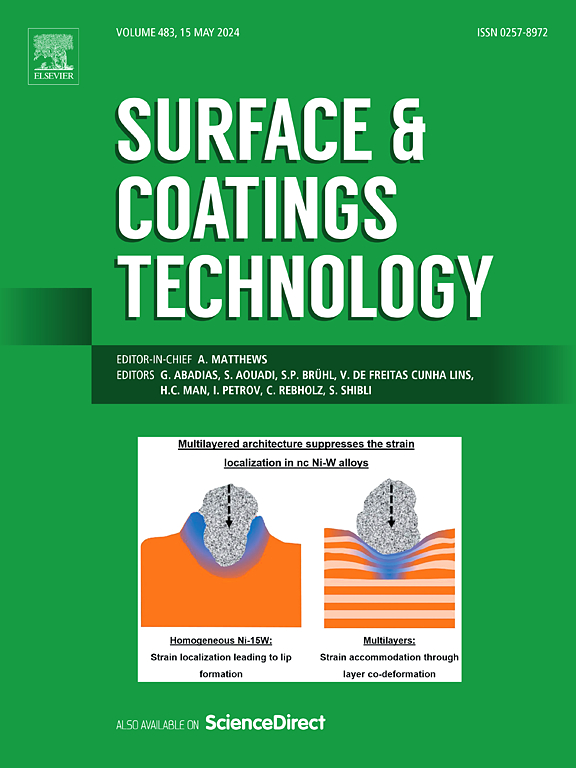
Surface and Coatings Technology is an international archival journal publishing scientific papers on significant developments in surface and interface engineering to modify and improve the surface properties of materials for protection in demanding contact conditions or aggressive environments, or for enhanced functional performance. Contributions range from original scientific articles concerned with fundamental and applied aspects of research or direct applications of metallic, inorganic, organic and composite coatings, to invited reviews of current technology in specific areas. Papers submitted to this journal are expected to be in line with the following aspects in processes, and properties/performance:
A. Processes: Physical and chemical vapour deposition techniques, thermal and plasma spraying, surface modification by directed energy techniques such as ion, electron and laser beams, thermo-chemical treatment, wet chemical and electrochemical processes such as plating, sol-gel coating, anodization, plasma electrolytic oxidation, etc., but excluding painting.
B. Properties/performance: friction performance, wear resistance (e.g., abrasion, erosion, fretting, etc), corrosion and oxidation resistance, thermal protection, diffusion resistance, hydrophilicity/hydrophobicity, and properties relevant to smart materials behaviour and enhanced multifunctional performance for environmental, energy and medical applications, but excluding device aspects.





 京公网安备 11010802042870号
京ICP备2023020795号-1
京公网安备 11010802042870号
京ICP备2023020795号-1

 分享
分享
 求助内容:
求助内容: 应助结果提醒方式:
 扫码关注我们
