{"title":"食用蜂王浆对缺血性脑卒中患者临床结局的影响:一项三盲随机对照试验","authors":"Elham Karimi , Arman Arab , Fariborz Khorvash , Maryam Kazemi , Reza Amani","doi":"10.1016/j.jff.2025.106688","DOIUrl":null,"url":null,"abstract":"<div><div>The therapeutic impact of royal jelly (RJ) consumption in patients with ischemic stroke is unknown. Therefore, we conducted a randomized, triple-blind, placebo-controlled clinical trial to evaluate the role of RJ supplementation on clinical and biochemical outcomes in patients recovering from ischemic stroke. Out of 64 enrolled patients (45–80 yrs.) with ischemic stroke, 32 were randomized to the RJ group and 32 to the placebo (control) group. Groups completed a 12-week intervention. The intervention group received 1000 mg/d of RJ dragee after breakfast. We evaluated stroke-related disability, quality of life, and inflammatory and oxidative stress markers at baseline and post-intervention. At post-intervention, serum levels of erythrocyte sedimentation rate decreased in the RJ group compared to the control group (adjusted mean difference, −8.65 mm/h [95 % CI, −14.75 to −2.55]). Additionally, serum nitric oxide levels increased in the RJ group (adjusted mean difference, 10.18 nmol/mL [95 % CI, 0.51 to 19.86]) post-intervention compared to the control group. Furthermore, the RJ group exhibited a decreased oxidative status index (adjusted mean difference, −0.003 [95 % CI, −0.006 to −0.0001]) and reduced odds of stroke-related disability (adjusted odds ratio, 0.20 [95 % CI, 0.05 to 0.70]) compared to the placebo group. Moreover, RJ supplementation improved the quality-of-life measures in the RJ group (adjusted mean difference, 16.64 [95 % CI, 1.17 to 32.12]) compared to the control group. Our findings reflect the potential benefits of RJ consumption on clinical and biochemical outcomes of patients recovering from ischemic stroke. Importantly, we acknowledge the necessity of additional studies to verify the efficacy of RJ supplementation in patients recovering from strokes.</div></div><div><h3>Trial registration</h3><div>Iranian Registry of Clinical Trials (IRCT20180818040827N4), registered on October 9, 2021; <span><span>https://www.irct.ir/trial/59275</span><svg><path></path></svg></span></div></div>","PeriodicalId":360,"journal":{"name":"Journal of Functional Foods","volume":"125 ","pages":"Article 106688"},"PeriodicalIF":3.9000,"publicationDate":"2025-02-01","publicationTypes":"Journal Article","fieldsOfStudy":null,"isOpenAccess":false,"openAccessPdf":"","citationCount":"0","resultStr":"{\"title\":\"Effects of royal jelly consumption on clinical outcomes in patients with ischemic stroke: A triple-blind randomized controlled trial\",\"authors\":\"Elham Karimi , Arman Arab , Fariborz Khorvash , Maryam Kazemi , Reza Amani\",\"doi\":\"10.1016/j.jff.2025.106688\",\"DOIUrl\":null,\"url\":null,\"abstract\":\"<div><div>The therapeutic impact of royal jelly (RJ) consumption in patients with ischemic stroke is unknown. Therefore, we conducted a randomized, triple-blind, placebo-controlled clinical trial to evaluate the role of RJ supplementation on clinical and biochemical outcomes in patients recovering from ischemic stroke. Out of 64 enrolled patients (45–80 yrs.) with ischemic stroke, 32 were randomized to the RJ group and 32 to the placebo (control) group. Groups completed a 12-week intervention. The intervention group received 1000 mg/d of RJ dragee after breakfast. We evaluated stroke-related disability, quality of life, and inflammatory and oxidative stress markers at baseline and post-intervention. At post-intervention, serum levels of erythrocyte sedimentation rate decreased in the RJ group compared to the control group (adjusted mean difference, −8.65 mm/h [95 % CI, −14.75 to −2.55]). Additionally, serum nitric oxide levels increased in the RJ group (adjusted mean difference, 10.18 nmol/mL [95 % CI, 0.51 to 19.86]) post-intervention compared to the control group. Furthermore, the RJ group exhibited a decreased oxidative status index (adjusted mean difference, −0.003 [95 % CI, −0.006 to −0.0001]) and reduced odds of stroke-related disability (adjusted odds ratio, 0.20 [95 % CI, 0.05 to 0.70]) compared to the placebo group. Moreover, RJ supplementation improved the quality-of-life measures in the RJ group (adjusted mean difference, 16.64 [95 % CI, 1.17 to 32.12]) compared to the control group. Our findings reflect the potential benefits of RJ consumption on clinical and biochemical outcomes of patients recovering from ischemic stroke. Importantly, we acknowledge the necessity of additional studies to verify the efficacy of RJ supplementation in patients recovering from strokes.</div></div><div><h3>Trial registration</h3><div>Iranian Registry of Clinical Trials (IRCT20180818040827N4), registered on October 9, 2021; <span><span>https://www.irct.ir/trial/59275</span><svg><path></path></svg></span></div></div>\",\"PeriodicalId\":360,\"journal\":{\"name\":\"Journal of Functional Foods\",\"volume\":\"125 \",\"pages\":\"Article 106688\"},\"PeriodicalIF\":3.9000,\"publicationDate\":\"2025-02-01\",\"publicationTypes\":\"Journal Article\",\"fieldsOfStudy\":null,\"isOpenAccess\":false,\"openAccessPdf\":\"\",\"citationCount\":\"0\",\"resultStr\":null,\"platform\":\"Semanticscholar\",\"paperid\":null,\"PeriodicalName\":\"Journal of Functional Foods\",\"FirstCategoryId\":\"97\",\"ListUrlMain\":\"https://www.sciencedirect.com/science/article/pii/S1756464625000301\",\"RegionNum\":2,\"RegionCategory\":\"农林科学\",\"ArticlePicture\":[],\"TitleCN\":null,\"AbstractTextCN\":null,\"PMCID\":null,\"EPubDate\":\"2025/1/31 0:00:00\",\"PubModel\":\"Epub\",\"JCR\":\"Q2\",\"JCRName\":\"FOOD SCIENCE & TECHNOLOGY\",\"Score\":null,\"Total\":0}","platform":"Semanticscholar","paperid":null,"PeriodicalName":"Journal of Functional Foods","FirstCategoryId":"97","ListUrlMain":"https://www.sciencedirect.com/science/article/pii/S1756464625000301","RegionNum":2,"RegionCategory":"农林科学","ArticlePicture":[],"TitleCN":null,"AbstractTextCN":null,"PMCID":null,"EPubDate":"2025/1/31 0:00:00","PubModel":"Epub","JCR":"Q2","JCRName":"FOOD SCIENCE & TECHNOLOGY","Score":null,"Total":0}
Effects of royal jelly consumption on clinical outcomes in patients with ischemic stroke: A triple-blind randomized controlled trial
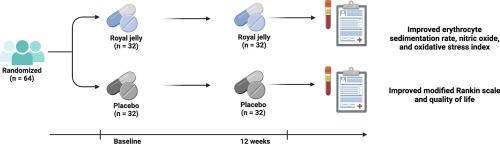
The therapeutic impact of royal jelly (RJ) consumption in patients with ischemic stroke is unknown. Therefore, we conducted a randomized, triple-blind, placebo-controlled clinical trial to evaluate the role of RJ supplementation on clinical and biochemical outcomes in patients recovering from ischemic stroke. Out of 64 enrolled patients (45–80 yrs.) with ischemic stroke, 32 were randomized to the RJ group and 32 to the placebo (control) group. Groups completed a 12-week intervention. The intervention group received 1000 mg/d of RJ dragee after breakfast. We evaluated stroke-related disability, quality of life, and inflammatory and oxidative stress markers at baseline and post-intervention. At post-intervention, serum levels of erythrocyte sedimentation rate decreased in the RJ group compared to the control group (adjusted mean difference, −8.65 mm/h [95 % CI, −14.75 to −2.55]). Additionally, serum nitric oxide levels increased in the RJ group (adjusted mean difference, 10.18 nmol/mL [95 % CI, 0.51 to 19.86]) post-intervention compared to the control group. Furthermore, the RJ group exhibited a decreased oxidative status index (adjusted mean difference, −0.003 [95 % CI, −0.006 to −0.0001]) and reduced odds of stroke-related disability (adjusted odds ratio, 0.20 [95 % CI, 0.05 to 0.70]) compared to the placebo group. Moreover, RJ supplementation improved the quality-of-life measures in the RJ group (adjusted mean difference, 16.64 [95 % CI, 1.17 to 32.12]) compared to the control group. Our findings reflect the potential benefits of RJ consumption on clinical and biochemical outcomes of patients recovering from ischemic stroke. Importantly, we acknowledge the necessity of additional studies to verify the efficacy of RJ supplementation in patients recovering from strokes.
Trial registration
Iranian Registry of Clinical Trials (IRCT20180818040827N4), registered on October 9, 2021; https://www.irct.ir/trial/59275
期刊介绍:
Journal of Functional Foods continues with the same aims and scope, editorial team, submission system and rigorous peer review. We give authors the possibility to publish their top-quality papers in a well-established leading journal in the food and nutrition fields. The Journal will keep its rigorous criteria to screen high impact research addressing relevant scientific topics and performed by sound methodologies.
The Journal of Functional Foods aims to bring together the results of fundamental and applied research into healthy foods and biologically active food ingredients.
The Journal is centered in the specific area at the boundaries among food technology, nutrition and health welcoming papers having a good interdisciplinary approach. The Journal will cover the fields of plant bioactives; dietary fibre, probiotics; functional lipids; bioactive peptides; vitamins, minerals and botanicals and other dietary supplements. Nutritional and technological aspects related to the development of functional foods and beverages are of core interest to the journal. Experimental works dealing with food digestion, bioavailability of food bioactives and on the mechanisms by which foods and their components are able to modulate physiological parameters connected with disease prevention are of particular interest as well as those dealing with personalized nutrition and nutritional needs in pathological subjects.




 京公网安备 11010802042870号
京ICP备2023020795号-1
京公网安备 11010802042870号
京ICP备2023020795号-1

 分享
分享
 求助内容:
求助内容: 应助结果提醒方式:
 扫码关注我们
