Ting Gong , Linzheng Liao , Yong Tang , Weiwei Liu , Ling Yao , Zhen Wu , Jianmei Li , Fulai Bai , Qian Zhang , Liling Tang
{"title":"l -阿拉伯糖通过大鼠胃肠肽、肠道菌群和胃肠节律的Phlpp2缓解便秘","authors":"Ting Gong , Linzheng Liao , Yong Tang , Weiwei Liu , Ling Yao , Zhen Wu , Jianmei Li , Fulai Bai , Qian Zhang , Liling Tang","doi":"10.1016/j.jff.2025.106697","DOIUrl":null,"url":null,"abstract":"<div><div>Constipation is a common gastrointestinal disorder, and while L-arabinose has been shown to relieve it, the exact molecular mechanisms remain unclear. This study investigated the effects of L-arabinose in constipated rat at doses of 400, 600, and 800 mg/kg body weight (B.W.). The 800 mg/kg B.W. dose significantly improved overall physiological state, stool consistency, intestinal transit, and gastric emptying. It also improved gastric, liver, and kidney function, while modulating key gastrointestinal peptides, including motilin (MTL), substance P (SP), vasoactive intestinal peptide (VIP), acetylcholinesterase (AchE), endothelin-1 (ET-1), serotonin (5-HT), somatostatin (SS), gastrin (Gas), and nitric oxide (NO). In addition, the 800 mg/kg dose notably increased goblet cell numbers, mucus layer thickness, and beneficial gut microbes such as <em>Ruminococcus flavefaciens</em> and <em>Muribaculum intestinale</em>. It also upregulated the expression of <em>Cd38, Phlpp2, Muc3,</em> and <em>Acat2</em>, while downregulating <em>Cd34</em>, <em>C1qa</em>, and <em>C1qc.</em> These results indicate that L-arabinose not only alleviates constipation but also enhances immune function and regulates signaling pathways, restoring gastrointestinal peptides to near-normal levels.</div></div>","PeriodicalId":360,"journal":{"name":"Journal of Functional Foods","volume":"125 ","pages":"Article 106697"},"PeriodicalIF":4.0000,"publicationDate":"2025-02-01","publicationTypes":"Journal Article","fieldsOfStudy":null,"isOpenAccess":false,"openAccessPdf":"","citationCount":"0","resultStr":"{\"title\":\"L-arabinose alleviates constipation through gastrointestinal peptide,gut microbiota,and Phlpp2 of gastrointestinal rhythms in rats\",\"authors\":\"Ting Gong , Linzheng Liao , Yong Tang , Weiwei Liu , Ling Yao , Zhen Wu , Jianmei Li , Fulai Bai , Qian Zhang , Liling Tang\",\"doi\":\"10.1016/j.jff.2025.106697\",\"DOIUrl\":null,\"url\":null,\"abstract\":\"<div><div>Constipation is a common gastrointestinal disorder, and while L-arabinose has been shown to relieve it, the exact molecular mechanisms remain unclear. This study investigated the effects of L-arabinose in constipated rat at doses of 400, 600, and 800 mg/kg body weight (B.W.). The 800 mg/kg B.W. dose significantly improved overall physiological state, stool consistency, intestinal transit, and gastric emptying. It also improved gastric, liver, and kidney function, while modulating key gastrointestinal peptides, including motilin (MTL), substance P (SP), vasoactive intestinal peptide (VIP), acetylcholinesterase (AchE), endothelin-1 (ET-1), serotonin (5-HT), somatostatin (SS), gastrin (Gas), and nitric oxide (NO). In addition, the 800 mg/kg dose notably increased goblet cell numbers, mucus layer thickness, and beneficial gut microbes such as <em>Ruminococcus flavefaciens</em> and <em>Muribaculum intestinale</em>. It also upregulated the expression of <em>Cd38, Phlpp2, Muc3,</em> and <em>Acat2</em>, while downregulating <em>Cd34</em>, <em>C1qa</em>, and <em>C1qc.</em> These results indicate that L-arabinose not only alleviates constipation but also enhances immune function and regulates signaling pathways, restoring gastrointestinal peptides to near-normal levels.</div></div>\",\"PeriodicalId\":360,\"journal\":{\"name\":\"Journal of Functional Foods\",\"volume\":\"125 \",\"pages\":\"Article 106697\"},\"PeriodicalIF\":4.0000,\"publicationDate\":\"2025-02-01\",\"publicationTypes\":\"Journal Article\",\"fieldsOfStudy\":null,\"isOpenAccess\":false,\"openAccessPdf\":\"\",\"citationCount\":\"0\",\"resultStr\":null,\"platform\":\"Semanticscholar\",\"paperid\":null,\"PeriodicalName\":\"Journal of Functional Foods\",\"FirstCategoryId\":\"97\",\"ListUrlMain\":\"https://www.sciencedirect.com/science/article/pii/S1756464625000398\",\"RegionNum\":2,\"RegionCategory\":\"农林科学\",\"ArticlePicture\":[],\"TitleCN\":null,\"AbstractTextCN\":null,\"PMCID\":null,\"EPubDate\":\"2025/1/30 0:00:00\",\"PubModel\":\"Epub\",\"JCR\":\"Q2\",\"JCRName\":\"FOOD SCIENCE & TECHNOLOGY\",\"Score\":null,\"Total\":0}","platform":"Semanticscholar","paperid":null,"PeriodicalName":"Journal of Functional Foods","FirstCategoryId":"97","ListUrlMain":"https://www.sciencedirect.com/science/article/pii/S1756464625000398","RegionNum":2,"RegionCategory":"农林科学","ArticlePicture":[],"TitleCN":null,"AbstractTextCN":null,"PMCID":null,"EPubDate":"2025/1/30 0:00:00","PubModel":"Epub","JCR":"Q2","JCRName":"FOOD SCIENCE & TECHNOLOGY","Score":null,"Total":0}
L-arabinose alleviates constipation through gastrointestinal peptide,gut microbiota,and Phlpp2 of gastrointestinal rhythms in rats
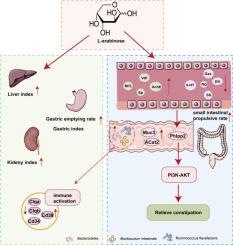
Constipation is a common gastrointestinal disorder, and while L-arabinose has been shown to relieve it, the exact molecular mechanisms remain unclear. This study investigated the effects of L-arabinose in constipated rat at doses of 400, 600, and 800 mg/kg body weight (B.W.). The 800 mg/kg B.W. dose significantly improved overall physiological state, stool consistency, intestinal transit, and gastric emptying. It also improved gastric, liver, and kidney function, while modulating key gastrointestinal peptides, including motilin (MTL), substance P (SP), vasoactive intestinal peptide (VIP), acetylcholinesterase (AchE), endothelin-1 (ET-1), serotonin (5-HT), somatostatin (SS), gastrin (Gas), and nitric oxide (NO). In addition, the 800 mg/kg dose notably increased goblet cell numbers, mucus layer thickness, and beneficial gut microbes such as Ruminococcus flavefaciens and Muribaculum intestinale. It also upregulated the expression of Cd38, Phlpp2, Muc3, and Acat2, while downregulating Cd34, C1qa, and C1qc. These results indicate that L-arabinose not only alleviates constipation but also enhances immune function and regulates signaling pathways, restoring gastrointestinal peptides to near-normal levels.
期刊介绍:
Journal of Functional Foods continues with the same aims and scope, editorial team, submission system and rigorous peer review. We give authors the possibility to publish their top-quality papers in a well-established leading journal in the food and nutrition fields. The Journal will keep its rigorous criteria to screen high impact research addressing relevant scientific topics and performed by sound methodologies.
The Journal of Functional Foods aims to bring together the results of fundamental and applied research into healthy foods and biologically active food ingredients.
The Journal is centered in the specific area at the boundaries among food technology, nutrition and health welcoming papers having a good interdisciplinary approach. The Journal will cover the fields of plant bioactives; dietary fibre, probiotics; functional lipids; bioactive peptides; vitamins, minerals and botanicals and other dietary supplements. Nutritional and technological aspects related to the development of functional foods and beverages are of core interest to the journal. Experimental works dealing with food digestion, bioavailability of food bioactives and on the mechanisms by which foods and their components are able to modulate physiological parameters connected with disease prevention are of particular interest as well as those dealing with personalized nutrition and nutritional needs in pathological subjects.




 京公网安备 11010802042870号
京ICP备2023020795号-1
京公网安备 11010802042870号
京ICP备2023020795号-1

 分享
分享
 求助内容:
求助内容: 应助结果提醒方式:
 扫码关注我们
