Emily G. Knox , Paula Sánchez-Díaz , Colin Buttimer , Sarah-Jane Leigh , Klara Vlckova , Colin Hill , Elaine Kennedy , Jonathan O’Regan , Seamus McSweeney , David Goulding , Maria Rodriguez Aburto , Caitriona M. O’Driscoll , John F. Cryan , Eoin Gunnigle , Gerard Clarke
{"title":"婴儿配方奶粉中的双歧杆菌发酵对肠道和脑屏障功能有益","authors":"Emily G. Knox , Paula Sánchez-Díaz , Colin Buttimer , Sarah-Jane Leigh , Klara Vlckova , Colin Hill , Elaine Kennedy , Jonathan O’Regan , Seamus McSweeney , David Goulding , Maria Rodriguez Aburto , Caitriona M. O’Driscoll , John F. Cryan , Eoin Gunnigle , Gerard Clarke","doi":"10.1016/j.jff.2025.106661","DOIUrl":null,"url":null,"abstract":"<div><div>The gut and blood-brain barrier are essential components of the microbiota-gut-brain axis and are influenced by diet, particularly in infancy. Breast milk supports gut and brain barrier function, but infant formulas often lack key protective components. Bifidobacterium is the predominant bacteria in the infant gut microbiome. Here, we evaluated the impact of four infant formulas fermented with three Bifidobacterium strains, originally isolated from infant stool, on gut and BBB integrity. Cell-free supernatants from these fermentations were exposed to cultures of T84 colonocytes (gut barrier model) or bEnd.3 brain endothelial cells (BBB model), with and without lipopolysaccharide challenge. All three <em>Bifidobacterium</em> strains exhibited protective effects on both gut barrier and BBB integrity with a profile that depended on the infant formula. Taken together, this data indicates that the fermentation products of relevant <em>Bifidobacterium</em> strains with infant formulas may provide protection against barrier disruption.</div></div>","PeriodicalId":360,"journal":{"name":"Journal of Functional Foods","volume":"125 ","pages":"Article 106661"},"PeriodicalIF":3.9000,"publicationDate":"2025-02-01","publicationTypes":"Journal Article","fieldsOfStudy":null,"isOpenAccess":false,"openAccessPdf":"","citationCount":"0","resultStr":"{\"title\":\"Bifidobacterium fermentation with infant formulas is associated with benefits for gut and brain barrier function\",\"authors\":\"Emily G. Knox , Paula Sánchez-Díaz , Colin Buttimer , Sarah-Jane Leigh , Klara Vlckova , Colin Hill , Elaine Kennedy , Jonathan O’Regan , Seamus McSweeney , David Goulding , Maria Rodriguez Aburto , Caitriona M. O’Driscoll , John F. Cryan , Eoin Gunnigle , Gerard Clarke\",\"doi\":\"10.1016/j.jff.2025.106661\",\"DOIUrl\":null,\"url\":null,\"abstract\":\"<div><div>The gut and blood-brain barrier are essential components of the microbiota-gut-brain axis and are influenced by diet, particularly in infancy. Breast milk supports gut and brain barrier function, but infant formulas often lack key protective components. Bifidobacterium is the predominant bacteria in the infant gut microbiome. Here, we evaluated the impact of four infant formulas fermented with three Bifidobacterium strains, originally isolated from infant stool, on gut and BBB integrity. Cell-free supernatants from these fermentations were exposed to cultures of T84 colonocytes (gut barrier model) or bEnd.3 brain endothelial cells (BBB model), with and without lipopolysaccharide challenge. All three <em>Bifidobacterium</em> strains exhibited protective effects on both gut barrier and BBB integrity with a profile that depended on the infant formula. Taken together, this data indicates that the fermentation products of relevant <em>Bifidobacterium</em> strains with infant formulas may provide protection against barrier disruption.</div></div>\",\"PeriodicalId\":360,\"journal\":{\"name\":\"Journal of Functional Foods\",\"volume\":\"125 \",\"pages\":\"Article 106661\"},\"PeriodicalIF\":3.9000,\"publicationDate\":\"2025-02-01\",\"publicationTypes\":\"Journal Article\",\"fieldsOfStudy\":null,\"isOpenAccess\":false,\"openAccessPdf\":\"\",\"citationCount\":\"0\",\"resultStr\":null,\"platform\":\"Semanticscholar\",\"paperid\":null,\"PeriodicalName\":\"Journal of Functional Foods\",\"FirstCategoryId\":\"97\",\"ListUrlMain\":\"https://www.sciencedirect.com/science/article/pii/S1756464625000039\",\"RegionNum\":2,\"RegionCategory\":\"农林科学\",\"ArticlePicture\":[],\"TitleCN\":null,\"AbstractTextCN\":null,\"PMCID\":null,\"EPubDate\":\"2025/1/16 0:00:00\",\"PubModel\":\"Epub\",\"JCR\":\"Q2\",\"JCRName\":\"FOOD SCIENCE & TECHNOLOGY\",\"Score\":null,\"Total\":0}","platform":"Semanticscholar","paperid":null,"PeriodicalName":"Journal of Functional Foods","FirstCategoryId":"97","ListUrlMain":"https://www.sciencedirect.com/science/article/pii/S1756464625000039","RegionNum":2,"RegionCategory":"农林科学","ArticlePicture":[],"TitleCN":null,"AbstractTextCN":null,"PMCID":null,"EPubDate":"2025/1/16 0:00:00","PubModel":"Epub","JCR":"Q2","JCRName":"FOOD SCIENCE & TECHNOLOGY","Score":null,"Total":0}
Bifidobacterium fermentation with infant formulas is associated with benefits for gut and brain barrier function
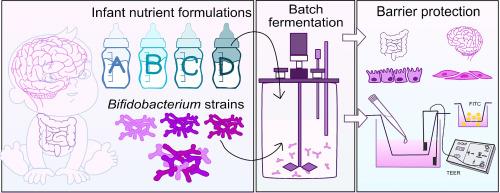
The gut and blood-brain barrier are essential components of the microbiota-gut-brain axis and are influenced by diet, particularly in infancy. Breast milk supports gut and brain barrier function, but infant formulas often lack key protective components. Bifidobacterium is the predominant bacteria in the infant gut microbiome. Here, we evaluated the impact of four infant formulas fermented with three Bifidobacterium strains, originally isolated from infant stool, on gut and BBB integrity. Cell-free supernatants from these fermentations were exposed to cultures of T84 colonocytes (gut barrier model) or bEnd.3 brain endothelial cells (BBB model), with and without lipopolysaccharide challenge. All three Bifidobacterium strains exhibited protective effects on both gut barrier and BBB integrity with a profile that depended on the infant formula. Taken together, this data indicates that the fermentation products of relevant Bifidobacterium strains with infant formulas may provide protection against barrier disruption.
期刊介绍:
Journal of Functional Foods continues with the same aims and scope, editorial team, submission system and rigorous peer review. We give authors the possibility to publish their top-quality papers in a well-established leading journal in the food and nutrition fields. The Journal will keep its rigorous criteria to screen high impact research addressing relevant scientific topics and performed by sound methodologies.
The Journal of Functional Foods aims to bring together the results of fundamental and applied research into healthy foods and biologically active food ingredients.
The Journal is centered in the specific area at the boundaries among food technology, nutrition and health welcoming papers having a good interdisciplinary approach. The Journal will cover the fields of plant bioactives; dietary fibre, probiotics; functional lipids; bioactive peptides; vitamins, minerals and botanicals and other dietary supplements. Nutritional and technological aspects related to the development of functional foods and beverages are of core interest to the journal. Experimental works dealing with food digestion, bioavailability of food bioactives and on the mechanisms by which foods and their components are able to modulate physiological parameters connected with disease prevention are of particular interest as well as those dealing with personalized nutrition and nutritional needs in pathological subjects.




 京公网安备 11010802042870号
京ICP备2023020795号-1
京公网安备 11010802042870号
京ICP备2023020795号-1

 分享
分享
 求助内容:
求助内容: 应助结果提醒方式:
 扫码关注我们
