Qiuer Liang , Minghao Chen , Guangtian Chen , Pengli Xu , Lai Kwan Lam , Pengcheng Xie , Ting Xie , Wanqing Tu , Tianhao Liu , Xiaopeng Peng , Haoyao Yuan , Liguo Chen , Ya Xiao
{"title":"山奈酚通过ATF4/ACSL4途径抑制铁下垂,可预防高盐诱导的高血压和血管内皮损伤","authors":"Qiuer Liang , Minghao Chen , Guangtian Chen , Pengli Xu , Lai Kwan Lam , Pengcheng Xie , Ting Xie , Wanqing Tu , Tianhao Liu , Xiaopeng Peng , Haoyao Yuan , Liguo Chen , Ya Xiao","doi":"10.1016/j.jff.2025.106684","DOIUrl":null,"url":null,"abstract":"<div><div>To date, no specific treatments have been developed for high-salt-induced hypertensive vascular damage, emphasizing the need to elucidate its underlying molecular mechanisms for therapeutic innovation. Kaempferol (Kae), a natural flavonol belonging to the flavonoid family, has demonstrated significant vascular protective effects in previous studies. However, its impact on high-salt-induced hypertensive vascular injury remains unclear. This study aimed to explore the pharmacological effects and underlying mechanisms of Kae in mitigating hypertensive vascular damage. Using an 8 % high-salt diet model, we evaluated the effects of Kae (200 mg/kg/day) in wild-type (WT) and activating transcription factor 4 (ATF4<sup>+/−</sup>) knockout mice. Additionally, human aortic endothelial cells (HAECs) cultured under high-salt conditions were used to assess Kae's protective effects, with ATF4 and acyl-CoA synthetase long-chain family member 4 (ACSL4) knocked down via siRNA transfection. Our results showed that Kae significantly reduced high-salt-induced hypertension, improved vascular endothelial dysfunction, inhibited ferroptosis, and suppressed ATF4 expression. Compared to ATF4<sup>+/−</sup>mice on a high-salt diet, ATF4<sup>+/−</sup>mice treated with Kae exhibited greater reductions in blood pressure and endothelial damage and more pronounced inhibition of ferroptosis. Surface plasmon resonance and molecular docking analyses revealed that Kae directly binds to ATF4, while proteome microarray and co-immunoprecipitation assays demonstrated that ATF4 interacts with ACSL4 in HAECs. Furthermore, inhibition of ATF4 or ACSL4 effectively alleviated endothelial ferroptosis induced by high-salt stress. In summary, our findings suggest that Kae mitigates high-salt-induced hypertension by inhibiting endothelial ferroptosis via the ATF4/ACSL4 pathway, providing a potential therapeutic strategy for hypertensive vascular injury.</div></div>","PeriodicalId":360,"journal":{"name":"Journal of Functional Foods","volume":"125 ","pages":"Article 106684"},"PeriodicalIF":4.0000,"publicationDate":"2025-02-01","publicationTypes":"Journal Article","fieldsOfStudy":null,"isOpenAccess":false,"openAccessPdf":"","citationCount":"0","resultStr":"{\"title\":\"Kaempferol protects against high-salt-induced hypertension and vascular endothelial injury by inhibiting ferroptosis through the ATF4/ACSL4 pathway\",\"authors\":\"Qiuer Liang , Minghao Chen , Guangtian Chen , Pengli Xu , Lai Kwan Lam , Pengcheng Xie , Ting Xie , Wanqing Tu , Tianhao Liu , Xiaopeng Peng , Haoyao Yuan , Liguo Chen , Ya Xiao\",\"doi\":\"10.1016/j.jff.2025.106684\",\"DOIUrl\":null,\"url\":null,\"abstract\":\"<div><div>To date, no specific treatments have been developed for high-salt-induced hypertensive vascular damage, emphasizing the need to elucidate its underlying molecular mechanisms for therapeutic innovation. Kaempferol (Kae), a natural flavonol belonging to the flavonoid family, has demonstrated significant vascular protective effects in previous studies. However, its impact on high-salt-induced hypertensive vascular injury remains unclear. This study aimed to explore the pharmacological effects and underlying mechanisms of Kae in mitigating hypertensive vascular damage. Using an 8 % high-salt diet model, we evaluated the effects of Kae (200 mg/kg/day) in wild-type (WT) and activating transcription factor 4 (ATF4<sup>+/−</sup>) knockout mice. Additionally, human aortic endothelial cells (HAECs) cultured under high-salt conditions were used to assess Kae's protective effects, with ATF4 and acyl-CoA synthetase long-chain family member 4 (ACSL4) knocked down via siRNA transfection. Our results showed that Kae significantly reduced high-salt-induced hypertension, improved vascular endothelial dysfunction, inhibited ferroptosis, and suppressed ATF4 expression. Compared to ATF4<sup>+/−</sup>mice on a high-salt diet, ATF4<sup>+/−</sup>mice treated with Kae exhibited greater reductions in blood pressure and endothelial damage and more pronounced inhibition of ferroptosis. Surface plasmon resonance and molecular docking analyses revealed that Kae directly binds to ATF4, while proteome microarray and co-immunoprecipitation assays demonstrated that ATF4 interacts with ACSL4 in HAECs. Furthermore, inhibition of ATF4 or ACSL4 effectively alleviated endothelial ferroptosis induced by high-salt stress. In summary, our findings suggest that Kae mitigates high-salt-induced hypertension by inhibiting endothelial ferroptosis via the ATF4/ACSL4 pathway, providing a potential therapeutic strategy for hypertensive vascular injury.</div></div>\",\"PeriodicalId\":360,\"journal\":{\"name\":\"Journal of Functional Foods\",\"volume\":\"125 \",\"pages\":\"Article 106684\"},\"PeriodicalIF\":4.0000,\"publicationDate\":\"2025-02-01\",\"publicationTypes\":\"Journal Article\",\"fieldsOfStudy\":null,\"isOpenAccess\":false,\"openAccessPdf\":\"\",\"citationCount\":\"0\",\"resultStr\":null,\"platform\":\"Semanticscholar\",\"paperid\":null,\"PeriodicalName\":\"Journal of Functional Foods\",\"FirstCategoryId\":\"97\",\"ListUrlMain\":\"https://www.sciencedirect.com/science/article/pii/S175646462500026X\",\"RegionNum\":2,\"RegionCategory\":\"农林科学\",\"ArticlePicture\":[],\"TitleCN\":null,\"AbstractTextCN\":null,\"PMCID\":null,\"EPubDate\":\"2025/1/23 0:00:00\",\"PubModel\":\"Epub\",\"JCR\":\"Q2\",\"JCRName\":\"FOOD SCIENCE & TECHNOLOGY\",\"Score\":null,\"Total\":0}","platform":"Semanticscholar","paperid":null,"PeriodicalName":"Journal of Functional Foods","FirstCategoryId":"97","ListUrlMain":"https://www.sciencedirect.com/science/article/pii/S175646462500026X","RegionNum":2,"RegionCategory":"农林科学","ArticlePicture":[],"TitleCN":null,"AbstractTextCN":null,"PMCID":null,"EPubDate":"2025/1/23 0:00:00","PubModel":"Epub","JCR":"Q2","JCRName":"FOOD SCIENCE & TECHNOLOGY","Score":null,"Total":0}
Kaempferol protects against high-salt-induced hypertension and vascular endothelial injury by inhibiting ferroptosis through the ATF4/ACSL4 pathway
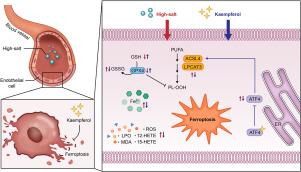
To date, no specific treatments have been developed for high-salt-induced hypertensive vascular damage, emphasizing the need to elucidate its underlying molecular mechanisms for therapeutic innovation. Kaempferol (Kae), a natural flavonol belonging to the flavonoid family, has demonstrated significant vascular protective effects in previous studies. However, its impact on high-salt-induced hypertensive vascular injury remains unclear. This study aimed to explore the pharmacological effects and underlying mechanisms of Kae in mitigating hypertensive vascular damage. Using an 8 % high-salt diet model, we evaluated the effects of Kae (200 mg/kg/day) in wild-type (WT) and activating transcription factor 4 (ATF4+/−) knockout mice. Additionally, human aortic endothelial cells (HAECs) cultured under high-salt conditions were used to assess Kae's protective effects, with ATF4 and acyl-CoA synthetase long-chain family member 4 (ACSL4) knocked down via siRNA transfection. Our results showed that Kae significantly reduced high-salt-induced hypertension, improved vascular endothelial dysfunction, inhibited ferroptosis, and suppressed ATF4 expression. Compared to ATF4+/−mice on a high-salt diet, ATF4+/−mice treated with Kae exhibited greater reductions in blood pressure and endothelial damage and more pronounced inhibition of ferroptosis. Surface plasmon resonance and molecular docking analyses revealed that Kae directly binds to ATF4, while proteome microarray and co-immunoprecipitation assays demonstrated that ATF4 interacts with ACSL4 in HAECs. Furthermore, inhibition of ATF4 or ACSL4 effectively alleviated endothelial ferroptosis induced by high-salt stress. In summary, our findings suggest that Kae mitigates high-salt-induced hypertension by inhibiting endothelial ferroptosis via the ATF4/ACSL4 pathway, providing a potential therapeutic strategy for hypertensive vascular injury.
期刊介绍:
Journal of Functional Foods continues with the same aims and scope, editorial team, submission system and rigorous peer review. We give authors the possibility to publish their top-quality papers in a well-established leading journal in the food and nutrition fields. The Journal will keep its rigorous criteria to screen high impact research addressing relevant scientific topics and performed by sound methodologies.
The Journal of Functional Foods aims to bring together the results of fundamental and applied research into healthy foods and biologically active food ingredients.
The Journal is centered in the specific area at the boundaries among food technology, nutrition and health welcoming papers having a good interdisciplinary approach. The Journal will cover the fields of plant bioactives; dietary fibre, probiotics; functional lipids; bioactive peptides; vitamins, minerals and botanicals and other dietary supplements. Nutritional and technological aspects related to the development of functional foods and beverages are of core interest to the journal. Experimental works dealing with food digestion, bioavailability of food bioactives and on the mechanisms by which foods and their components are able to modulate physiological parameters connected with disease prevention are of particular interest as well as those dealing with personalized nutrition and nutritional needs in pathological subjects.




 京公网安备 11010802042870号
京ICP备2023020795号-1
京公网安备 11010802042870号
京ICP备2023020795号-1

 分享
分享
 求助内容:
求助内容: 应助结果提醒方式:
 扫码关注我们
