Xinyi Lv , Zijian Wu , Limin Wang , Peibo Guo , Ao Qu , Wenjing Liang , Pengbo Zheng , Yuan Li , Wen Zhang
{"title":"ph驱动法制备姜黄素负载的玉米紫胶纳米颗粒:制备、表征及抗炎效果","authors":"Xinyi Lv , Zijian Wu , Limin Wang , Peibo Guo , Ao Qu , Wenjing Liang , Pengbo Zheng , Yuan Li , Wen Zhang","doi":"10.1016/j.jff.2025.106692","DOIUrl":null,"url":null,"abstract":"<div><div>Curcumin (Cur), a naturally occurring flavonoid compound, is known for its multiple health benefits. Nevertheless, its bioavailability is greatly restricted due to poor solubility and stability. In order to address this problem, phytic acid was used in a pH-driven method to create curcumin-loaded zein-shellac nanoparticles (Zein-SH-CurNPs). The results confirmed that the hydrophobic center of zein-shellac nanoparticles (Zein-SHNPs) effectively encapsulated curcumin, leading to the formation of spherical particles that exhibited an impressive encapsulation efficiency of 96.96 % and a loading capacity of 4.65 %. Curcumin-induced zein fluorescence quenching was found to be static using fluorescence spectroscopy. <em>In vivo</em> colitis experiments conducted on mice disclosed that Zein-SH-CurNP exhibits a protective effect against DSS-induced colitis. Notably, the levels of pro-inflammatory cytokines, namely tumor necrosis factor-α (TNF-α), mouse interleukin-6 (IL-6), and interleukin-1β (IL-1β), were significantly reduced. To summarize, the results suggest that the zein-shellac composites hold potential as advanced nano-delivery structures for insoluble bioactive substances.</div></div>","PeriodicalId":360,"journal":{"name":"Journal of Functional Foods","volume":"125 ","pages":"Article 106692"},"PeriodicalIF":4.0000,"publicationDate":"2025-02-01","publicationTypes":"Journal Article","fieldsOfStudy":null,"isOpenAccess":false,"openAccessPdf":"","citationCount":"0","resultStr":"{\"title\":\"The curcumin-loaded zein-shellac nanoparticles using pH-driven method: Fabrication, characterization, and anti-inflammatory effect\",\"authors\":\"Xinyi Lv , Zijian Wu , Limin Wang , Peibo Guo , Ao Qu , Wenjing Liang , Pengbo Zheng , Yuan Li , Wen Zhang\",\"doi\":\"10.1016/j.jff.2025.106692\",\"DOIUrl\":null,\"url\":null,\"abstract\":\"<div><div>Curcumin (Cur), a naturally occurring flavonoid compound, is known for its multiple health benefits. Nevertheless, its bioavailability is greatly restricted due to poor solubility and stability. In order to address this problem, phytic acid was used in a pH-driven method to create curcumin-loaded zein-shellac nanoparticles (Zein-SH-CurNPs). The results confirmed that the hydrophobic center of zein-shellac nanoparticles (Zein-SHNPs) effectively encapsulated curcumin, leading to the formation of spherical particles that exhibited an impressive encapsulation efficiency of 96.96 % and a loading capacity of 4.65 %. Curcumin-induced zein fluorescence quenching was found to be static using fluorescence spectroscopy. <em>In vivo</em> colitis experiments conducted on mice disclosed that Zein-SH-CurNP exhibits a protective effect against DSS-induced colitis. Notably, the levels of pro-inflammatory cytokines, namely tumor necrosis factor-α (TNF-α), mouse interleukin-6 (IL-6), and interleukin-1β (IL-1β), were significantly reduced. To summarize, the results suggest that the zein-shellac composites hold potential as advanced nano-delivery structures for insoluble bioactive substances.</div></div>\",\"PeriodicalId\":360,\"journal\":{\"name\":\"Journal of Functional Foods\",\"volume\":\"125 \",\"pages\":\"Article 106692\"},\"PeriodicalIF\":4.0000,\"publicationDate\":\"2025-02-01\",\"publicationTypes\":\"Journal Article\",\"fieldsOfStudy\":null,\"isOpenAccess\":false,\"openAccessPdf\":\"\",\"citationCount\":\"0\",\"resultStr\":null,\"platform\":\"Semanticscholar\",\"paperid\":null,\"PeriodicalName\":\"Journal of Functional Foods\",\"FirstCategoryId\":\"97\",\"ListUrlMain\":\"https://www.sciencedirect.com/science/article/pii/S1756464625000349\",\"RegionNum\":2,\"RegionCategory\":\"农林科学\",\"ArticlePicture\":[],\"TitleCN\":null,\"AbstractTextCN\":null,\"PMCID\":null,\"EPubDate\":\"2025/1/27 0:00:00\",\"PubModel\":\"Epub\",\"JCR\":\"Q2\",\"JCRName\":\"FOOD SCIENCE & TECHNOLOGY\",\"Score\":null,\"Total\":0}","platform":"Semanticscholar","paperid":null,"PeriodicalName":"Journal of Functional Foods","FirstCategoryId":"97","ListUrlMain":"https://www.sciencedirect.com/science/article/pii/S1756464625000349","RegionNum":2,"RegionCategory":"农林科学","ArticlePicture":[],"TitleCN":null,"AbstractTextCN":null,"PMCID":null,"EPubDate":"2025/1/27 0:00:00","PubModel":"Epub","JCR":"Q2","JCRName":"FOOD SCIENCE & TECHNOLOGY","Score":null,"Total":0}
The curcumin-loaded zein-shellac nanoparticles using pH-driven method: Fabrication, characterization, and anti-inflammatory effect
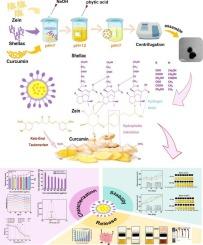
Curcumin (Cur), a naturally occurring flavonoid compound, is known for its multiple health benefits. Nevertheless, its bioavailability is greatly restricted due to poor solubility and stability. In order to address this problem, phytic acid was used in a pH-driven method to create curcumin-loaded zein-shellac nanoparticles (Zein-SH-CurNPs). The results confirmed that the hydrophobic center of zein-shellac nanoparticles (Zein-SHNPs) effectively encapsulated curcumin, leading to the formation of spherical particles that exhibited an impressive encapsulation efficiency of 96.96 % and a loading capacity of 4.65 %. Curcumin-induced zein fluorescence quenching was found to be static using fluorescence spectroscopy. In vivo colitis experiments conducted on mice disclosed that Zein-SH-CurNP exhibits a protective effect against DSS-induced colitis. Notably, the levels of pro-inflammatory cytokines, namely tumor necrosis factor-α (TNF-α), mouse interleukin-6 (IL-6), and interleukin-1β (IL-1β), were significantly reduced. To summarize, the results suggest that the zein-shellac composites hold potential as advanced nano-delivery structures for insoluble bioactive substances.
期刊介绍:
Journal of Functional Foods continues with the same aims and scope, editorial team, submission system and rigorous peer review. We give authors the possibility to publish their top-quality papers in a well-established leading journal in the food and nutrition fields. The Journal will keep its rigorous criteria to screen high impact research addressing relevant scientific topics and performed by sound methodologies.
The Journal of Functional Foods aims to bring together the results of fundamental and applied research into healthy foods and biologically active food ingredients.
The Journal is centered in the specific area at the boundaries among food technology, nutrition and health welcoming papers having a good interdisciplinary approach. The Journal will cover the fields of plant bioactives; dietary fibre, probiotics; functional lipids; bioactive peptides; vitamins, minerals and botanicals and other dietary supplements. Nutritional and technological aspects related to the development of functional foods and beverages are of core interest to the journal. Experimental works dealing with food digestion, bioavailability of food bioactives and on the mechanisms by which foods and their components are able to modulate physiological parameters connected with disease prevention are of particular interest as well as those dealing with personalized nutrition and nutritional needs in pathological subjects.




 京公网安备 11010802042870号
京ICP备2023020795号-1
京公网安备 11010802042870号
京ICP备2023020795号-1

 分享
分享
 求助内容:
求助内容: 应助结果提醒方式:
 扫码关注我们
