Jinjia Liu , Songhao Tian , Jixiang Wang , Qing Sang , Wenting Su , Jinqiang Wu , Fenglei Zai
{"title":"蜂胶乙醇提取物对d -半乳糖诱导的衰老小鼠的肝脏保护作用:胰岛素抵抗途径的代谢组学和转录组学分析","authors":"Jinjia Liu , Songhao Tian , Jixiang Wang , Qing Sang , Wenting Su , Jinqiang Wu , Fenglei Zai","doi":"10.1016/j.jff.2025.106668","DOIUrl":null,"url":null,"abstract":"<div><div>This study aimed to evaluate the hepatoprotective effects of Propolis ethanol extract (PEE) in D-galactose (D-gal)-induced senescence mice and explore its underlying mechanisms. Mice were administered PEE by gavage, and body weight, organ index, and serum biomarkers (SOD, MDA, AST, ALT) were measured. Liver histopathological changes were examined using HE staining. Additionally, transcriptomics and metabolomics analyses were employed to elucidate the molecular mechanisms. The results demonstrated that PEE ameliorated the reductions in body weight and liver index in aged mice. PEE significantly increased serum SOD levels and reduced MDA, AST, and ALT levels. Histological analysis revealed that PEE mitigated liver damage. Mechanistically, PEE appeared to exert hepatoprotective effects by modulating the insulin resistance pathway, particularly through the PI3K-AKT/PP1 signaling axis, thereby enhancing glycogen synthesis in the damaged liver. These findings provide a scientific foundation for the therapeutic potential of PEE in anti-aging and liver disease.</div></div>","PeriodicalId":360,"journal":{"name":"Journal of Functional Foods","volume":"125 ","pages":"Article 106668"},"PeriodicalIF":3.9000,"publicationDate":"2025-02-01","publicationTypes":"Journal Article","fieldsOfStudy":null,"isOpenAccess":false,"openAccessPdf":"","citationCount":"0","resultStr":"{\"title\":\"Hepatoprotective effects of propolis ethanol extract on D-galactose-induced aging mice: A metabolomics and transcriptomics analysis focusing on insulin resistance pathways\",\"authors\":\"Jinjia Liu , Songhao Tian , Jixiang Wang , Qing Sang , Wenting Su , Jinqiang Wu , Fenglei Zai\",\"doi\":\"10.1016/j.jff.2025.106668\",\"DOIUrl\":null,\"url\":null,\"abstract\":\"<div><div>This study aimed to evaluate the hepatoprotective effects of Propolis ethanol extract (PEE) in D-galactose (D-gal)-induced senescence mice and explore its underlying mechanisms. Mice were administered PEE by gavage, and body weight, organ index, and serum biomarkers (SOD, MDA, AST, ALT) were measured. Liver histopathological changes were examined using HE staining. Additionally, transcriptomics and metabolomics analyses were employed to elucidate the molecular mechanisms. The results demonstrated that PEE ameliorated the reductions in body weight and liver index in aged mice. PEE significantly increased serum SOD levels and reduced MDA, AST, and ALT levels. Histological analysis revealed that PEE mitigated liver damage. Mechanistically, PEE appeared to exert hepatoprotective effects by modulating the insulin resistance pathway, particularly through the PI3K-AKT/PP1 signaling axis, thereby enhancing glycogen synthesis in the damaged liver. These findings provide a scientific foundation for the therapeutic potential of PEE in anti-aging and liver disease.</div></div>\",\"PeriodicalId\":360,\"journal\":{\"name\":\"Journal of Functional Foods\",\"volume\":\"125 \",\"pages\":\"Article 106668\"},\"PeriodicalIF\":3.9000,\"publicationDate\":\"2025-02-01\",\"publicationTypes\":\"Journal Article\",\"fieldsOfStudy\":null,\"isOpenAccess\":false,\"openAccessPdf\":\"\",\"citationCount\":\"0\",\"resultStr\":null,\"platform\":\"Semanticscholar\",\"paperid\":null,\"PeriodicalName\":\"Journal of Functional Foods\",\"FirstCategoryId\":\"97\",\"ListUrlMain\":\"https://www.sciencedirect.com/science/article/pii/S1756464625000106\",\"RegionNum\":2,\"RegionCategory\":\"农林科学\",\"ArticlePicture\":[],\"TitleCN\":null,\"AbstractTextCN\":null,\"PMCID\":null,\"EPubDate\":\"2025/1/9 0:00:00\",\"PubModel\":\"Epub\",\"JCR\":\"Q2\",\"JCRName\":\"FOOD SCIENCE & TECHNOLOGY\",\"Score\":null,\"Total\":0}","platform":"Semanticscholar","paperid":null,"PeriodicalName":"Journal of Functional Foods","FirstCategoryId":"97","ListUrlMain":"https://www.sciencedirect.com/science/article/pii/S1756464625000106","RegionNum":2,"RegionCategory":"农林科学","ArticlePicture":[],"TitleCN":null,"AbstractTextCN":null,"PMCID":null,"EPubDate":"2025/1/9 0:00:00","PubModel":"Epub","JCR":"Q2","JCRName":"FOOD SCIENCE & TECHNOLOGY","Score":null,"Total":0}
Hepatoprotective effects of propolis ethanol extract on D-galactose-induced aging mice: A metabolomics and transcriptomics analysis focusing on insulin resistance pathways
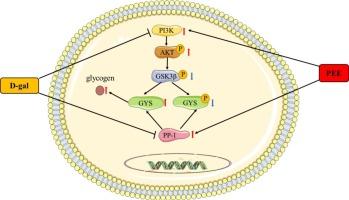
This study aimed to evaluate the hepatoprotective effects of Propolis ethanol extract (PEE) in D-galactose (D-gal)-induced senescence mice and explore its underlying mechanisms. Mice were administered PEE by gavage, and body weight, organ index, and serum biomarkers (SOD, MDA, AST, ALT) were measured. Liver histopathological changes were examined using HE staining. Additionally, transcriptomics and metabolomics analyses were employed to elucidate the molecular mechanisms. The results demonstrated that PEE ameliorated the reductions in body weight and liver index in aged mice. PEE significantly increased serum SOD levels and reduced MDA, AST, and ALT levels. Histological analysis revealed that PEE mitigated liver damage. Mechanistically, PEE appeared to exert hepatoprotective effects by modulating the insulin resistance pathway, particularly through the PI3K-AKT/PP1 signaling axis, thereby enhancing glycogen synthesis in the damaged liver. These findings provide a scientific foundation for the therapeutic potential of PEE in anti-aging and liver disease.
期刊介绍:
Journal of Functional Foods continues with the same aims and scope, editorial team, submission system and rigorous peer review. We give authors the possibility to publish their top-quality papers in a well-established leading journal in the food and nutrition fields. The Journal will keep its rigorous criteria to screen high impact research addressing relevant scientific topics and performed by sound methodologies.
The Journal of Functional Foods aims to bring together the results of fundamental and applied research into healthy foods and biologically active food ingredients.
The Journal is centered in the specific area at the boundaries among food technology, nutrition and health welcoming papers having a good interdisciplinary approach. The Journal will cover the fields of plant bioactives; dietary fibre, probiotics; functional lipids; bioactive peptides; vitamins, minerals and botanicals and other dietary supplements. Nutritional and technological aspects related to the development of functional foods and beverages are of core interest to the journal. Experimental works dealing with food digestion, bioavailability of food bioactives and on the mechanisms by which foods and their components are able to modulate physiological parameters connected with disease prevention are of particular interest as well as those dealing with personalized nutrition and nutritional needs in pathological subjects.




 京公网安备 11010802042870号
京ICP备2023020795号-1
京公网安备 11010802042870号
京ICP备2023020795号-1

 分享
分享
 求助内容:
求助内容: 应助结果提醒方式:
 扫码关注我们
