{"title":"主观和客观测量压力和负荷之间的联系:来自189名优秀运动员45周前瞻性研究的见解。","authors":"Kristina Drole, Mojca Doupona, Kathrin Steffen, Aleš Jerin, Armin Paravlic","doi":"10.3389/fpsyg.2024.1521290","DOIUrl":null,"url":null,"abstract":"<p><strong>Introduction: </strong>The aim of this study was to investigate the associations between subjective and objective measures of stress and load in elite male handball players at both the group and individual levels.</p><p><strong>Methods: </strong>In this 45-week prospective cohort study, 189 elite male handball players weekly reported their perceived stress and load across training, competition, academic, and work domains. Blood samples were collected five times during the 2022/23 season to measure cortisol and the free testosterone to cortisol ratio (FTCR). We derived a \"load\" variable as the sum of training, competition, academic and work hours and calculated acute, chronic, and acute-to-chronic ratio variables for both load and stress. Associations between subjective and objective measures were analyzed using Spearman's rank correlation.</p><p><strong>Results: </strong>Weak to moderate positive associations were found between load and perceived stress (<i>r</i> = 0.19 to 0.46, <i>p</i> < 0.001), and between perceived stress and cortisol (<i>r</i> = 0.10, <i>p</i> = 0.023). Weak negative associations were found between perceived stress and FTCR (<i>r</i> = -0.18 to -0.20, <i>p</i> < 0.001) and between load and FTCR (<i>r</i> = -0.13, <i>p</i> = 0.003). A total of 86% of athletes had positive associations between stress and load (47% weak, 34% moderate, 5% high); 78% between stress and cortisol (27% weak, 22% moderate, 29% high); and 63% demonstrated negative associations between FTCR and load (18% weak, 32% moderate, 13% high).</p><p><strong>Conclusion: </strong>This study highlights the complexity between subjective and objective measures of stress and load in athletes. Understanding the link between these measures may help coaches and sports scientists streamline athlete monitoring. In cases where moderate to strong associations exist, subjective measures might serve as a reliable substitute for objective ones, making the monitoring process more time- and cost-efficient.</p>","PeriodicalId":12525,"journal":{"name":"Frontiers in Psychology","volume":"15 ","pages":"1521290"},"PeriodicalIF":2.9000,"publicationDate":"2025-01-21","publicationTypes":"Journal Article","fieldsOfStudy":null,"isOpenAccess":false,"openAccessPdf":"https://www.ncbi.nlm.nih.gov/pmc/articles/PMC11791750/pdf/","citationCount":"0","resultStr":"{\"title\":\"Associations between subjective and objective measures of stress and load: an insight from 45-week prospective study in 189 elite athletes.\",\"authors\":\"Kristina Drole, Mojca Doupona, Kathrin Steffen, Aleš Jerin, Armin Paravlic\",\"doi\":\"10.3389/fpsyg.2024.1521290\",\"DOIUrl\":null,\"url\":null,\"abstract\":\"<p><strong>Introduction: </strong>The aim of this study was to investigate the associations between subjective and objective measures of stress and load in elite male handball players at both the group and individual levels.</p><p><strong>Methods: </strong>In this 45-week prospective cohort study, 189 elite male handball players weekly reported their perceived stress and load across training, competition, academic, and work domains. Blood samples were collected five times during the 2022/23 season to measure cortisol and the free testosterone to cortisol ratio (FTCR). We derived a \\\"load\\\" variable as the sum of training, competition, academic and work hours and calculated acute, chronic, and acute-to-chronic ratio variables for both load and stress. Associations between subjective and objective measures were analyzed using Spearman's rank correlation.</p><p><strong>Results: </strong>Weak to moderate positive associations were found between load and perceived stress (<i>r</i> = 0.19 to 0.46, <i>p</i> < 0.001), and between perceived stress and cortisol (<i>r</i> = 0.10, <i>p</i> = 0.023). Weak negative associations were found between perceived stress and FTCR (<i>r</i> = -0.18 to -0.20, <i>p</i> < 0.001) and between load and FTCR (<i>r</i> = -0.13, <i>p</i> = 0.003). A total of 86% of athletes had positive associations between stress and load (47% weak, 34% moderate, 5% high); 78% between stress and cortisol (27% weak, 22% moderate, 29% high); and 63% demonstrated negative associations between FTCR and load (18% weak, 32% moderate, 13% high).</p><p><strong>Conclusion: </strong>This study highlights the complexity between subjective and objective measures of stress and load in athletes. Understanding the link between these measures may help coaches and sports scientists streamline athlete monitoring. In cases where moderate to strong associations exist, subjective measures might serve as a reliable substitute for objective ones, making the monitoring process more time- and cost-efficient.</p>\",\"PeriodicalId\":12525,\"journal\":{\"name\":\"Frontiers in Psychology\",\"volume\":\"15 \",\"pages\":\"1521290\"},\"PeriodicalIF\":2.9000,\"publicationDate\":\"2025-01-21\",\"publicationTypes\":\"Journal Article\",\"fieldsOfStudy\":null,\"isOpenAccess\":false,\"openAccessPdf\":\"https://www.ncbi.nlm.nih.gov/pmc/articles/PMC11791750/pdf/\",\"citationCount\":\"0\",\"resultStr\":null,\"platform\":\"Semanticscholar\",\"paperid\":null,\"PeriodicalName\":\"Frontiers in Psychology\",\"FirstCategoryId\":\"102\",\"ListUrlMain\":\"https://doi.org/10.3389/fpsyg.2024.1521290\",\"RegionNum\":3,\"RegionCategory\":\"心理学\",\"ArticlePicture\":[],\"TitleCN\":null,\"AbstractTextCN\":null,\"PMCID\":null,\"EPubDate\":\"2024/1/1 0:00:00\",\"PubModel\":\"eCollection\",\"JCR\":\"Q2\",\"JCRName\":\"PSYCHOLOGY, MULTIDISCIPLINARY\",\"Score\":null,\"Total\":0}","platform":"Semanticscholar","paperid":null,"PeriodicalName":"Frontiers in Psychology","FirstCategoryId":"102","ListUrlMain":"https://doi.org/10.3389/fpsyg.2024.1521290","RegionNum":3,"RegionCategory":"心理学","ArticlePicture":[],"TitleCN":null,"AbstractTextCN":null,"PMCID":null,"EPubDate":"2024/1/1 0:00:00","PubModel":"eCollection","JCR":"Q2","JCRName":"PSYCHOLOGY, MULTIDISCIPLINARY","Score":null,"Total":0}
引用次数: 0
摘要
前言:本研究的目的是探讨优秀男子手球运动员在群体和个人水平上主观和客观的压力和负荷测量之间的关系。方法:在这项为期45周的前瞻性队列研究中,189名优秀男子手球运动员每周报告他们在训练、比赛、学业和工作领域的感知压力和负荷。在2022/23赛季采集了5次血液样本,以测量皮质醇和游离睾酮与皮质醇的比率(FTCR)。我们导出了一个“负荷”变量,作为训练、比赛、学习和工作时间的总和,并计算了负荷和压力的急性、慢性和急性-慢性比率变量。使用Spearman等级相关分析主观和客观测量之间的关联。结果:负荷与感知压力之间存在弱至中度正相关(r = 0.19至0.46,p < 0.001),感知压力与皮质醇之间存在弱至中度正相关(r = 0.10, p = 0.023)。感知压力与FTCR之间呈弱负相关(r = -0.18 ~ -0.20, p < 0.001),负荷与FTCR之间呈弱负相关(r = -0.13, p = 0.003)。86%的运动员在压力和负荷之间存在正相关(47%为弱相关,34%为中等相关,5%为高相关);78%的压力和皮质醇(27%弱,22%中等,29%高);63%的人表现出FTCR与负荷呈负相关(18%弱,32%中等,13%高)。结论:本研究强调了运动员压力和负荷的主观和客观测量之间的复杂性。了解这些措施之间的联系可以帮助教练和运动科学家简化对运动员的监测。在存在中度至强烈关联的情况下,主观措施可以作为客观措施的可靠替代品,使监测过程更省时和更具成本效益。
Associations between subjective and objective measures of stress and load: an insight from 45-week prospective study in 189 elite athletes.
Introduction: The aim of this study was to investigate the associations between subjective and objective measures of stress and load in elite male handball players at both the group and individual levels.
Methods: In this 45-week prospective cohort study, 189 elite male handball players weekly reported their perceived stress and load across training, competition, academic, and work domains. Blood samples were collected five times during the 2022/23 season to measure cortisol and the free testosterone to cortisol ratio (FTCR). We derived a "load" variable as the sum of training, competition, academic and work hours and calculated acute, chronic, and acute-to-chronic ratio variables for both load and stress. Associations between subjective and objective measures were analyzed using Spearman's rank correlation.
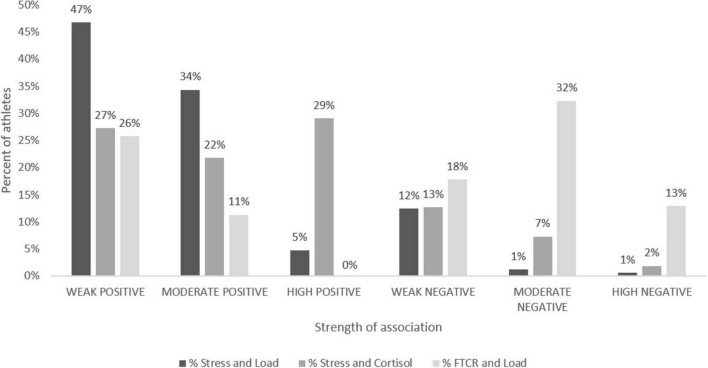
Results: Weak to moderate positive associations were found between load and perceived stress (r = 0.19 to 0.46, p < 0.001), and between perceived stress and cortisol (r = 0.10, p = 0.023). Weak negative associations were found between perceived stress and FTCR (r = -0.18 to -0.20, p < 0.001) and between load and FTCR (r = -0.13, p = 0.003). A total of 86% of athletes had positive associations between stress and load (47% weak, 34% moderate, 5% high); 78% between stress and cortisol (27% weak, 22% moderate, 29% high); and 63% demonstrated negative associations between FTCR and load (18% weak, 32% moderate, 13% high).
Conclusion: This study highlights the complexity between subjective and objective measures of stress and load in athletes. Understanding the link between these measures may help coaches and sports scientists streamline athlete monitoring. In cases where moderate to strong associations exist, subjective measures might serve as a reliable substitute for objective ones, making the monitoring process more time- and cost-efficient.
期刊介绍:
Frontiers in Psychology is the largest journal in its field, publishing rigorously peer-reviewed research across the psychological sciences, from clinical research to cognitive science, from perception to consciousness, from imaging studies to human factors, and from animal cognition to social psychology. Field Chief Editor Axel Cleeremans at the Free University of Brussels is supported by an outstanding Editorial Board of international researchers. This multidisciplinary open-access journal is at the forefront of disseminating and communicating scientific knowledge and impactful discoveries to researchers, academics, clinicians and the public worldwide. The journal publishes the best research across the entire field of psychology. Today, psychological science is becoming increasingly important at all levels of society, from the treatment of clinical disorders to our basic understanding of how the mind works. It is highly interdisciplinary, borrowing questions from philosophy, methods from neuroscience and insights from clinical practice - all in the goal of furthering our grasp of human nature and society, as well as our ability to develop new intervention methods.







 京公网安备 11010802042870号
京ICP备2023020795号-1
京公网安备 11010802042870号
京ICP备2023020795号-1

 分享
分享
 求助内容:
求助内容: 应助结果提醒方式:
 扫码关注我们
