{"title":"血清神经丝轻链与认知障碍的关系:来自全国健康和营养检查调查的结果。","authors":"Tianjiao Meng, Qinwen Fei, Tian Lv, Shiqin Chen","doi":"10.3389/fnagi.2025.1517663","DOIUrl":null,"url":null,"abstract":"<p><strong>Background: </strong>Serum Neurofilament Light chain (NfL) is a promising biomarker of neuronal damage, used to assess the extent of neuronal injury and neurodegeneration, and it is widely applied in the diagnosis of neurodegenerative disease and monitoring disease progression. This article aims to determine whether serum NfL associated with cognitive level.</p><p><strong>Methods: </strong>Using NHANES data, we conducted an analysis of cognitive test results for 450 adults aged 60 years and older and examined their correlation with serum NfL levels. When exploring the association between cognitive test scores and serum NfL levels, regression models and restricted cubic spline (RCS) regression models were employed to adjust for potential confounding factors. The least absolute shrinkage and selection operator (LASSO) regression was applied for identifying key cognitive impairment factors, which was then included in the establishment of a risk prediction nomogram model, with the receiver operating characteristic (ROC) curve being built to evaluate its discriminatory power for cognitive impairment.</p><p><strong>Results: </strong>It was found that there is a strong positive correlation between serum NfL levels and both low total cognitive function (total-CF) OR: 1.028 (95%CI = 1.015-1.041 <i>p</i> < 0.001) and low Digit Symbol Substitution Test (DSST) OR: 1.026 (95%CI = 1.003-1.050, <i>p</i> = 0.027). Furthermore, using the RCS model, we observed a linear trend in the relationship between NfL and low total-CF. The nomogram model based on NfL identified by LASSO regression displayed a considerable predicative value for low total-CF, with an area under the curve [AUC = 85.6% (81.6-89.3%)].</p><p><strong>Conclusion: </strong>There is a strong correlation between serum NfL levels and cognitive function, especially DSST, which reflects attention and information processing abilities, as well as overall cognitive function, but not memory and language fluency. Thus, NfL may serve as a serum biomarker for dementia monitoring.</p>","PeriodicalId":12450,"journal":{"name":"Frontiers in Aging Neuroscience","volume":"17 ","pages":"1517663"},"PeriodicalIF":4.5000,"publicationDate":"2025-01-20","publicationTypes":"Journal Article","fieldsOfStudy":null,"isOpenAccess":false,"openAccessPdf":"https://www.ncbi.nlm.nih.gov/pmc/articles/PMC11788381/pdf/","citationCount":"0","resultStr":"{\"title\":\"Association of serum neurofilament light chain with cognitive impairment: findings from the National Health and Nutrition Examination Survey.\",\"authors\":\"Tianjiao Meng, Qinwen Fei, Tian Lv, Shiqin Chen\",\"doi\":\"10.3389/fnagi.2025.1517663\",\"DOIUrl\":null,\"url\":null,\"abstract\":\"<p><strong>Background: </strong>Serum Neurofilament Light chain (NfL) is a promising biomarker of neuronal damage, used to assess the extent of neuronal injury and neurodegeneration, and it is widely applied in the diagnosis of neurodegenerative disease and monitoring disease progression. This article aims to determine whether serum NfL associated with cognitive level.</p><p><strong>Methods: </strong>Using NHANES data, we conducted an analysis of cognitive test results for 450 adults aged 60 years and older and examined their correlation with serum NfL levels. When exploring the association between cognitive test scores and serum NfL levels, regression models and restricted cubic spline (RCS) regression models were employed to adjust for potential confounding factors. The least absolute shrinkage and selection operator (LASSO) regression was applied for identifying key cognitive impairment factors, which was then included in the establishment of a risk prediction nomogram model, with the receiver operating characteristic (ROC) curve being built to evaluate its discriminatory power for cognitive impairment.</p><p><strong>Results: </strong>It was found that there is a strong positive correlation between serum NfL levels and both low total cognitive function (total-CF) OR: 1.028 (95%CI = 1.015-1.041 <i>p</i> < 0.001) and low Digit Symbol Substitution Test (DSST) OR: 1.026 (95%CI = 1.003-1.050, <i>p</i> = 0.027). Furthermore, using the RCS model, we observed a linear trend in the relationship between NfL and low total-CF. The nomogram model based on NfL identified by LASSO regression displayed a considerable predicative value for low total-CF, with an area under the curve [AUC = 85.6% (81.6-89.3%)].</p><p><strong>Conclusion: </strong>There is a strong correlation between serum NfL levels and cognitive function, especially DSST, which reflects attention and information processing abilities, as well as overall cognitive function, but not memory and language fluency. Thus, NfL may serve as a serum biomarker for dementia monitoring.</p>\",\"PeriodicalId\":12450,\"journal\":{\"name\":\"Frontiers in Aging Neuroscience\",\"volume\":\"17 \",\"pages\":\"1517663\"},\"PeriodicalIF\":4.5000,\"publicationDate\":\"2025-01-20\",\"publicationTypes\":\"Journal Article\",\"fieldsOfStudy\":null,\"isOpenAccess\":false,\"openAccessPdf\":\"https://www.ncbi.nlm.nih.gov/pmc/articles/PMC11788381/pdf/\",\"citationCount\":\"0\",\"resultStr\":null,\"platform\":\"Semanticscholar\",\"paperid\":null,\"PeriodicalName\":\"Frontiers in Aging Neuroscience\",\"FirstCategoryId\":\"3\",\"ListUrlMain\":\"https://doi.org/10.3389/fnagi.2025.1517663\",\"RegionNum\":2,\"RegionCategory\":\"医学\",\"ArticlePicture\":[],\"TitleCN\":null,\"AbstractTextCN\":null,\"PMCID\":null,\"EPubDate\":\"2025/1/1 0:00:00\",\"PubModel\":\"eCollection\",\"JCR\":\"Q2\",\"JCRName\":\"GERIATRICS & GERONTOLOGY\",\"Score\":null,\"Total\":0}","platform":"Semanticscholar","paperid":null,"PeriodicalName":"Frontiers in Aging Neuroscience","FirstCategoryId":"3","ListUrlMain":"https://doi.org/10.3389/fnagi.2025.1517663","RegionNum":2,"RegionCategory":"医学","ArticlePicture":[],"TitleCN":null,"AbstractTextCN":null,"PMCID":null,"EPubDate":"2025/1/1 0:00:00","PubModel":"eCollection","JCR":"Q2","JCRName":"GERIATRICS & GERONTOLOGY","Score":null,"Total":0}
引用次数: 0
摘要
背景:血清神经丝轻链(NfL)是一种很有前景的神经损伤生物标志物,用于评估神经损伤和神经退行性疾病的程度,广泛应用于神经退行性疾病的诊断和疾病进展的监测。本文旨在探讨血清NfL是否与认知水平相关。方法:使用NHANES数据,我们对450名年龄在60岁 及以上的成年人的认知测试结果进行了分析,并检查了它们与血清NfL水平的相关性。在探讨认知测试成绩与血清NfL水平之间的关系时,采用回归模型和限制性三次样条(RCS)回归模型来调整潜在的混杂因素。采用最小绝对收缩和选择算子(LASSO)回归识别认知功能障碍的关键因素,并将其纳入风险预测nomogram模型的建立,构建受试者工作特征(ROC)曲线,评价其对认知功能障碍的区分能力。结果:血清NfL水平与两组低总认知功能(total- cf)呈正相关OR: 1.028 (95%CI = 1.015-1.041 p p = 0.027)。此外,利用RCS模型,我们观察到NfL与低总cf之间的关系呈线性趋势。LASSO回归识别的基于NfL的nomogram模型对低total-CF具有相当的预测价值,曲线下面积[AUC = 85.6%(81.6-89.3%)]。结论:血清NfL水平与认知功能有较强的相关性,尤其是反映注意力和信息加工能力以及整体认知功能的DSST,而与记忆和语言流畅性无关。因此,NfL可以作为痴呆监测的血清生物标志物。
Association of serum neurofilament light chain with cognitive impairment: findings from the National Health and Nutrition Examination Survey.
Background: Serum Neurofilament Light chain (NfL) is a promising biomarker of neuronal damage, used to assess the extent of neuronal injury and neurodegeneration, and it is widely applied in the diagnosis of neurodegenerative disease and monitoring disease progression. This article aims to determine whether serum NfL associated with cognitive level.
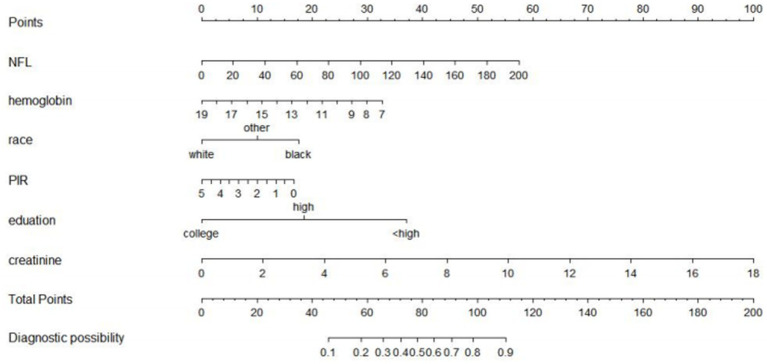
Methods: Using NHANES data, we conducted an analysis of cognitive test results for 450 adults aged 60 years and older and examined their correlation with serum NfL levels. When exploring the association between cognitive test scores and serum NfL levels, regression models and restricted cubic spline (RCS) regression models were employed to adjust for potential confounding factors. The least absolute shrinkage and selection operator (LASSO) regression was applied for identifying key cognitive impairment factors, which was then included in the establishment of a risk prediction nomogram model, with the receiver operating characteristic (ROC) curve being built to evaluate its discriminatory power for cognitive impairment.
Results: It was found that there is a strong positive correlation between serum NfL levels and both low total cognitive function (total-CF) OR: 1.028 (95%CI = 1.015-1.041 p < 0.001) and low Digit Symbol Substitution Test (DSST) OR: 1.026 (95%CI = 1.003-1.050, p = 0.027). Furthermore, using the RCS model, we observed a linear trend in the relationship between NfL and low total-CF. The nomogram model based on NfL identified by LASSO regression displayed a considerable predicative value for low total-CF, with an area under the curve [AUC = 85.6% (81.6-89.3%)].
Conclusion: There is a strong correlation between serum NfL levels and cognitive function, especially DSST, which reflects attention and information processing abilities, as well as overall cognitive function, but not memory and language fluency. Thus, NfL may serve as a serum biomarker for dementia monitoring.
期刊介绍:
Frontiers in Aging Neuroscience is a leading journal in its field, publishing rigorously peer-reviewed research that advances our understanding of the mechanisms of Central Nervous System aging and age-related neural diseases. Specialty Chief Editor Thomas Wisniewski at the New York University School of Medicine is supported by an outstanding Editorial Board of international researchers. This multidisciplinary open-access journal is at the forefront of disseminating and communicating scientific knowledge and impactful discoveries to researchers, academics, clinicians and the public worldwide.






 京公网安备 11010802042870号
京ICP备2023020795号-1
京公网安备 11010802042870号
京ICP备2023020795号-1

 分享
分享
 求助内容:
求助内容: 应助结果提醒方式:
 扫码关注我们
