Chunxue Zhuo, Chengcheng Wang, Pinliang Xie, Zhiyuan Kuang, Yuyang Zhang, Junjie Feng, Mian Dai, Nana Chen, Lei Xu, Xiaozhen Li, Jin Chang, Jianpu Wang
{"title":"高效碘化铯铜发光二极管中添加剂- cs +相互作用的调控","authors":"Chunxue Zhuo, Chengcheng Wang, Pinliang Xie, Zhiyuan Kuang, Yuyang Zhang, Junjie Feng, Mian Dai, Nana Chen, Lei Xu, Xiaozhen Li, Jin Chang, Jianpu Wang","doi":"10.1021/acsphotonics.4c02485","DOIUrl":null,"url":null,"abstract":"Molecular additives are widely used to improve the film quality and optoelectronic performance of solution-processed metal halides, owing to their diverse interactions with metal-halide precursors. However, the relationship between additive-precursor interaction strength and the optoelectronic performance of metal halides remains unclear. In this study, we investigate cesium copper iodide (Cs–Cu–I) light-emitting diodes (LEDs) incorporating crown ether (CE) additives and demonstrate that the additive-Cs<sup>+</sup> interactions can significantly influence the device performance. By regulating the additive-Cs<sup>+</sup> interaction strength, we achieve Cs–Cu–I LEDs with a peak external quantum efficiency of 4.5%, over 20 times higher than that of the control device. The remarkable EQE enhancement is primarily attributed to the suitable additive-Cs<sup>+</sup> interactions, which enable a gradual release of free precursors to participate in the crystallization of Cs–Cu–I, thus improving the crystalline quality of emissive films. This work not only provides valuable insights into the rational design of molecular additives for copper halide LEDs but also offers guidance for other metal halide optoelectronic devices, particularly those involving additive-precursor interactions.","PeriodicalId":23,"journal":{"name":"ACS Photonics","volume":"40 1","pages":""},"PeriodicalIF":6.0000,"publicationDate":"2025-02-06","publicationTypes":"Journal Article","fieldsOfStudy":null,"isOpenAccess":false,"openAccessPdf":"","citationCount":"0","resultStr":"{\"title\":\"Regulation of Additive-Cs+ Interactions for Efficient Cesium Copper Iodide Light-Emitting Diodes\",\"authors\":\"Chunxue Zhuo, Chengcheng Wang, Pinliang Xie, Zhiyuan Kuang, Yuyang Zhang, Junjie Feng, Mian Dai, Nana Chen, Lei Xu, Xiaozhen Li, Jin Chang, Jianpu Wang\",\"doi\":\"10.1021/acsphotonics.4c02485\",\"DOIUrl\":null,\"url\":null,\"abstract\":\"Molecular additives are widely used to improve the film quality and optoelectronic performance of solution-processed metal halides, owing to their diverse interactions with metal-halide precursors. However, the relationship between additive-precursor interaction strength and the optoelectronic performance of metal halides remains unclear. In this study, we investigate cesium copper iodide (Cs–Cu–I) light-emitting diodes (LEDs) incorporating crown ether (CE) additives and demonstrate that the additive-Cs<sup>+</sup> interactions can significantly influence the device performance. By regulating the additive-Cs<sup>+</sup> interaction strength, we achieve Cs–Cu–I LEDs with a peak external quantum efficiency of 4.5%, over 20 times higher than that of the control device. The remarkable EQE enhancement is primarily attributed to the suitable additive-Cs<sup>+</sup> interactions, which enable a gradual release of free precursors to participate in the crystallization of Cs–Cu–I, thus improving the crystalline quality of emissive films. This work not only provides valuable insights into the rational design of molecular additives for copper halide LEDs but also offers guidance for other metal halide optoelectronic devices, particularly those involving additive-precursor interactions.\",\"PeriodicalId\":23,\"journal\":{\"name\":\"ACS Photonics\",\"volume\":\"40 1\",\"pages\":\"\"},\"PeriodicalIF\":6.0000,\"publicationDate\":\"2025-02-06\",\"publicationTypes\":\"Journal Article\",\"fieldsOfStudy\":null,\"isOpenAccess\":false,\"openAccessPdf\":\"\",\"citationCount\":\"0\",\"resultStr\":null,\"platform\":\"Semanticscholar\",\"paperid\":null,\"PeriodicalName\":\"ACS Photonics\",\"FirstCategoryId\":\"101\",\"ListUrlMain\":\"https://doi.org/10.1021/acsphotonics.4c02485\",\"RegionNum\":1,\"RegionCategory\":\"物理与天体物理\",\"ArticlePicture\":[],\"TitleCN\":null,\"AbstractTextCN\":null,\"PMCID\":null,\"EPubDate\":\"\",\"PubModel\":\"\",\"JCR\":\"Q1\",\"JCRName\":\"MATERIALS SCIENCE, MULTIDISCIPLINARY\",\"Score\":null,\"Total\":0}","platform":"Semanticscholar","paperid":null,"PeriodicalName":"ACS Photonics","FirstCategoryId":"101","ListUrlMain":"https://doi.org/10.1021/acsphotonics.4c02485","RegionNum":1,"RegionCategory":"物理与天体物理","ArticlePicture":[],"TitleCN":null,"AbstractTextCN":null,"PMCID":null,"EPubDate":"","PubModel":"","JCR":"Q1","JCRName":"MATERIALS SCIENCE, MULTIDISCIPLINARY","Score":null,"Total":0}
Regulation of Additive-Cs+ Interactions for Efficient Cesium Copper Iodide Light-Emitting Diodes
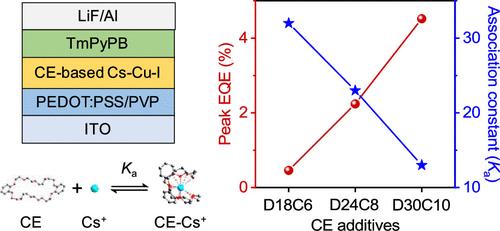
Molecular additives are widely used to improve the film quality and optoelectronic performance of solution-processed metal halides, owing to their diverse interactions with metal-halide precursors. However, the relationship between additive-precursor interaction strength and the optoelectronic performance of metal halides remains unclear. In this study, we investigate cesium copper iodide (Cs–Cu–I) light-emitting diodes (LEDs) incorporating crown ether (CE) additives and demonstrate that the additive-Cs+ interactions can significantly influence the device performance. By regulating the additive-Cs+ interaction strength, we achieve Cs–Cu–I LEDs with a peak external quantum efficiency of 4.5%, over 20 times higher than that of the control device. The remarkable EQE enhancement is primarily attributed to the suitable additive-Cs+ interactions, which enable a gradual release of free precursors to participate in the crystallization of Cs–Cu–I, thus improving the crystalline quality of emissive films. This work not only provides valuable insights into the rational design of molecular additives for copper halide LEDs but also offers guidance for other metal halide optoelectronic devices, particularly those involving additive-precursor interactions.
期刊介绍:
Published as soon as accepted and summarized in monthly issues, ACS Photonics will publish Research Articles, Letters, Perspectives, and Reviews, to encompass the full scope of published research in this field.




 京公网安备 11010802042870号
京ICP备2023020795号-1
京公网安备 11010802042870号
京ICP备2023020795号-1

 分享
分享
 求助内容:
求助内容: 应助结果提醒方式:
 扫码关注我们
