D. A. Chaplygina, O. V. Patrusheva, C. Chen, A. V. Shtareva, C. C. Stoumpos, R. Kevorkyants, A. V. Emeline and D. S. Shtarev
{"title":"环取代基位置对新型准低维杂化2-、3-和4-(溴乙基)吡啶溴化铅结构和光电性能的影响","authors":"D. A. Chaplygina, O. V. Patrusheva, C. Chen, A. V. Shtareva, C. C. Stoumpos, R. Kevorkyants, A. V. Emeline and D. S. Shtarev","doi":"10.1039/D4DT02158D","DOIUrl":null,"url":null,"abstract":"<p >In this work, the synthesis, crystal structure, morphology, and optoelectronic properties of novel quasi low-dimensional hybrid (bromomethyl)pyridinium crystalline phases (2-BrCH<small><sub>2</sub></small>PyH)Pb<small><sub>2</sub></small>Br<small><sub>5</sub></small>, (3-BrCH<small><sub>2</sub></small>PyH)PbBr<small><sub>3</sub></small>, and (4-BrCH<small><sub>2</sub></small>PyH)PbBr<small><sub>3</sub></small> are reported. The first compound formed quasi 2D crystals, while the other two species crystallized as quasi 1D structures. DFT calculations predicted that the bromides are semiconductors featuring electronic VB-to-CB transitions of ∼3.2 eV. (2-BrCH<small><sub>2</sub></small>PyH)Pb<small><sub>2</sub></small>Br<small><sub>5</sub></small> and (3-BrCH<small><sub>2</sub></small>PyH)PbBr<small><sub>3</sub></small> exhibited low-temperature (77 K) photoluminescence (PL). However, PL was not observed in (4-BrCH<small><sub>2</sub></small>PyH)PbBr<small><sub>3</sub></small>, which was presumably due to the small distance between the lead cations and bromine atoms of the 4-BrCH<small><sub>2</sub></small>PyH cations, resulting in a radiationless electronic transition. Furthermore, the studied species demonstrated quantum size effects.</p>","PeriodicalId":71,"journal":{"name":"Dalton Transactions","volume":" 11","pages":" 4608-4618"},"PeriodicalIF":3.3000,"publicationDate":"2025-02-06","publicationTypes":"Journal Article","fieldsOfStudy":null,"isOpenAccess":false,"openAccessPdf":"","citationCount":"0","resultStr":"{\"title\":\"Effect of ring substituent position on the structural and optoelectronic properties of novel quasi low-dimensional hybrid 2-, 3-, and 4-(bromomethyl)pyridinium lead bromides†\",\"authors\":\"D. A. Chaplygina, O. V. Patrusheva, C. Chen, A. V. Shtareva, C. C. Stoumpos, R. Kevorkyants, A. V. Emeline and D. S. Shtarev\",\"doi\":\"10.1039/D4DT02158D\",\"DOIUrl\":null,\"url\":null,\"abstract\":\"<p >In this work, the synthesis, crystal structure, morphology, and optoelectronic properties of novel quasi low-dimensional hybrid (bromomethyl)pyridinium crystalline phases (2-BrCH<small><sub>2</sub></small>PyH)Pb<small><sub>2</sub></small>Br<small><sub>5</sub></small>, (3-BrCH<small><sub>2</sub></small>PyH)PbBr<small><sub>3</sub></small>, and (4-BrCH<small><sub>2</sub></small>PyH)PbBr<small><sub>3</sub></small> are reported. The first compound formed quasi 2D crystals, while the other two species crystallized as quasi 1D structures. DFT calculations predicted that the bromides are semiconductors featuring electronic VB-to-CB transitions of ∼3.2 eV. (2-BrCH<small><sub>2</sub></small>PyH)Pb<small><sub>2</sub></small>Br<small><sub>5</sub></small> and (3-BrCH<small><sub>2</sub></small>PyH)PbBr<small><sub>3</sub></small> exhibited low-temperature (77 K) photoluminescence (PL). However, PL was not observed in (4-BrCH<small><sub>2</sub></small>PyH)PbBr<small><sub>3</sub></small>, which was presumably due to the small distance between the lead cations and bromine atoms of the 4-BrCH<small><sub>2</sub></small>PyH cations, resulting in a radiationless electronic transition. Furthermore, the studied species demonstrated quantum size effects.</p>\",\"PeriodicalId\":71,\"journal\":{\"name\":\"Dalton Transactions\",\"volume\":\" 11\",\"pages\":\" 4608-4618\"},\"PeriodicalIF\":3.3000,\"publicationDate\":\"2025-02-06\",\"publicationTypes\":\"Journal Article\",\"fieldsOfStudy\":null,\"isOpenAccess\":false,\"openAccessPdf\":\"\",\"citationCount\":\"0\",\"resultStr\":null,\"platform\":\"Semanticscholar\",\"paperid\":null,\"PeriodicalName\":\"Dalton Transactions\",\"FirstCategoryId\":\"92\",\"ListUrlMain\":\"https://pubs.rsc.org/en/content/articlelanding/2025/dt/d4dt02158d\",\"RegionNum\":3,\"RegionCategory\":\"化学\",\"ArticlePicture\":[],\"TitleCN\":null,\"AbstractTextCN\":null,\"PMCID\":null,\"EPubDate\":\"\",\"PubModel\":\"\",\"JCR\":\"Q2\",\"JCRName\":\"CHEMISTRY, INORGANIC & NUCLEAR\",\"Score\":null,\"Total\":0}","platform":"Semanticscholar","paperid":null,"PeriodicalName":"Dalton Transactions","FirstCategoryId":"92","ListUrlMain":"https://pubs.rsc.org/en/content/articlelanding/2025/dt/d4dt02158d","RegionNum":3,"RegionCategory":"化学","ArticlePicture":[],"TitleCN":null,"AbstractTextCN":null,"PMCID":null,"EPubDate":"","PubModel":"","JCR":"Q2","JCRName":"CHEMISTRY, INORGANIC & NUCLEAR","Score":null,"Total":0}
Effect of ring substituent position on the structural and optoelectronic properties of novel quasi low-dimensional hybrid 2-, 3-, and 4-(bromomethyl)pyridinium lead bromides†
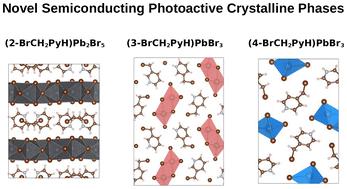
In this work, the synthesis, crystal structure, morphology, and optoelectronic properties of novel quasi low-dimensional hybrid (bromomethyl)pyridinium crystalline phases (2-BrCH2PyH)Pb2Br5, (3-BrCH2PyH)PbBr3, and (4-BrCH2PyH)PbBr3 are reported. The first compound formed quasi 2D crystals, while the other two species crystallized as quasi 1D structures. DFT calculations predicted that the bromides are semiconductors featuring electronic VB-to-CB transitions of ∼3.2 eV. (2-BrCH2PyH)Pb2Br5 and (3-BrCH2PyH)PbBr3 exhibited low-temperature (77 K) photoluminescence (PL). However, PL was not observed in (4-BrCH2PyH)PbBr3, which was presumably due to the small distance between the lead cations and bromine atoms of the 4-BrCH2PyH cations, resulting in a radiationless electronic transition. Furthermore, the studied species demonstrated quantum size effects.
期刊介绍:
Dalton Transactions is a journal for all areas of inorganic chemistry, which encompasses the organometallic, bioinorganic and materials chemistry of the elements, with applications including synthesis, catalysis, energy conversion/storage, electrical devices and medicine. Dalton Transactions welcomes high-quality, original submissions in all of these areas and more, where the advancement of knowledge in inorganic chemistry is significant.




 京公网安备 11010802042870号
京ICP备2023020795号-1
京公网安备 11010802042870号
京ICP备2023020795号-1

 分享
分享
 求助内容:
求助内容: 应助结果提醒方式:
 扫码关注我们
