Jiazhu Xu , Jacob Brown , Rubia Shaik , Luis Soto-Garcia , Jun Liao , Kytai Nguyen , Ge Zhang , Yi Hong
{"title":"含SDF-1α释放的可注射心肌源性水凝胶用于心脏修复","authors":"Jiazhu Xu , Jacob Brown , Rubia Shaik , Luis Soto-Garcia , Jun Liao , Kytai Nguyen , Ge Zhang , Yi Hong","doi":"10.1016/j.bioadv.2025.214203","DOIUrl":null,"url":null,"abstract":"<div><div>Myocardial infarction (MI) is a predominant cause of morbidity and mortality globally. Therapeutic chemokines, such as stromal cell-derived factor 1α (SDF-1α), present a promising opportunity to treat the profibrotic remodeling post-MI if they can be delivered effectively to the injured tissue. However, direct injection of SDF-1α or physical entrapment in a hydrogel has shown limited efficacy. Here, we developed a sustained-release system consisting of SDF-1α loaded poly(lactic-<em>co</em>-glycolic acid) nanoparticles (PLGA NPs) and an injectable porcine cardiac decellularized extracellular matrix (cdECM) hydrogel. This system demonstrated a sustained release of SDF-1α over four weeks while there is one week release for SDF-1α directly encapsulated in the cdECM hydrogel during <em>in vitro</em> testing. The incorporation of PLGA NPs into the cdECM hydrogel significantly enhanced its mechanical properties, increasing the Young's modulus from 561 ± 228 kPa to 1007 ± 2 kPa and the maximum compressive strength from 639 ± 42 kPa to 1014 ± 101 kPa. This nanocomposite hydrogel showed good cell compatibility after 7 days of culture with H9C2 cells, while the released SDF-1α retained its bioactivity, as evidenced by its chemotactic effects <em>in vitro.</em> Furthermore, <em>in vivo</em> studies further highlighted its significant ability to promote angiogenesis in the infarcted area and improve cardiac function after intramyocardial injection. These results demonstrated the therapeutic potential of combining local release of SDF-1α with the cdECM hydrogel for MI treatment.</div></div>","PeriodicalId":51111,"journal":{"name":"Materials Science & Engineering C-Materials for Biological Applications","volume":"170 ","pages":"Article 214203"},"PeriodicalIF":6.0000,"publicationDate":"2025-05-01","publicationTypes":"Journal Article","fieldsOfStudy":null,"isOpenAccess":false,"openAccessPdf":"","citationCount":"0","resultStr":"{\"title\":\"Injectable myocardium-derived hydrogels with SDF-1α releasing for cardiac repair\",\"authors\":\"Jiazhu Xu , Jacob Brown , Rubia Shaik , Luis Soto-Garcia , Jun Liao , Kytai Nguyen , Ge Zhang , Yi Hong\",\"doi\":\"10.1016/j.bioadv.2025.214203\",\"DOIUrl\":null,\"url\":null,\"abstract\":\"<div><div>Myocardial infarction (MI) is a predominant cause of morbidity and mortality globally. Therapeutic chemokines, such as stromal cell-derived factor 1α (SDF-1α), present a promising opportunity to treat the profibrotic remodeling post-MI if they can be delivered effectively to the injured tissue. However, direct injection of SDF-1α or physical entrapment in a hydrogel has shown limited efficacy. Here, we developed a sustained-release system consisting of SDF-1α loaded poly(lactic-<em>co</em>-glycolic acid) nanoparticles (PLGA NPs) and an injectable porcine cardiac decellularized extracellular matrix (cdECM) hydrogel. This system demonstrated a sustained release of SDF-1α over four weeks while there is one week release for SDF-1α directly encapsulated in the cdECM hydrogel during <em>in vitro</em> testing. The incorporation of PLGA NPs into the cdECM hydrogel significantly enhanced its mechanical properties, increasing the Young's modulus from 561 ± 228 kPa to 1007 ± 2 kPa and the maximum compressive strength from 639 ± 42 kPa to 1014 ± 101 kPa. This nanocomposite hydrogel showed good cell compatibility after 7 days of culture with H9C2 cells, while the released SDF-1α retained its bioactivity, as evidenced by its chemotactic effects <em>in vitro.</em> Furthermore, <em>in vivo</em> studies further highlighted its significant ability to promote angiogenesis in the infarcted area and improve cardiac function after intramyocardial injection. These results demonstrated the therapeutic potential of combining local release of SDF-1α with the cdECM hydrogel for MI treatment.</div></div>\",\"PeriodicalId\":51111,\"journal\":{\"name\":\"Materials Science & Engineering C-Materials for Biological Applications\",\"volume\":\"170 \",\"pages\":\"Article 214203\"},\"PeriodicalIF\":6.0000,\"publicationDate\":\"2025-05-01\",\"publicationTypes\":\"Journal Article\",\"fieldsOfStudy\":null,\"isOpenAccess\":false,\"openAccessPdf\":\"\",\"citationCount\":\"0\",\"resultStr\":null,\"platform\":\"Semanticscholar\",\"paperid\":null,\"PeriodicalName\":\"Materials Science & Engineering C-Materials for Biological Applications\",\"FirstCategoryId\":\"1085\",\"ListUrlMain\":\"https://www.sciencedirect.com/science/article/pii/S2772950825000305\",\"RegionNum\":2,\"RegionCategory\":\"医学\",\"ArticlePicture\":[],\"TitleCN\":null,\"AbstractTextCN\":null,\"PMCID\":null,\"EPubDate\":\"2025/1/30 0:00:00\",\"PubModel\":\"Epub\",\"JCR\":\"Q2\",\"JCRName\":\"MATERIALS SCIENCE, BIOMATERIALS\",\"Score\":null,\"Total\":0}","platform":"Semanticscholar","paperid":null,"PeriodicalName":"Materials Science & Engineering C-Materials for Biological Applications","FirstCategoryId":"1085","ListUrlMain":"https://www.sciencedirect.com/science/article/pii/S2772950825000305","RegionNum":2,"RegionCategory":"医学","ArticlePicture":[],"TitleCN":null,"AbstractTextCN":null,"PMCID":null,"EPubDate":"2025/1/30 0:00:00","PubModel":"Epub","JCR":"Q2","JCRName":"MATERIALS SCIENCE, BIOMATERIALS","Score":null,"Total":0}
Injectable myocardium-derived hydrogels with SDF-1α releasing for cardiac repair
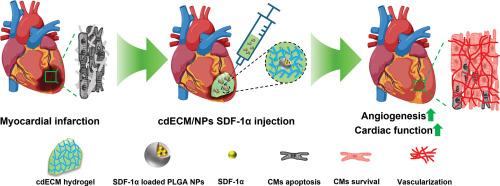
Myocardial infarction (MI) is a predominant cause of morbidity and mortality globally. Therapeutic chemokines, such as stromal cell-derived factor 1α (SDF-1α), present a promising opportunity to treat the profibrotic remodeling post-MI if they can be delivered effectively to the injured tissue. However, direct injection of SDF-1α or physical entrapment in a hydrogel has shown limited efficacy. Here, we developed a sustained-release system consisting of SDF-1α loaded poly(lactic-co-glycolic acid) nanoparticles (PLGA NPs) and an injectable porcine cardiac decellularized extracellular matrix (cdECM) hydrogel. This system demonstrated a sustained release of SDF-1α over four weeks while there is one week release for SDF-1α directly encapsulated in the cdECM hydrogel during in vitro testing. The incorporation of PLGA NPs into the cdECM hydrogel significantly enhanced its mechanical properties, increasing the Young's modulus from 561 ± 228 kPa to 1007 ± 2 kPa and the maximum compressive strength from 639 ± 42 kPa to 1014 ± 101 kPa. This nanocomposite hydrogel showed good cell compatibility after 7 days of culture with H9C2 cells, while the released SDF-1α retained its bioactivity, as evidenced by its chemotactic effects in vitro. Furthermore, in vivo studies further highlighted its significant ability to promote angiogenesis in the infarcted area and improve cardiac function after intramyocardial injection. These results demonstrated the therapeutic potential of combining local release of SDF-1α with the cdECM hydrogel for MI treatment.
期刊介绍:
Biomaterials Advances, previously known as Materials Science and Engineering: C-Materials for Biological Applications (P-ISSN: 0928-4931, E-ISSN: 1873-0191). Includes topics at the interface of the biomedical sciences and materials engineering. These topics include:
• Bioinspired and biomimetic materials for medical applications
• Materials of biological origin for medical applications
• Materials for "active" medical applications
• Self-assembling and self-healing materials for medical applications
• "Smart" (i.e., stimulus-response) materials for medical applications
• Ceramic, metallic, polymeric, and composite materials for medical applications
• Materials for in vivo sensing
• Materials for in vivo imaging
• Materials for delivery of pharmacologic agents and vaccines
• Novel approaches for characterizing and modeling materials for medical applications
Manuscripts on biological topics without a materials science component, or manuscripts on materials science without biological applications, will not be considered for publication in Materials Science and Engineering C. New submissions are first assessed for language, scope and originality (plagiarism check) and can be desk rejected before review if they need English language improvements, are out of scope or present excessive duplication with published sources.
Biomaterials Advances sits within Elsevier''s biomaterials science portfolio alongside Biomaterials, Materials Today Bio and Biomaterials and Biosystems. As part of the broader Materials Today family, Biomaterials Advances offers authors rigorous peer review, rapid decisions, and high visibility. We look forward to receiving your submissions!




 京公网安备 11010802042870号
京ICP备2023020795号-1
京公网安备 11010802042870号
京ICP备2023020795号-1

 分享
分享
 求助内容:
求助内容: 应助结果提醒方式:
 扫码关注我们
