L.E. Robles-Jimenez , S. Angeles , A.H. Ramirez-Perez , B. Fuente , V. Velazquez-Ordoñez , E. Cardoso-Gutierrez , M. Renna , L. Rastello , M.T. Capucchio , T. Hassan , L. Gasco , J.M. Pino-Moreno , N. Ghavipanje , I.A. Dominguez-Vara , M. Gonzalez-Ronquillo
{"title":"黄粉虫(tenbrio molitor)作为育肥羔羊蛋白质饲料新原料的体内外试验研究","authors":"L.E. Robles-Jimenez , S. Angeles , A.H. Ramirez-Perez , B. Fuente , V. Velazquez-Ordoñez , E. Cardoso-Gutierrez , M. Renna , L. Rastello , M.T. Capucchio , T. Hassan , L. Gasco , J.M. Pino-Moreno , N. Ghavipanje , I.A. Dominguez-Vara , M. Gonzalez-Ronquillo","doi":"10.1016/j.anifeedsci.2025.116224","DOIUrl":null,"url":null,"abstract":"<div><div>The quest for novel, alternative, and sustainable protein feed sources, including insects, has gained attraction by the feed industry. Here, two experiments (Exp.) explored the impacts of <em>Tenebrio molitor</em> meal (TMM) as a protein feed ingredient for fattening lambs, as compared to conventional plant-based and animal-based protein sources, namely soybean meal (SBM) and fish meal (FM), respectively. In Exp. 1, <em>in vitro</em> rumen gas kinetics and fermentation profile of three experimental diets [1- SBM at 150 g/kg dry matter (DM); 2- FM at 50 g/kg DM; and 3- TMM at 60 g/kg DM] were assessed using three fistulated lambs. In Exp. 2, twenty-four male Suffolk lambs [3 months of age; 24 ± 1.3 kg body weight (BW)] were randomly assigned for 30 days to one of the three experimental diets. Feed intake, digestibility, and nitrogen balance were assessed. At the end of the trial, the lambs were slaughtered, and samples of rumen (dorsal and ventral sacs), proximal intestine, and liver were collected and subjected to histomorphometric and histopathological evaluations. Data were analyzed using a general linear model and mixed models for the <em>in vitro</em> and <em>in vivo</em> trials, respectively; histopathological data were analyzed by a Kruskal-Wallis test. Results of Exp. 1 showed that total gas production was lower (<em>P</em> = 0.021; η<sup>2</sup> = 0.359), while DM disappearance (<em>P</em> = 0.021; η<sup>2</sup> = 0.233) and microbial crude protein production (<em>P</em> = 0.015; η<sup>2</sup> = 0.347) were higher, for the TMM diet when compared to the FM diet, while the SBM diet showed intermediate values. Results of Exp. 2 revealed that the DM intake of TMM-fed lambs was comparable to that of FM-fed lambs, but lower than that of SBM-fed lambs (<em>P</em> = 0.035; η<sup>2</sup> = 0.407). The average daily gain was the lowest in the TMM-fed lambs (<em>P</em> = 0.033; η<sup>2</sup> = 0.373), while the final BW remained unaffected by diet. Higher total tract apparent digestibility of DM and organic matter was obtained with the TMM and FM diets than with the SBM diet (<em>P</em> < 0.001; η<sup>2</sup> = 0.411 and 0.408, respectively). Nitrogen balance ranked in the following order: FM > TMM > SBM (<em>P</em> < 0.001; η<sup>2</sup> = 0.385). Ruminal morphometric indexes (i.e., papillae length and width, absorption area, and thickness of mucosa, submucosa and muscular layers) were not affected by diet. When compared to SBM-fed lambs, the TMM- and FM-fed ones exhibited significantly lower severity of epithelial keratinization in the ruminal dorsal sac (<em>P</em> = 0.034; ε<sup>2</sup> = 0.299). Intestinal inflammation was predominantly characterized by mononuclear cells and eosinophils in the TMM and SBM groups, respectively. No differences among the experimental groups were observed for other histopathological features at rumen, intestine, and liver levels. Overall, our results suggest that TMM can be used as a protein source for fattening lambs, but further studies should explore its use in combination with conventional protein sources to optimize the performance of lambs.</div></div>","PeriodicalId":7861,"journal":{"name":"Animal Feed Science and Technology","volume":"320 ","pages":"Article 116224"},"PeriodicalIF":2.7000,"publicationDate":"2025-02-01","publicationTypes":"Journal Article","fieldsOfStudy":null,"isOpenAccess":false,"openAccessPdf":"","citationCount":"0","resultStr":"{\"title\":\"In vitro and in vivo investigations on the use of yellow mealworm (Tenebrio molitor) as a novel protein feed ingredient for fattening lambs\",\"authors\":\"L.E. Robles-Jimenez , S. Angeles , A.H. Ramirez-Perez , B. Fuente , V. Velazquez-Ordoñez , E. Cardoso-Gutierrez , M. Renna , L. Rastello , M.T. Capucchio , T. Hassan , L. Gasco , J.M. Pino-Moreno , N. Ghavipanje , I.A. Dominguez-Vara , M. Gonzalez-Ronquillo\",\"doi\":\"10.1016/j.anifeedsci.2025.116224\",\"DOIUrl\":null,\"url\":null,\"abstract\":\"<div><div>The quest for novel, alternative, and sustainable protein feed sources, including insects, has gained attraction by the feed industry. Here, two experiments (Exp.) explored the impacts of <em>Tenebrio molitor</em> meal (TMM) as a protein feed ingredient for fattening lambs, as compared to conventional plant-based and animal-based protein sources, namely soybean meal (SBM) and fish meal (FM), respectively. In Exp. 1, <em>in vitro</em> rumen gas kinetics and fermentation profile of three experimental diets [1- SBM at 150 g/kg dry matter (DM); 2- FM at 50 g/kg DM; and 3- TMM at 60 g/kg DM] were assessed using three fistulated lambs. In Exp. 2, twenty-four male Suffolk lambs [3 months of age; 24 ± 1.3 kg body weight (BW)] were randomly assigned for 30 days to one of the three experimental diets. Feed intake, digestibility, and nitrogen balance were assessed. At the end of the trial, the lambs were slaughtered, and samples of rumen (dorsal and ventral sacs), proximal intestine, and liver were collected and subjected to histomorphometric and histopathological evaluations. Data were analyzed using a general linear model and mixed models for the <em>in vitro</em> and <em>in vivo</em> trials, respectively; histopathological data were analyzed by a Kruskal-Wallis test. Results of Exp. 1 showed that total gas production was lower (<em>P</em> = 0.021; η<sup>2</sup> = 0.359), while DM disappearance (<em>P</em> = 0.021; η<sup>2</sup> = 0.233) and microbial crude protein production (<em>P</em> = 0.015; η<sup>2</sup> = 0.347) were higher, for the TMM diet when compared to the FM diet, while the SBM diet showed intermediate values. Results of Exp. 2 revealed that the DM intake of TMM-fed lambs was comparable to that of FM-fed lambs, but lower than that of SBM-fed lambs (<em>P</em> = 0.035; η<sup>2</sup> = 0.407). The average daily gain was the lowest in the TMM-fed lambs (<em>P</em> = 0.033; η<sup>2</sup> = 0.373), while the final BW remained unaffected by diet. Higher total tract apparent digestibility of DM and organic matter was obtained with the TMM and FM diets than with the SBM diet (<em>P</em> < 0.001; η<sup>2</sup> = 0.411 and 0.408, respectively). Nitrogen balance ranked in the following order: FM > TMM > SBM (<em>P</em> < 0.001; η<sup>2</sup> = 0.385). Ruminal morphometric indexes (i.e., papillae length and width, absorption area, and thickness of mucosa, submucosa and muscular layers) were not affected by diet. When compared to SBM-fed lambs, the TMM- and FM-fed ones exhibited significantly lower severity of epithelial keratinization in the ruminal dorsal sac (<em>P</em> = 0.034; ε<sup>2</sup> = 0.299). Intestinal inflammation was predominantly characterized by mononuclear cells and eosinophils in the TMM and SBM groups, respectively. No differences among the experimental groups were observed for other histopathological features at rumen, intestine, and liver levels. Overall, our results suggest that TMM can be used as a protein source for fattening lambs, but further studies should explore its use in combination with conventional protein sources to optimize the performance of lambs.</div></div>\",\"PeriodicalId\":7861,\"journal\":{\"name\":\"Animal Feed Science and Technology\",\"volume\":\"320 \",\"pages\":\"Article 116224\"},\"PeriodicalIF\":2.7000,\"publicationDate\":\"2025-02-01\",\"publicationTypes\":\"Journal Article\",\"fieldsOfStudy\":null,\"isOpenAccess\":false,\"openAccessPdf\":\"\",\"citationCount\":\"0\",\"resultStr\":null,\"platform\":\"Semanticscholar\",\"paperid\":null,\"PeriodicalName\":\"Animal Feed Science and Technology\",\"FirstCategoryId\":\"97\",\"ListUrlMain\":\"https://www.sciencedirect.com/science/article/pii/S0377840125000197\",\"RegionNum\":2,\"RegionCategory\":\"农林科学\",\"ArticlePicture\":[],\"TitleCN\":null,\"AbstractTextCN\":null,\"PMCID\":null,\"EPubDate\":\"2025/1/10 0:00:00\",\"PubModel\":\"Epub\",\"JCR\":\"Q1\",\"JCRName\":\"AGRICULTURE, DAIRY & ANIMAL SCIENCE\",\"Score\":null,\"Total\":0}","platform":"Semanticscholar","paperid":null,"PeriodicalName":"Animal Feed Science and Technology","FirstCategoryId":"97","ListUrlMain":"https://www.sciencedirect.com/science/article/pii/S0377840125000197","RegionNum":2,"RegionCategory":"农林科学","ArticlePicture":[],"TitleCN":null,"AbstractTextCN":null,"PMCID":null,"EPubDate":"2025/1/10 0:00:00","PubModel":"Epub","JCR":"Q1","JCRName":"AGRICULTURE, DAIRY & ANIMAL SCIENCE","Score":null,"Total":0}
In vitro and in vivo investigations on the use of yellow mealworm (Tenebrio molitor) as a novel protein feed ingredient for fattening lambs
The quest for novel, alternative, and sustainable protein feed sources, including insects, has gained attraction by the feed industry. Here, two experiments (Exp.) explored the impacts of Tenebrio molitor meal (TMM) as a protein feed ingredient for fattening lambs, as compared to conventional plant-based and animal-based protein sources, namely soybean meal (SBM) and fish meal (FM), respectively. In Exp. 1, in vitro rumen gas kinetics and fermentation profile of three experimental diets [1- SBM at 150 g/kg dry matter (DM); 2- FM at 50 g/kg DM; and 3- TMM at 60 g/kg DM] were assessed using three fistulated lambs. In Exp. 2, twenty-four male Suffolk lambs [3 months of age; 24 ± 1.3 kg body weight (BW)] were randomly assigned for 30 days to one of the three experimental diets. Feed intake, digestibility, and nitrogen balance were assessed. At the end of the trial, the lambs were slaughtered, and samples of rumen (dorsal and ventral sacs), proximal intestine, and liver were collected and subjected to histomorphometric and histopathological evaluations. Data were analyzed using a general linear model and mixed models for the in vitro and in vivo trials, respectively; histopathological data were analyzed by a Kruskal-Wallis test. Results of Exp. 1 showed that total gas production was lower (P = 0.021; η2 = 0.359), while DM disappearance (P = 0.021; η2 = 0.233) and microbial crude protein production (P = 0.015; η2 = 0.347) were higher, for the TMM diet when compared to the FM diet, while the SBM diet showed intermediate values. Results of Exp. 2 revealed that the DM intake of TMM-fed lambs was comparable to that of FM-fed lambs, but lower than that of SBM-fed lambs (P = 0.035; η2 = 0.407). The average daily gain was the lowest in the TMM-fed lambs (P = 0.033; η2 = 0.373), while the final BW remained unaffected by diet. Higher total tract apparent digestibility of DM and organic matter was obtained with the TMM and FM diets than with the SBM diet (P < 0.001; η2 = 0.411 and 0.408, respectively). Nitrogen balance ranked in the following order: FM > TMM > SBM (P < 0.001; η2 = 0.385). Ruminal morphometric indexes (i.e., papillae length and width, absorption area, and thickness of mucosa, submucosa and muscular layers) were not affected by diet. When compared to SBM-fed lambs, the TMM- and FM-fed ones exhibited significantly lower severity of epithelial keratinization in the ruminal dorsal sac (P = 0.034; ε2 = 0.299). Intestinal inflammation was predominantly characterized by mononuclear cells and eosinophils in the TMM and SBM groups, respectively. No differences among the experimental groups were observed for other histopathological features at rumen, intestine, and liver levels. Overall, our results suggest that TMM can be used as a protein source for fattening lambs, but further studies should explore its use in combination with conventional protein sources to optimize the performance of lambs.
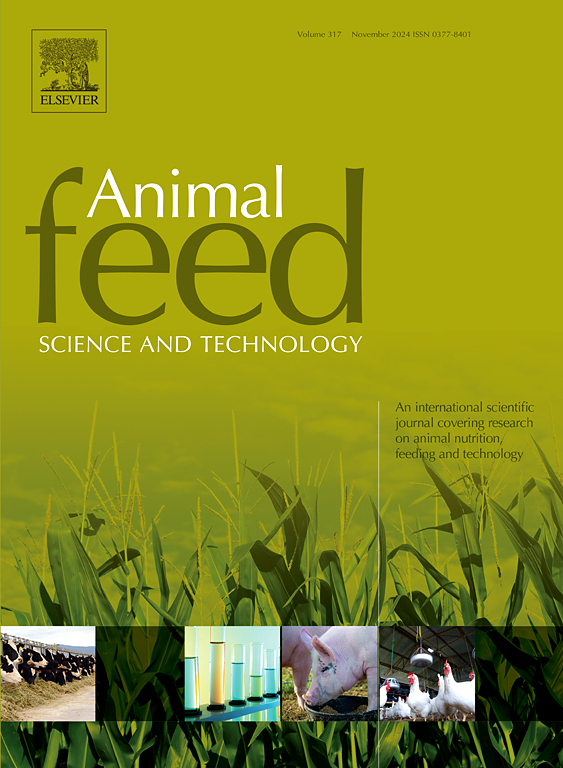
期刊介绍:
Animal Feed Science and Technology is a unique journal publishing scientific papers of international interest focusing on animal feeds and their feeding.
Papers describing research on feed for ruminants and non-ruminants, including poultry, horses, companion animals and aquatic animals, are welcome.
The journal covers the following areas:
Nutritive value of feeds (e.g., assessment, improvement)
Methods of conserving and processing feeds that affect their nutritional value
Agronomic and climatic factors influencing the nutritive value of feeds
Utilization of feeds and the improvement of such
Metabolic, production, reproduction and health responses, as well as potential environmental impacts, of diet inputs and feed technologies (e.g., feeds, feed additives, feed components, mycotoxins)
Mathematical models relating directly to animal-feed interactions
Analytical and experimental methods for feed evaluation
Environmental impacts of feed technologies in animal production.




 京公网安备 11010802042870号
京ICP备2023020795号-1
京公网安备 11010802042870号
京ICP备2023020795号-1

 分享
分享
 求助内容:
求助内容: 应助结果提醒方式:
 扫码关注我们
