{"title":"Mu2e实验状态","authors":"S. Miscetti, Mu2e Collaboration","doi":"10.1016/j.nima.2025.170257","DOIUrl":null,"url":null,"abstract":"<div><div>The Mu2e experiment at Fermilab searches for the coherent, neutrino-less conversion of a <span><math><msup><mrow><mi>μ</mi></mrow><mrow><mo>−</mo></mrow></msup></math></span> to e<span><math><msup><mrow></mrow><mrow><mo>−</mo></mrow></msup></math></span> in the Coulomb field of Al nuclei, that represents one of the cleanest Charged Lepton Flavor Violating (CLFV) processes for exploring Beyond the Standard Model (BSM) physics. Mu2e aims to improve previous sensitivity by four orders of magnitude, with a distinctive signature provided by identifying mono-energetic electrons with energy slightly below the muon rest mass. To reach this goal, the experiment will use the highest intensity pulsed muon beam in the world, with up to 6<span><math><mrow><mo>×</mo><mn>1</mn><msup><mrow><mn>0</mn></mrow><mrow><mn>9</mn></mrow></msup></mrow></math></span> stopped muons/sec. This is achieved using the Fermilab proton beam and the design and realization of a unique 25 m long superconducting solenoidal system. The high beam intensity relies upon minimizing beam losses in the slow extraction region, indicating an opportunity of using bent crystals for shadowing. A high-resolution straw tracker and a fast CsI crystal calorimeter identify the conversion electron. Both detectors are inserted behind the Stopping Target in the last solenoid section. A Cosmic Ray Veto covers a large part of the solenoids to suppress background produced by cosmic rays. In this paper, we report the details of the experimental layout, the construction status of the magnetic system and detectors, and a short description of the simulation and realization of the bent crystals. Performing crystal channeling in front of the first slow extraction septa will allow beam shadowing and largely reduce beam losses.</div></div>","PeriodicalId":19359,"journal":{"name":"Nuclear Instruments & Methods in Physics Research Section A-accelerators Spectrometers Detectors and Associated Equipment","volume":"1073 ","pages":"Article 170257"},"PeriodicalIF":1.5000,"publicationDate":"2025-04-01","publicationTypes":"Journal Article","fieldsOfStudy":null,"isOpenAccess":false,"openAccessPdf":"","citationCount":"0","resultStr":"{\"title\":\"Status of the Mu2e experiment\",\"authors\":\"S. Miscetti, Mu2e Collaboration\",\"doi\":\"10.1016/j.nima.2025.170257\",\"DOIUrl\":null,\"url\":null,\"abstract\":\"<div><div>The Mu2e experiment at Fermilab searches for the coherent, neutrino-less conversion of a <span><math><msup><mrow><mi>μ</mi></mrow><mrow><mo>−</mo></mrow></msup></math></span> to e<span><math><msup><mrow></mrow><mrow><mo>−</mo></mrow></msup></math></span> in the Coulomb field of Al nuclei, that represents one of the cleanest Charged Lepton Flavor Violating (CLFV) processes for exploring Beyond the Standard Model (BSM) physics. Mu2e aims to improve previous sensitivity by four orders of magnitude, with a distinctive signature provided by identifying mono-energetic electrons with energy slightly below the muon rest mass. To reach this goal, the experiment will use the highest intensity pulsed muon beam in the world, with up to 6<span><math><mrow><mo>×</mo><mn>1</mn><msup><mrow><mn>0</mn></mrow><mrow><mn>9</mn></mrow></msup></mrow></math></span> stopped muons/sec. This is achieved using the Fermilab proton beam and the design and realization of a unique 25 m long superconducting solenoidal system. The high beam intensity relies upon minimizing beam losses in the slow extraction region, indicating an opportunity of using bent crystals for shadowing. A high-resolution straw tracker and a fast CsI crystal calorimeter identify the conversion electron. Both detectors are inserted behind the Stopping Target in the last solenoid section. A Cosmic Ray Veto covers a large part of the solenoids to suppress background produced by cosmic rays. In this paper, we report the details of the experimental layout, the construction status of the magnetic system and detectors, and a short description of the simulation and realization of the bent crystals. Performing crystal channeling in front of the first slow extraction septa will allow beam shadowing and largely reduce beam losses.</div></div>\",\"PeriodicalId\":19359,\"journal\":{\"name\":\"Nuclear Instruments & Methods in Physics Research Section A-accelerators Spectrometers Detectors and Associated Equipment\",\"volume\":\"1073 \",\"pages\":\"Article 170257\"},\"PeriodicalIF\":1.5000,\"publicationDate\":\"2025-04-01\",\"publicationTypes\":\"Journal Article\",\"fieldsOfStudy\":null,\"isOpenAccess\":false,\"openAccessPdf\":\"\",\"citationCount\":\"0\",\"resultStr\":null,\"platform\":\"Semanticscholar\",\"paperid\":null,\"PeriodicalName\":\"Nuclear Instruments & Methods in Physics Research Section A-accelerators Spectrometers Detectors and Associated Equipment\",\"FirstCategoryId\":\"101\",\"ListUrlMain\":\"https://www.sciencedirect.com/science/article/pii/S0168900225000580\",\"RegionNum\":3,\"RegionCategory\":\"物理与天体物理\",\"ArticlePicture\":[],\"TitleCN\":null,\"AbstractTextCN\":null,\"PMCID\":null,\"EPubDate\":\"2025/1/31 0:00:00\",\"PubModel\":\"Epub\",\"JCR\":\"Q3\",\"JCRName\":\"INSTRUMENTS & INSTRUMENTATION\",\"Score\":null,\"Total\":0}","platform":"Semanticscholar","paperid":null,"PeriodicalName":"Nuclear Instruments & Methods in Physics Research Section A-accelerators Spectrometers Detectors and Associated Equipment","FirstCategoryId":"101","ListUrlMain":"https://www.sciencedirect.com/science/article/pii/S0168900225000580","RegionNum":3,"RegionCategory":"物理与天体物理","ArticlePicture":[],"TitleCN":null,"AbstractTextCN":null,"PMCID":null,"EPubDate":"2025/1/31 0:00:00","PubModel":"Epub","JCR":"Q3","JCRName":"INSTRUMENTS & INSTRUMENTATION","Score":null,"Total":0}
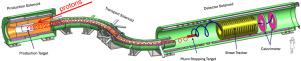
The Mu2e experiment at Fermilab searches for the coherent, neutrino-less conversion of a to e in the Coulomb field of Al nuclei, that represents one of the cleanest Charged Lepton Flavor Violating (CLFV) processes for exploring Beyond the Standard Model (BSM) physics. Mu2e aims to improve previous sensitivity by four orders of magnitude, with a distinctive signature provided by identifying mono-energetic electrons with energy slightly below the muon rest mass. To reach this goal, the experiment will use the highest intensity pulsed muon beam in the world, with up to 6 stopped muons/sec. This is achieved using the Fermilab proton beam and the design and realization of a unique 25 m long superconducting solenoidal system. The high beam intensity relies upon minimizing beam losses in the slow extraction region, indicating an opportunity of using bent crystals for shadowing. A high-resolution straw tracker and a fast CsI crystal calorimeter identify the conversion electron. Both detectors are inserted behind the Stopping Target in the last solenoid section. A Cosmic Ray Veto covers a large part of the solenoids to suppress background produced by cosmic rays. In this paper, we report the details of the experimental layout, the construction status of the magnetic system and detectors, and a short description of the simulation and realization of the bent crystals. Performing crystal channeling in front of the first slow extraction septa will allow beam shadowing and largely reduce beam losses.
期刊介绍:
Section A of Nuclear Instruments and Methods in Physics Research publishes papers on design, manufacturing and performance of scientific instruments with an emphasis on large scale facilities. This includes the development of particle accelerators, ion sources, beam transport systems and target arrangements as well as the use of secondary phenomena such as synchrotron radiation and free electron lasers. It also includes all types of instrumentation for the detection and spectrometry of radiations from high energy processes and nuclear decays, as well as instrumentation for experiments at nuclear reactors. Specialized electronics for nuclear and other types of spectrometry as well as computerization of measurements and control systems in this area also find their place in the A section.
Theoretical as well as experimental papers are accepted.




 京公网安备 11010802042870号
京ICP备2023020795号-1
京公网安备 11010802042870号
京ICP备2023020795号-1

 分享
分享
 求助内容:
求助内容: 应助结果提醒方式:
 扫码关注我们
