Ju Cheng , Lei Zhang , Weigui Fu , Zihan An , Meixiu Sun , Yiping Zhao , Li Chen
{"title":"Al2O3中空纤维膜上自清洁梯度多层TiO2涂层的构建强化明胶净化","authors":"Ju Cheng , Lei Zhang , Weigui Fu , Zihan An , Meixiu Sun , Yiping Zhao , Li Chen","doi":"10.1016/j.ceramint.2024.11.427","DOIUrl":null,"url":null,"abstract":"<div><div>Gelatin, a natural protein, is extensively used in the food, pharmaceutical, and cosmetics industries. However, purifying gelatin to meet the specific requirements of various industries remains a considerable challenge. Ceramic membrane separation technology, renowned for its high permeability, excellent anti-fouling properties, and long lifespan, has been widely applied in the food, biotechnology, and water purification industries. In this study, a sol-gel method was employed to fabricate a gradient multilayer TiO<sub>2</sub>-modified coating on the surface of an α-Al<sub>2</sub>O<sub>3</sub> porous ceramic membrane. The viscosity of the TiO<sub>2</sub> sols was adjusted by varying the concentrations of polyethylene glycol (PEG 2000) and aging times. The results indicated that coating the C-P5^5 composite membrane with a sol containing 5 wt% PEG, aged for different durations (2, 5, 10, 15, and 18 d), effectively reduced the weight-average molecular weight (<em>M</em><sub>w</sub>) of the permeate from the feed solution of 52.4 kDa–11.9 kDa. However, the C-P10^5 composite membrane, with a 10 wt% PEG content and aged for the same durations, yielded a permeate gelatin <em>M</em><sub>w</sub> of 13.6 kDa. The composite membrane with excellent anti-fouling and photocatalytic self-cleaning properties holds promise for innovative applications in gelatin purification and bio-separation processes.</div></div>","PeriodicalId":267,"journal":{"name":"Ceramics International","volume":"51 4","pages":"Pages 4521-4531"},"PeriodicalIF":5.6000,"publicationDate":"2025-02-01","publicationTypes":"Journal Article","fieldsOfStudy":null,"isOpenAccess":false,"openAccessPdf":"","citationCount":"0","resultStr":"{\"title\":\"Construction of self-cleaning gradient multilayer TiO2 coating on Al2O3 hollow fiber membrane for enhanced gelatin purification\",\"authors\":\"Ju Cheng , Lei Zhang , Weigui Fu , Zihan An , Meixiu Sun , Yiping Zhao , Li Chen\",\"doi\":\"10.1016/j.ceramint.2024.11.427\",\"DOIUrl\":null,\"url\":null,\"abstract\":\"<div><div>Gelatin, a natural protein, is extensively used in the food, pharmaceutical, and cosmetics industries. However, purifying gelatin to meet the specific requirements of various industries remains a considerable challenge. Ceramic membrane separation technology, renowned for its high permeability, excellent anti-fouling properties, and long lifespan, has been widely applied in the food, biotechnology, and water purification industries. In this study, a sol-gel method was employed to fabricate a gradient multilayer TiO<sub>2</sub>-modified coating on the surface of an α-Al<sub>2</sub>O<sub>3</sub> porous ceramic membrane. The viscosity of the TiO<sub>2</sub> sols was adjusted by varying the concentrations of polyethylene glycol (PEG 2000) and aging times. The results indicated that coating the C-P5^5 composite membrane with a sol containing 5 wt% PEG, aged for different durations (2, 5, 10, 15, and 18 d), effectively reduced the weight-average molecular weight (<em>M</em><sub>w</sub>) of the permeate from the feed solution of 52.4 kDa–11.9 kDa. However, the C-P10^5 composite membrane, with a 10 wt% PEG content and aged for the same durations, yielded a permeate gelatin <em>M</em><sub>w</sub> of 13.6 kDa. The composite membrane with excellent anti-fouling and photocatalytic self-cleaning properties holds promise for innovative applications in gelatin purification and bio-separation processes.</div></div>\",\"PeriodicalId\":267,\"journal\":{\"name\":\"Ceramics International\",\"volume\":\"51 4\",\"pages\":\"Pages 4521-4531\"},\"PeriodicalIF\":5.6000,\"publicationDate\":\"2025-02-01\",\"publicationTypes\":\"Journal Article\",\"fieldsOfStudy\":null,\"isOpenAccess\":false,\"openAccessPdf\":\"\",\"citationCount\":\"0\",\"resultStr\":null,\"platform\":\"Semanticscholar\",\"paperid\":null,\"PeriodicalName\":\"Ceramics International\",\"FirstCategoryId\":\"88\",\"ListUrlMain\":\"https://www.sciencedirect.com/science/article/pii/S0272884224055378\",\"RegionNum\":2,\"RegionCategory\":\"材料科学\",\"ArticlePicture\":[],\"TitleCN\":null,\"AbstractTextCN\":null,\"PMCID\":null,\"EPubDate\":\"2024/11/30 0:00:00\",\"PubModel\":\"Epub\",\"JCR\":\"Q1\",\"JCRName\":\"MATERIALS SCIENCE, CERAMICS\",\"Score\":null,\"Total\":0}","platform":"Semanticscholar","paperid":null,"PeriodicalName":"Ceramics International","FirstCategoryId":"88","ListUrlMain":"https://www.sciencedirect.com/science/article/pii/S0272884224055378","RegionNum":2,"RegionCategory":"材料科学","ArticlePicture":[],"TitleCN":null,"AbstractTextCN":null,"PMCID":null,"EPubDate":"2024/11/30 0:00:00","PubModel":"Epub","JCR":"Q1","JCRName":"MATERIALS SCIENCE, CERAMICS","Score":null,"Total":0}
Construction of self-cleaning gradient multilayer TiO2 coating on Al2O3 hollow fiber membrane for enhanced gelatin purification
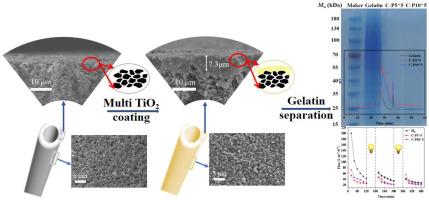
Gelatin, a natural protein, is extensively used in the food, pharmaceutical, and cosmetics industries. However, purifying gelatin to meet the specific requirements of various industries remains a considerable challenge. Ceramic membrane separation technology, renowned for its high permeability, excellent anti-fouling properties, and long lifespan, has been widely applied in the food, biotechnology, and water purification industries. In this study, a sol-gel method was employed to fabricate a gradient multilayer TiO2-modified coating on the surface of an α-Al2O3 porous ceramic membrane. The viscosity of the TiO2 sols was adjusted by varying the concentrations of polyethylene glycol (PEG 2000) and aging times. The results indicated that coating the C-P5^5 composite membrane with a sol containing 5 wt% PEG, aged for different durations (2, 5, 10, 15, and 18 d), effectively reduced the weight-average molecular weight (Mw) of the permeate from the feed solution of 52.4 kDa–11.9 kDa. However, the C-P10^5 composite membrane, with a 10 wt% PEG content and aged for the same durations, yielded a permeate gelatin Mw of 13.6 kDa. The composite membrane with excellent anti-fouling and photocatalytic self-cleaning properties holds promise for innovative applications in gelatin purification and bio-separation processes.
期刊介绍:
Ceramics International covers the science of advanced ceramic materials. The journal encourages contributions that demonstrate how an understanding of the basic chemical and physical phenomena may direct materials design and stimulate ideas for new or improved processing techniques, in order to obtain materials with desired structural features and properties.
Ceramics International covers oxide and non-oxide ceramics, functional glasses, glass ceramics, amorphous inorganic non-metallic materials (and their combinations with metal and organic materials), in the form of particulates, dense or porous bodies, thin/thick films and laminated, graded and composite structures. Process related topics such as ceramic-ceramic joints or joining ceramics with dissimilar materials, as well as surface finishing and conditioning are also covered. Besides traditional processing techniques, manufacturing routes of interest include innovative procedures benefiting from externally applied stresses, electromagnetic fields and energetic beams, as well as top-down and self-assembly nanotechnology approaches. In addition, the journal welcomes submissions on bio-inspired and bio-enabled materials designs, experimentally validated multi scale modelling and simulation for materials design, and the use of the most advanced chemical and physical characterization techniques of structure, properties and behaviour.
Technologically relevant low-dimensional systems are a particular focus of Ceramics International. These include 0, 1 and 2-D nanomaterials (also covering CNTs, graphene and related materials, and diamond-like carbons), their nanocomposites, as well as nano-hybrids and hierarchical multifunctional nanostructures that might integrate molecular, biological and electronic components.




 京公网安备 11010802042870号
京ICP备2023020795号-1
京公网安备 11010802042870号
京ICP备2023020795号-1

 分享
分享
 求助内容:
求助内容: 应助结果提醒方式:
 扫码关注我们
