{"title":"机械合成钛酸钙-铜电陶瓷的相变与结构发展","authors":"Morteza Alizadeh , Hamed Ahmadi Ardakani , Rasool Amini , Mohammad Ghaffari , Shima Pashangeh","doi":"10.1016/j.ceramint.2024.11.446","DOIUrl":null,"url":null,"abstract":"<div><div>This research focuses on the mechano-synthesis of synthesizing calcium-copper-titanate (CCTO) powder through mechanical alloying of the respective oxides aiming to optimize the production of nanoscale electroceramics with high dielectric properties. Structural characterization was carried out using X-ray diffraction with Rietveld refinement (phase identification and quantification), while transmission electron microscopy was employed to observe particle size changes including the reduction of particle size to nanometric scales (10–35 nm). The mechano-synthesis process involving CaO, CuO, and TiO<sub>2</sub> resulted in the creation of perovskite CCTO, with minimal contamination observed from the milling process. Significant particle size reduction, nanostructure formation, and a high level of amorphization, alongside polymorphic transitions in TiO<sub>2</sub> during milling that played a critical role in achieving full amorphization, which was essential for the formation of high-purity CCTO. The study demonstrates that after 256 h of milling, 88 wt% of the powder consisted of crystalline CCTO, highlighting the potential for enhanced performance in dielectric and microelectronic applications. There was no detection of either stoichiometric CCTO or any non-stoichiometric phases prior to the complete amorphization of the powders. Therefore, results revealing significant advancements in particle size reduction, nanostructure formation, and amorphization, which influence enhanced material performance. Nucleating and growing the CCTO phase directly from an amorphous state without the formation of intermediate crystalline phases clears the potential for optimizing CCTO production processes.</div></div>","PeriodicalId":267,"journal":{"name":"Ceramics International","volume":"51 4","pages":"Pages 4721-4728"},"PeriodicalIF":5.6000,"publicationDate":"2025-02-01","publicationTypes":"Journal Article","fieldsOfStudy":null,"isOpenAccess":false,"openAccessPdf":"","citationCount":"0","resultStr":"{\"title\":\"Phase transformation and structural development in mechano-synthesized calcium-copper-titanate electroceramics\",\"authors\":\"Morteza Alizadeh , Hamed Ahmadi Ardakani , Rasool Amini , Mohammad Ghaffari , Shima Pashangeh\",\"doi\":\"10.1016/j.ceramint.2024.11.446\",\"DOIUrl\":null,\"url\":null,\"abstract\":\"<div><div>This research focuses on the mechano-synthesis of synthesizing calcium-copper-titanate (CCTO) powder through mechanical alloying of the respective oxides aiming to optimize the production of nanoscale electroceramics with high dielectric properties. Structural characterization was carried out using X-ray diffraction with Rietveld refinement (phase identification and quantification), while transmission electron microscopy was employed to observe particle size changes including the reduction of particle size to nanometric scales (10–35 nm). The mechano-synthesis process involving CaO, CuO, and TiO<sub>2</sub> resulted in the creation of perovskite CCTO, with minimal contamination observed from the milling process. Significant particle size reduction, nanostructure formation, and a high level of amorphization, alongside polymorphic transitions in TiO<sub>2</sub> during milling that played a critical role in achieving full amorphization, which was essential for the formation of high-purity CCTO. The study demonstrates that after 256 h of milling, 88 wt% of the powder consisted of crystalline CCTO, highlighting the potential for enhanced performance in dielectric and microelectronic applications. There was no detection of either stoichiometric CCTO or any non-stoichiometric phases prior to the complete amorphization of the powders. Therefore, results revealing significant advancements in particle size reduction, nanostructure formation, and amorphization, which influence enhanced material performance. Nucleating and growing the CCTO phase directly from an amorphous state without the formation of intermediate crystalline phases clears the potential for optimizing CCTO production processes.</div></div>\",\"PeriodicalId\":267,\"journal\":{\"name\":\"Ceramics International\",\"volume\":\"51 4\",\"pages\":\"Pages 4721-4728\"},\"PeriodicalIF\":5.6000,\"publicationDate\":\"2025-02-01\",\"publicationTypes\":\"Journal Article\",\"fieldsOfStudy\":null,\"isOpenAccess\":false,\"openAccessPdf\":\"\",\"citationCount\":\"0\",\"resultStr\":null,\"platform\":\"Semanticscholar\",\"paperid\":null,\"PeriodicalName\":\"Ceramics International\",\"FirstCategoryId\":\"88\",\"ListUrlMain\":\"https://www.sciencedirect.com/science/article/pii/S0272884224055561\",\"RegionNum\":2,\"RegionCategory\":\"材料科学\",\"ArticlePicture\":[],\"TitleCN\":null,\"AbstractTextCN\":null,\"PMCID\":null,\"EPubDate\":\"2024/11/27 0:00:00\",\"PubModel\":\"Epub\",\"JCR\":\"Q1\",\"JCRName\":\"MATERIALS SCIENCE, CERAMICS\",\"Score\":null,\"Total\":0}","platform":"Semanticscholar","paperid":null,"PeriodicalName":"Ceramics International","FirstCategoryId":"88","ListUrlMain":"https://www.sciencedirect.com/science/article/pii/S0272884224055561","RegionNum":2,"RegionCategory":"材料科学","ArticlePicture":[],"TitleCN":null,"AbstractTextCN":null,"PMCID":null,"EPubDate":"2024/11/27 0:00:00","PubModel":"Epub","JCR":"Q1","JCRName":"MATERIALS SCIENCE, CERAMICS","Score":null,"Total":0}
Phase transformation and structural development in mechano-synthesized calcium-copper-titanate electroceramics
This research focuses on the mechano-synthesis of synthesizing calcium-copper-titanate (CCTO) powder through mechanical alloying of the respective oxides aiming to optimize the production of nanoscale electroceramics with high dielectric properties. Structural characterization was carried out using X-ray diffraction with Rietveld refinement (phase identification and quantification), while transmission electron microscopy was employed to observe particle size changes including the reduction of particle size to nanometric scales (10–35 nm). The mechano-synthesis process involving CaO, CuO, and TiO2 resulted in the creation of perovskite CCTO, with minimal contamination observed from the milling process. Significant particle size reduction, nanostructure formation, and a high level of amorphization, alongside polymorphic transitions in TiO2 during milling that played a critical role in achieving full amorphization, which was essential for the formation of high-purity CCTO. The study demonstrates that after 256 h of milling, 88 wt% of the powder consisted of crystalline CCTO, highlighting the potential for enhanced performance in dielectric and microelectronic applications. There was no detection of either stoichiometric CCTO or any non-stoichiometric phases prior to the complete amorphization of the powders. Therefore, results revealing significant advancements in particle size reduction, nanostructure formation, and amorphization, which influence enhanced material performance. Nucleating and growing the CCTO phase directly from an amorphous state without the formation of intermediate crystalline phases clears the potential for optimizing CCTO production processes.
期刊介绍:
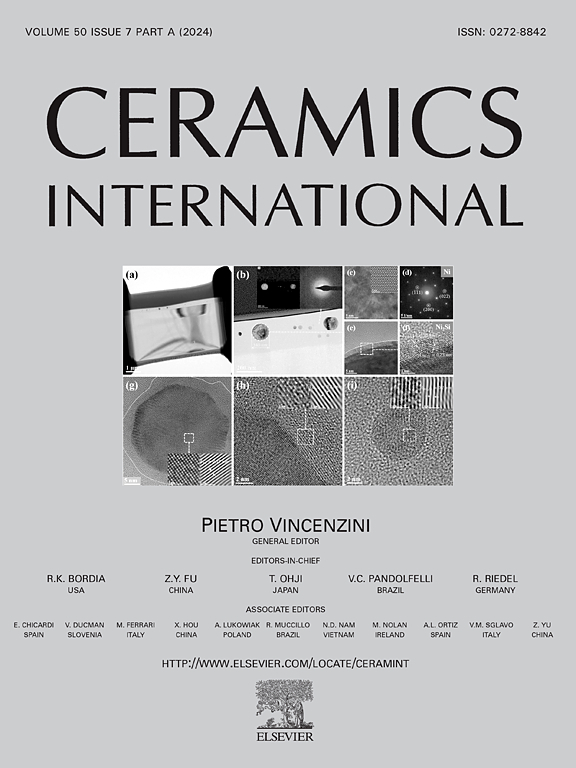
Ceramics International covers the science of advanced ceramic materials. The journal encourages contributions that demonstrate how an understanding of the basic chemical and physical phenomena may direct materials design and stimulate ideas for new or improved processing techniques, in order to obtain materials with desired structural features and properties.
Ceramics International covers oxide and non-oxide ceramics, functional glasses, glass ceramics, amorphous inorganic non-metallic materials (and their combinations with metal and organic materials), in the form of particulates, dense or porous bodies, thin/thick films and laminated, graded and composite structures. Process related topics such as ceramic-ceramic joints or joining ceramics with dissimilar materials, as well as surface finishing and conditioning are also covered. Besides traditional processing techniques, manufacturing routes of interest include innovative procedures benefiting from externally applied stresses, electromagnetic fields and energetic beams, as well as top-down and self-assembly nanotechnology approaches. In addition, the journal welcomes submissions on bio-inspired and bio-enabled materials designs, experimentally validated multi scale modelling and simulation for materials design, and the use of the most advanced chemical and physical characterization techniques of structure, properties and behaviour.
Technologically relevant low-dimensional systems are a particular focus of Ceramics International. These include 0, 1 and 2-D nanomaterials (also covering CNTs, graphene and related materials, and diamond-like carbons), their nanocomposites, as well as nano-hybrids and hierarchical multifunctional nanostructures that might integrate molecular, biological and electronic components.




 京公网安备 11010802042870号
京ICP备2023020795号-1
京公网安备 11010802042870号
京ICP备2023020795号-1

 分享
分享
 求助内容:
求助内容: 应助结果提醒方式:
 扫码关注我们
