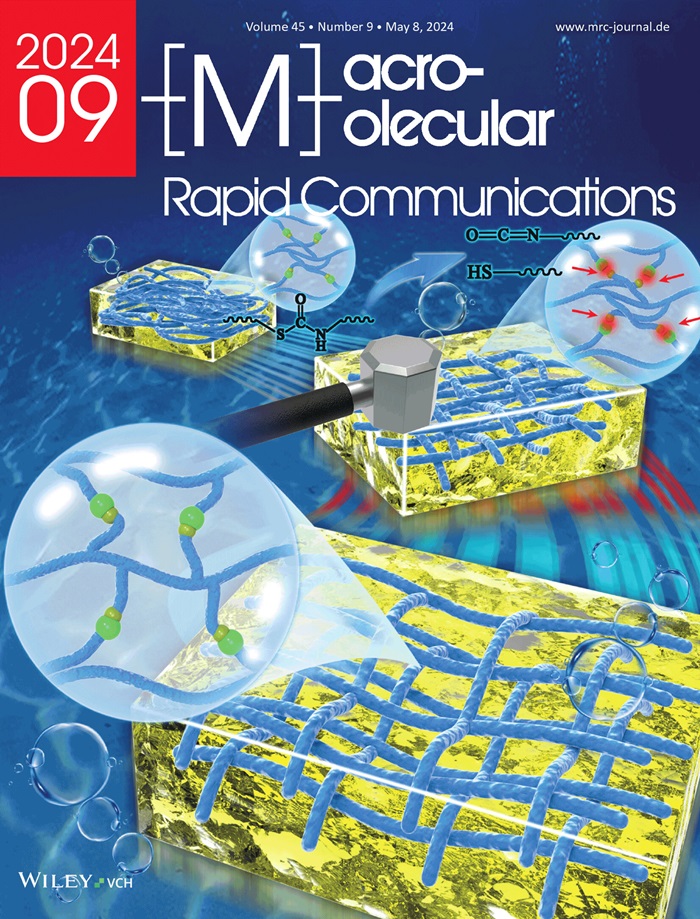
{"title":"基于聚(四亚甲基醚乙二醇)和聚(ε-己内酯)的双晶无应力双向形状记忆聚合物。","authors":"Bingyan Zhang, Jie Jiang, Jinjin Li, Shaoliang Lin, Ling Zhao, Zhenhao Xi, Weikang Yuan","doi":"10.1002/marc.202401102","DOIUrl":null,"url":null,"abstract":"<p>Two-way shape memory polymers (2W-SMPs) are a class of smart materials and can undergo spontaneously reversible deformation after specific stimuli. It is crucial to develop 2W-SMPs to achieve precise control of two-way shape memory behavior without external forces and reveal their structure-property relationships. In this study, dual-crystalline phase crosslinked polymer networks based on poly(tetramethylene ether glycol) (PTMEG) and poly(ε-caprolactone) (PCL) are fabricated via thiol-ene click reactions. The networks with two independent melting temperatures are gained by adjusting the ratio of the two segments and the two-way shape memory is enabled using the temperature difference between the two phases. The effects of network composition, pre-tensile strain, and actuation temperature on the two-way shape memory properties are investigated and the two-way shape memory mechanism of dual-crystalline phase polymers is further elucidated. Among the various compositions of networks, PTMEG<sup>8</sup>-PCL<sup>2</sup> exhibits the optimal two-way shape memory properties, with the actuation strain of 24.25% and reversible strain of up to 10.35% at the actuation temperature and pre-stretch strain of 45 °C and 15%, respectively, which is potential for soft robotics applications. It is believed that this work guides the design of semicrystalline networks with two-way shape memory properties.</p>","PeriodicalId":205,"journal":{"name":"Macromolecular Rapid Communications","volume":"46 9","pages":""},"PeriodicalIF":4.1000,"publicationDate":"2025-02-06","publicationTypes":"Journal Article","fieldsOfStudy":null,"isOpenAccess":false,"openAccessPdf":"","citationCount":"0","resultStr":"{\"title\":\"Stress-Free Two-Way Shape Memory Polymers with Dual-Crystalline Phase Based on Poly(Tetramethylene Ether Glycol) and Poly(ε-Caprolactone)\",\"authors\":\"Bingyan Zhang, Jie Jiang, Jinjin Li, Shaoliang Lin, Ling Zhao, Zhenhao Xi, Weikang Yuan\",\"doi\":\"10.1002/marc.202401102\",\"DOIUrl\":null,\"url\":null,\"abstract\":\"<p>Two-way shape memory polymers (2W-SMPs) are a class of smart materials and can undergo spontaneously reversible deformation after specific stimuli. It is crucial to develop 2W-SMPs to achieve precise control of two-way shape memory behavior without external forces and reveal their structure-property relationships. In this study, dual-crystalline phase crosslinked polymer networks based on poly(tetramethylene ether glycol) (PTMEG) and poly(ε-caprolactone) (PCL) are fabricated via thiol-ene click reactions. The networks with two independent melting temperatures are gained by adjusting the ratio of the two segments and the two-way shape memory is enabled using the temperature difference between the two phases. The effects of network composition, pre-tensile strain, and actuation temperature on the two-way shape memory properties are investigated and the two-way shape memory mechanism of dual-crystalline phase polymers is further elucidated. Among the various compositions of networks, PTMEG<sup>8</sup>-PCL<sup>2</sup> exhibits the optimal two-way shape memory properties, with the actuation strain of 24.25% and reversible strain of up to 10.35% at the actuation temperature and pre-stretch strain of 45 °C and 15%, respectively, which is potential for soft robotics applications. It is believed that this work guides the design of semicrystalline networks with two-way shape memory properties.</p>\",\"PeriodicalId\":205,\"journal\":{\"name\":\"Macromolecular Rapid Communications\",\"volume\":\"46 9\",\"pages\":\"\"},\"PeriodicalIF\":4.1000,\"publicationDate\":\"2025-02-06\",\"publicationTypes\":\"Journal Article\",\"fieldsOfStudy\":null,\"isOpenAccess\":false,\"openAccessPdf\":\"\",\"citationCount\":\"0\",\"resultStr\":null,\"platform\":\"Semanticscholar\",\"paperid\":null,\"PeriodicalName\":\"Macromolecular Rapid Communications\",\"FirstCategoryId\":\"92\",\"ListUrlMain\":\"https://onlinelibrary.wiley.com/doi/10.1002/marc.202401102\",\"RegionNum\":3,\"RegionCategory\":\"化学\",\"ArticlePicture\":[],\"TitleCN\":null,\"AbstractTextCN\":null,\"PMCID\":null,\"EPubDate\":\"\",\"PubModel\":\"\",\"JCR\":\"Q2\",\"JCRName\":\"POLYMER SCIENCE\",\"Score\":null,\"Total\":0}","platform":"Semanticscholar","paperid":null,"PeriodicalName":"Macromolecular Rapid Communications","FirstCategoryId":"92","ListUrlMain":"https://onlinelibrary.wiley.com/doi/10.1002/marc.202401102","RegionNum":3,"RegionCategory":"化学","ArticlePicture":[],"TitleCN":null,"AbstractTextCN":null,"PMCID":null,"EPubDate":"","PubModel":"","JCR":"Q2","JCRName":"POLYMER SCIENCE","Score":null,"Total":0}
Stress-Free Two-Way Shape Memory Polymers with Dual-Crystalline Phase Based on Poly(Tetramethylene Ether Glycol) and Poly(ε-Caprolactone)
Two-way shape memory polymers (2W-SMPs) are a class of smart materials and can undergo spontaneously reversible deformation after specific stimuli. It is crucial to develop 2W-SMPs to achieve precise control of two-way shape memory behavior without external forces and reveal their structure-property relationships. In this study, dual-crystalline phase crosslinked polymer networks based on poly(tetramethylene ether glycol) (PTMEG) and poly(ε-caprolactone) (PCL) are fabricated via thiol-ene click reactions. The networks with two independent melting temperatures are gained by adjusting the ratio of the two segments and the two-way shape memory is enabled using the temperature difference between the two phases. The effects of network composition, pre-tensile strain, and actuation temperature on the two-way shape memory properties are investigated and the two-way shape memory mechanism of dual-crystalline phase polymers is further elucidated. Among the various compositions of networks, PTMEG8-PCL2 exhibits the optimal two-way shape memory properties, with the actuation strain of 24.25% and reversible strain of up to 10.35% at the actuation temperature and pre-stretch strain of 45 °C and 15%, respectively, which is potential for soft robotics applications. It is believed that this work guides the design of semicrystalline networks with two-way shape memory properties.
期刊介绍:
Macromolecular Rapid Communications publishes original research in polymer science, ranging from chemistry and physics of polymers to polymers in materials science and life sciences.





 京公网安备 11010802042870号
京ICP备2023020795号-1
京公网安备 11010802042870号
京ICP备2023020795号-1

 分享
分享
 求助内容:
求助内容: 应助结果提醒方式:
 扫码关注我们
