Cheng Chen, Hao Xue, C Robert Horsburgh, Maryam Amour, Mark Hatherill, Michele Tameris, C Fordham von Reyn, Christiaan Rees, Ye Shen, Helen McShane, Alberto L García-Basteiro, Donglin Liu, Yijun Wang, Ruvandhi R Nathavitharana, Edward A Graviss, Yan Shao, Qiao Liu, Wei Lu, Limei Zhu, Leonardo Martinez
{"title":"在中国、南非、坦桑尼亚和美国的独立队列中,干扰素γ释放测定结果的轨迹超过两年。","authors":"Cheng Chen, Hao Xue, C Robert Horsburgh, Maryam Amour, Mark Hatherill, Michele Tameris, C Fordham von Reyn, Christiaan Rees, Ye Shen, Helen McShane, Alberto L García-Basteiro, Donglin Liu, Yijun Wang, Ruvandhi R Nathavitharana, Edward A Graviss, Yan Shao, Qiao Liu, Wei Lu, Limei Zhu, Leonardo Martinez","doi":"10.1016/j.chest.2025.01.031","DOIUrl":null,"url":null,"abstract":"<p><strong>Background: </strong>There is an ongoing debate about whether clearance of Mycobacterium tuberculosis infection occurs and at what magnitude. Recent studies quantifying \"uncertainty zones\" of interferon-gamma release assays (IGRAs) provide a more stringent estimate of reversion.</p><p><strong>Research question: </strong>When accounting for uncertainty zones through stringent cutoffs, what are the trajectories of IGRAs results over 2 years of testing?</p><p><strong>Study design and methods: </strong>Five cohorts from South Africa, China, Tanzania, and the United States tested with an IGRA 3 or more times were followed up for stringent conversion and reversion. The annual risk of IGRA reversion was assessed following an IGRA conversion and among those with baseline positivity.</p><p><strong>Results: </strong>A total of 26,596 IGRA measurements were taken over 13,593 years of follow-up (N<sub>participants</sub> = 7,683). Stringent reversion at year 2 following stringent conversion at year 1 varied between cohorts, occurring in 48% (43/90) for Wantai, 37% (22/59) for QuantiFERON, and 17% (2/12) for T-SPOT.TB, respectively. In the US cohorts, stringent reversion at year 1 following stringent conversion at 6 months was 58% (15 of 26) for QuantiFERON and 18% (12 of 60) for T-SPOT.TB. Stringent reversion at 1 year following baseline positivity occurred in 12% (47 of 404) for Wantai, 21% (10 of 48) for QuantiFERON, and 44% for T-SPOT.TB (45 of 102). In one cohort from China (N = 399; age range, 59 years [interquartile range, 48-67 years]), IGRA reversion was more common in younger participants (adjusted OR [aOR], 0.95; 95% CI, 0.93-0.97) and those without recent close TB exposure (aOR, 0.35 [95% CI, 0.11-1.03] in South Africa; aOR, 0.10 [95% CI, 0.01-0.61] in China).</p><p><strong>Interpretation: </strong>These results suggest high annual rates of IGRA reversion, even with the use of uncertainty zones; reversion rates decreased over time from exposure and at older ages.</p>","PeriodicalId":9782,"journal":{"name":"Chest","volume":" ","pages":"33-42"},"PeriodicalIF":8.6000,"publicationDate":"2025-07-01","publicationTypes":"Journal Article","fieldsOfStudy":null,"isOpenAccess":false,"openAccessPdf":"https://www.ncbi.nlm.nih.gov/pmc/articles/PMC12264344/pdf/","citationCount":"0","resultStr":"{\"title\":\"Trajectories of Interferon-Gamma Release Assay Results Over 2 Years in Independent Cohorts From China, South Africa, Tanzania, and the United States.\",\"authors\":\"Cheng Chen, Hao Xue, C Robert Horsburgh, Maryam Amour, Mark Hatherill, Michele Tameris, C Fordham von Reyn, Christiaan Rees, Ye Shen, Helen McShane, Alberto L García-Basteiro, Donglin Liu, Yijun Wang, Ruvandhi R Nathavitharana, Edward A Graviss, Yan Shao, Qiao Liu, Wei Lu, Limei Zhu, Leonardo Martinez\",\"doi\":\"10.1016/j.chest.2025.01.031\",\"DOIUrl\":null,\"url\":null,\"abstract\":\"<p><strong>Background: </strong>There is an ongoing debate about whether clearance of Mycobacterium tuberculosis infection occurs and at what magnitude. Recent studies quantifying \\\"uncertainty zones\\\" of interferon-gamma release assays (IGRAs) provide a more stringent estimate of reversion.</p><p><strong>Research question: </strong>When accounting for uncertainty zones through stringent cutoffs, what are the trajectories of IGRAs results over 2 years of testing?</p><p><strong>Study design and methods: </strong>Five cohorts from South Africa, China, Tanzania, and the United States tested with an IGRA 3 or more times were followed up for stringent conversion and reversion. The annual risk of IGRA reversion was assessed following an IGRA conversion and among those with baseline positivity.</p><p><strong>Results: </strong>A total of 26,596 IGRA measurements were taken over 13,593 years of follow-up (N<sub>participants</sub> = 7,683). Stringent reversion at year 2 following stringent conversion at year 1 varied between cohorts, occurring in 48% (43/90) for Wantai, 37% (22/59) for QuantiFERON, and 17% (2/12) for T-SPOT.TB, respectively. In the US cohorts, stringent reversion at year 1 following stringent conversion at 6 months was 58% (15 of 26) for QuantiFERON and 18% (12 of 60) for T-SPOT.TB. Stringent reversion at 1 year following baseline positivity occurred in 12% (47 of 404) for Wantai, 21% (10 of 48) for QuantiFERON, and 44% for T-SPOT.TB (45 of 102). In one cohort from China (N = 399; age range, 59 years [interquartile range, 48-67 years]), IGRA reversion was more common in younger participants (adjusted OR [aOR], 0.95; 95% CI, 0.93-0.97) and those without recent close TB exposure (aOR, 0.35 [95% CI, 0.11-1.03] in South Africa; aOR, 0.10 [95% CI, 0.01-0.61] in China).</p><p><strong>Interpretation: </strong>These results suggest high annual rates of IGRA reversion, even with the use of uncertainty zones; reversion rates decreased over time from exposure and at older ages.</p>\",\"PeriodicalId\":9782,\"journal\":{\"name\":\"Chest\",\"volume\":\" \",\"pages\":\"33-42\"},\"PeriodicalIF\":8.6000,\"publicationDate\":\"2025-07-01\",\"publicationTypes\":\"Journal Article\",\"fieldsOfStudy\":null,\"isOpenAccess\":false,\"openAccessPdf\":\"https://www.ncbi.nlm.nih.gov/pmc/articles/PMC12264344/pdf/\",\"citationCount\":\"0\",\"resultStr\":null,\"platform\":\"Semanticscholar\",\"paperid\":null,\"PeriodicalName\":\"Chest\",\"FirstCategoryId\":\"3\",\"ListUrlMain\":\"https://doi.org/10.1016/j.chest.2025.01.031\",\"RegionNum\":1,\"RegionCategory\":\"医学\",\"ArticlePicture\":[],\"TitleCN\":null,\"AbstractTextCN\":null,\"PMCID\":null,\"EPubDate\":\"2025/2/3 0:00:00\",\"PubModel\":\"Epub\",\"JCR\":\"Q1\",\"JCRName\":\"CRITICAL CARE MEDICINE\",\"Score\":null,\"Total\":0}","platform":"Semanticscholar","paperid":null,"PeriodicalName":"Chest","FirstCategoryId":"3","ListUrlMain":"https://doi.org/10.1016/j.chest.2025.01.031","RegionNum":1,"RegionCategory":"医学","ArticlePicture":[],"TitleCN":null,"AbstractTextCN":null,"PMCID":null,"EPubDate":"2025/2/3 0:00:00","PubModel":"Epub","JCR":"Q1","JCRName":"CRITICAL CARE MEDICINE","Score":null,"Total":0}
Trajectories of Interferon-Gamma Release Assay Results Over 2 Years in Independent Cohorts From China, South Africa, Tanzania, and the United States.
Background: There is an ongoing debate about whether clearance of Mycobacterium tuberculosis infection occurs and at what magnitude. Recent studies quantifying "uncertainty zones" of interferon-gamma release assays (IGRAs) provide a more stringent estimate of reversion.
Research question: When accounting for uncertainty zones through stringent cutoffs, what are the trajectories of IGRAs results over 2 years of testing?
Study design and methods: Five cohorts from South Africa, China, Tanzania, and the United States tested with an IGRA 3 or more times were followed up for stringent conversion and reversion. The annual risk of IGRA reversion was assessed following an IGRA conversion and among those with baseline positivity.
Results: A total of 26,596 IGRA measurements were taken over 13,593 years of follow-up (Nparticipants = 7,683). Stringent reversion at year 2 following stringent conversion at year 1 varied between cohorts, occurring in 48% (43/90) for Wantai, 37% (22/59) for QuantiFERON, and 17% (2/12) for T-SPOT.TB, respectively. In the US cohorts, stringent reversion at year 1 following stringent conversion at 6 months was 58% (15 of 26) for QuantiFERON and 18% (12 of 60) for T-SPOT.TB. Stringent reversion at 1 year following baseline positivity occurred in 12% (47 of 404) for Wantai, 21% (10 of 48) for QuantiFERON, and 44% for T-SPOT.TB (45 of 102). In one cohort from China (N = 399; age range, 59 years [interquartile range, 48-67 years]), IGRA reversion was more common in younger participants (adjusted OR [aOR], 0.95; 95% CI, 0.93-0.97) and those without recent close TB exposure (aOR, 0.35 [95% CI, 0.11-1.03] in South Africa; aOR, 0.10 [95% CI, 0.01-0.61] in China).
Interpretation: These results suggest high annual rates of IGRA reversion, even with the use of uncertainty zones; reversion rates decreased over time from exposure and at older ages.
期刊介绍:
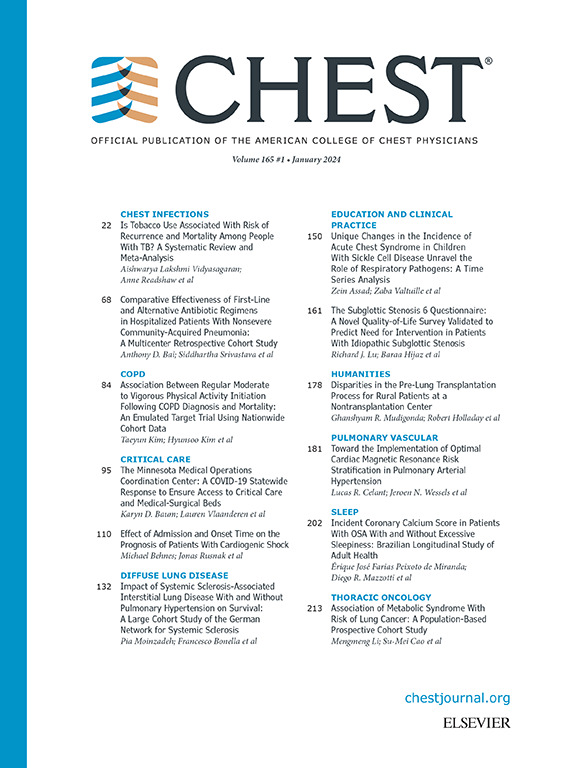
At CHEST, our mission is to revolutionize patient care through the collaboration of multidisciplinary clinicians in the fields of pulmonary, critical care, and sleep medicine. We achieve this by publishing cutting-edge clinical research that addresses current challenges and brings forth future advancements. To enhance understanding in a rapidly evolving field, CHEST also features review articles, commentaries, and facilitates discussions on emerging controversies. We place great emphasis on scientific rigor, employing a rigorous peer review process, and ensuring all accepted content is published online within two weeks.




 京公网安备 11010802042870号
京ICP备2023020795号-1
京公网安备 11010802042870号
京ICP备2023020795号-1

 分享
分享
 求助内容:
求助内容: 应助结果提醒方式:
 扫码关注我们
