{"title":"循环炎症蛋白和虹膜睫状体炎的遗传学:一项探索性孟德尔随机研究。","authors":"Huan Liu, Fuzhen Li, Feiyan Wang, Ziqing Hu, Liping Du, Jing Wei","doi":"10.1167/tvst.14.2.6","DOIUrl":null,"url":null,"abstract":"<p><strong>Purpose: </strong>This study aimed to explore the potential causal relationship between genetically determined elevated levels of pro-inflammatory cytokines and iridocyclitis, including its subtypes: acute and subacute iridocyclitis (ASIR) and chronic iridocyclitis (CIR).</p><p><strong>Methods: </strong>A two-sample Mendelian randomization (MR) analysis was conducted using genome-wide association study (GWAS) summary data for inflammatory cytokines (cases, n = 14,824), iridocyclitis (IR; cases, n = 7306 and controls, n = 357,814), and its subtypes (ASIR: cases, n = 6166 and controls, n = 357,814; and CIR: cases, n = 1401 and controls, n = 357,814). The inverse variance-weighted (IVW) method served as the primary analysis method. Supplementary analytic methods included MR Egger, Weighted median, Weighted mode, and Simple mode methods. Pleiotropy and heterogeneity were evaluated using the Cochran's Q test, MR Egger intercept test, MR Pleiotropy RESidual Sum and Outlier test (MR-PRESSO), Bayesian colocalization analysis, and Linkage disequilibrium score regression (LDSC) analysis.</p><p><strong>Results: </strong>Genetically predicted high levels of eotaxin, fibroblast growth factor 23 (FGF23), TNF-related apoptosis-inducing ligand (TRAIL), and Neurotrophin-3 were associated with an increased risk of IR. On the contrary, a high level of interleukin (IL)-2 was associated with a decreased risk of IR. Meanwhile, the IR subgroup analysis demonstrated that high levels of eotaxin and TRAIL were also associated with an increased risk of ASIR. High levels of cystatin D, tumor necrosis factor receptor superfamily member 9 (TNFRSF9), and caspase 8 were associated with an increased risk of CIR. CCL20 and CDCP1 were associated with a decreased risk of CIR. Heterogeneity and pleiotropy tests demonstrated that our findings were stable and reliable.</p><p><strong>Conclusions: </strong>Inflammatory cytokines are involved in the occurrence of IR and its subtypes. Further studies are warranted to elucidate the precise mechanisms of inflammatory cytokines in IR and its subtypes.</p><p><strong>Translational relevance: </strong>The present study highlighted the role of inflammatory cytokines in the development of IR.</p>","PeriodicalId":23322,"journal":{"name":"Translational Vision Science & Technology","volume":"14 2","pages":"6"},"PeriodicalIF":2.7000,"publicationDate":"2025-02-03","publicationTypes":"Journal Article","fieldsOfStudy":null,"isOpenAccess":false,"openAccessPdf":"https://www.ncbi.nlm.nih.gov/pmc/articles/PMC11804894/pdf/","citationCount":"0","resultStr":"{\"title\":\"Genetics of Circulating Inflammatory Proteins and Iridocyclitis: An Exploratory Mendelian Randomization Study.\",\"authors\":\"Huan Liu, Fuzhen Li, Feiyan Wang, Ziqing Hu, Liping Du, Jing Wei\",\"doi\":\"10.1167/tvst.14.2.6\",\"DOIUrl\":null,\"url\":null,\"abstract\":\"<p><strong>Purpose: </strong>This study aimed to explore the potential causal relationship between genetically determined elevated levels of pro-inflammatory cytokines and iridocyclitis, including its subtypes: acute and subacute iridocyclitis (ASIR) and chronic iridocyclitis (CIR).</p><p><strong>Methods: </strong>A two-sample Mendelian randomization (MR) analysis was conducted using genome-wide association study (GWAS) summary data for inflammatory cytokines (cases, n = 14,824), iridocyclitis (IR; cases, n = 7306 and controls, n = 357,814), and its subtypes (ASIR: cases, n = 6166 and controls, n = 357,814; and CIR: cases, n = 1401 and controls, n = 357,814). The inverse variance-weighted (IVW) method served as the primary analysis method. Supplementary analytic methods included MR Egger, Weighted median, Weighted mode, and Simple mode methods. Pleiotropy and heterogeneity were evaluated using the Cochran's Q test, MR Egger intercept test, MR Pleiotropy RESidual Sum and Outlier test (MR-PRESSO), Bayesian colocalization analysis, and Linkage disequilibrium score regression (LDSC) analysis.</p><p><strong>Results: </strong>Genetically predicted high levels of eotaxin, fibroblast growth factor 23 (FGF23), TNF-related apoptosis-inducing ligand (TRAIL), and Neurotrophin-3 were associated with an increased risk of IR. On the contrary, a high level of interleukin (IL)-2 was associated with a decreased risk of IR. Meanwhile, the IR subgroup analysis demonstrated that high levels of eotaxin and TRAIL were also associated with an increased risk of ASIR. High levels of cystatin D, tumor necrosis factor receptor superfamily member 9 (TNFRSF9), and caspase 8 were associated with an increased risk of CIR. CCL20 and CDCP1 were associated with a decreased risk of CIR. Heterogeneity and pleiotropy tests demonstrated that our findings were stable and reliable.</p><p><strong>Conclusions: </strong>Inflammatory cytokines are involved in the occurrence of IR and its subtypes. Further studies are warranted to elucidate the precise mechanisms of inflammatory cytokines in IR and its subtypes.</p><p><strong>Translational relevance: </strong>The present study highlighted the role of inflammatory cytokines in the development of IR.</p>\",\"PeriodicalId\":23322,\"journal\":{\"name\":\"Translational Vision Science & Technology\",\"volume\":\"14 2\",\"pages\":\"6\"},\"PeriodicalIF\":2.7000,\"publicationDate\":\"2025-02-03\",\"publicationTypes\":\"Journal Article\",\"fieldsOfStudy\":null,\"isOpenAccess\":false,\"openAccessPdf\":\"https://www.ncbi.nlm.nih.gov/pmc/articles/PMC11804894/pdf/\",\"citationCount\":\"0\",\"resultStr\":null,\"platform\":\"Semanticscholar\",\"paperid\":null,\"PeriodicalName\":\"Translational Vision Science & Technology\",\"FirstCategoryId\":\"3\",\"ListUrlMain\":\"https://doi.org/10.1167/tvst.14.2.6\",\"RegionNum\":3,\"RegionCategory\":\"医学\",\"ArticlePicture\":[],\"TitleCN\":null,\"AbstractTextCN\":null,\"PMCID\":null,\"EPubDate\":\"\",\"PubModel\":\"\",\"JCR\":\"Q2\",\"JCRName\":\"OPHTHALMOLOGY\",\"Score\":null,\"Total\":0}","platform":"Semanticscholar","paperid":null,"PeriodicalName":"Translational Vision Science & Technology","FirstCategoryId":"3","ListUrlMain":"https://doi.org/10.1167/tvst.14.2.6","RegionNum":3,"RegionCategory":"医学","ArticlePicture":[],"TitleCN":null,"AbstractTextCN":null,"PMCID":null,"EPubDate":"","PubModel":"","JCR":"Q2","JCRName":"OPHTHALMOLOGY","Score":null,"Total":0}
Genetics of Circulating Inflammatory Proteins and Iridocyclitis: An Exploratory Mendelian Randomization Study.
Purpose: This study aimed to explore the potential causal relationship between genetically determined elevated levels of pro-inflammatory cytokines and iridocyclitis, including its subtypes: acute and subacute iridocyclitis (ASIR) and chronic iridocyclitis (CIR).
Methods: A two-sample Mendelian randomization (MR) analysis was conducted using genome-wide association study (GWAS) summary data for inflammatory cytokines (cases, n = 14,824), iridocyclitis (IR; cases, n = 7306 and controls, n = 357,814), and its subtypes (ASIR: cases, n = 6166 and controls, n = 357,814; and CIR: cases, n = 1401 and controls, n = 357,814). The inverse variance-weighted (IVW) method served as the primary analysis method. Supplementary analytic methods included MR Egger, Weighted median, Weighted mode, and Simple mode methods. Pleiotropy and heterogeneity were evaluated using the Cochran's Q test, MR Egger intercept test, MR Pleiotropy RESidual Sum and Outlier test (MR-PRESSO), Bayesian colocalization analysis, and Linkage disequilibrium score regression (LDSC) analysis.
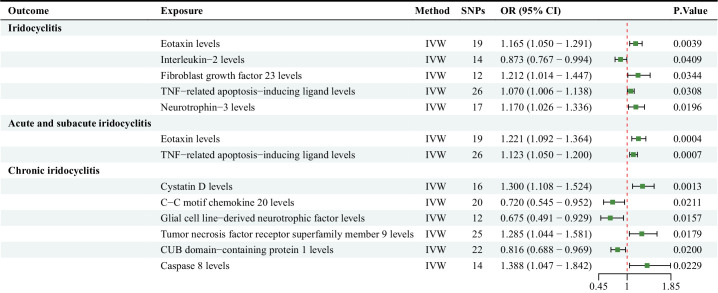
Results: Genetically predicted high levels of eotaxin, fibroblast growth factor 23 (FGF23), TNF-related apoptosis-inducing ligand (TRAIL), and Neurotrophin-3 were associated with an increased risk of IR. On the contrary, a high level of interleukin (IL)-2 was associated with a decreased risk of IR. Meanwhile, the IR subgroup analysis demonstrated that high levels of eotaxin and TRAIL were also associated with an increased risk of ASIR. High levels of cystatin D, tumor necrosis factor receptor superfamily member 9 (TNFRSF9), and caspase 8 were associated with an increased risk of CIR. CCL20 and CDCP1 were associated with a decreased risk of CIR. Heterogeneity and pleiotropy tests demonstrated that our findings were stable and reliable.
Conclusions: Inflammatory cytokines are involved in the occurrence of IR and its subtypes. Further studies are warranted to elucidate the precise mechanisms of inflammatory cytokines in IR and its subtypes.
Translational relevance: The present study highlighted the role of inflammatory cytokines in the development of IR.
期刊介绍:
Translational Vision Science & Technology (TVST), an official journal of the Association for Research in Vision and Ophthalmology (ARVO), an international organization whose purpose is to advance research worldwide into understanding the visual system and preventing, treating and curing its disorders, is an online, open access, peer-reviewed journal emphasizing multidisciplinary research that bridges the gap between basic research and clinical care. A highly qualified and diverse group of Associate Editors and Editorial Board Members is led by Editor-in-Chief Marco Zarbin, MD, PhD, FARVO.
The journal covers a broad spectrum of work, including but not limited to:
Applications of stem cell technology for regenerative medicine,
Development of new animal models of human diseases,
Tissue bioengineering,
Chemical engineering to improve virus-based gene delivery,
Nanotechnology for drug delivery,
Design and synthesis of artificial extracellular matrices,
Development of a true microsurgical operating environment,
Refining data analysis algorithms to improve in vivo imaging technology,
Results of Phase 1 clinical trials,
Reverse translational ("bedside to bench") research.
TVST seeks manuscripts from scientists and clinicians with diverse backgrounds ranging from basic chemistry to ophthalmic surgery that will advance or change the way we understand and/or treat vision-threatening diseases. TVST encourages the use of color, multimedia, hyperlinks, program code and other digital enhancements.






 京公网安备 11010802042870号
京ICP备2023020795号-1
京公网安备 11010802042870号
京ICP备2023020795号-1

 分享
分享
 求助内容:
求助内容: 应助结果提醒方式:
 扫码关注我们
