Yacheng Huang, Ni Zhao, Min Liang, Xuying Wang, Shudong Zhang, Chao Zhao, Linya Liu
{"title":"标题菊科锦绣子叶绿体全基因组及系统发育分析。","authors":"Yacheng Huang, Ni Zhao, Min Liang, Xuying Wang, Shudong Zhang, Chao Zhao, Linya Liu","doi":"10.1080/23802359.2025.2449686","DOIUrl":null,"url":null,"abstract":"<p><p><i>Emilia prenanthoidea</i> (<i>Emilia prenanthoidea</i> DC. Prodr. (DC.), 1838) belongs to the Asteraceae family and is a popular Miao medicinal plant in Guizhou, China. It has anti-inflammatory and antitumor properties. It is often used as a medication for healing injury, clearing heat and detoxifying, boosting blood circulation and eliminating blood stasis, and lowering inflammation and diuresis. This is the first reported study on the complete chloroplast genome of <i>E. prenanthoidea</i>. The <i>E. prenanthoidea</i> chloroplast genome is 151, 406 bp long, contains a pair of inverted repeats (IRs 24,705 bp), and is separated into a large single-copy (84,010 bp) and a short single-copy (17,986 bp) region. One hundred thirty genes were predicted, including 85 protein-coding genes, 37 tRNA genes, and eight rRNA genes. Nine protein-coding genes (<i>rps</i>16, <i>rpo</i>C1, <i>atp</i>F, <i>pet</i>B, <i>pet</i>D, <i>rpl</i>16, <i>rpl</i>2, <i>ndh</i>B, <i>ndh</i>A) had a single intron, two protein-coding genes (<i>ycf</i>3, <i>clp</i>P) had two, and the remainder had none. The phylogenetic analysis found <i>Emilia prenanthoidea</i> and <i>Emilia sonchifolia</i> clustered on a single branch, with <i>Pericallis hybrida</i> as its sister group. This study enhances our understanding of the evolutionary relationships within the Asteraceae family and provides valuable insights for developing germplasm-specific molecular markers.</p>","PeriodicalId":18647,"journal":{"name":"Mitochondrial DNA. Part B, Resources","volume":"10 3","pages":"162-166"},"PeriodicalIF":0.7000,"publicationDate":"2025-02-02","publicationTypes":"Journal Article","fieldsOfStudy":null,"isOpenAccess":false,"openAccessPdf":"https://www.ncbi.nlm.nih.gov/pmc/articles/PMC11792124/pdf/","citationCount":"0","resultStr":"{\"title\":\"The complete chloroplast genome and phylogenetic analysis of <i>Emilia prenanthoidea</i> (Asteraceae).\",\"authors\":\"Yacheng Huang, Ni Zhao, Min Liang, Xuying Wang, Shudong Zhang, Chao Zhao, Linya Liu\",\"doi\":\"10.1080/23802359.2025.2449686\",\"DOIUrl\":null,\"url\":null,\"abstract\":\"<p><p><i>Emilia prenanthoidea</i> (<i>Emilia prenanthoidea</i> DC. Prodr. (DC.), 1838) belongs to the Asteraceae family and is a popular Miao medicinal plant in Guizhou, China. It has anti-inflammatory and antitumor properties. It is often used as a medication for healing injury, clearing heat and detoxifying, boosting blood circulation and eliminating blood stasis, and lowering inflammation and diuresis. This is the first reported study on the complete chloroplast genome of <i>E. prenanthoidea</i>. The <i>E. prenanthoidea</i> chloroplast genome is 151, 406 bp long, contains a pair of inverted repeats (IRs 24,705 bp), and is separated into a large single-copy (84,010 bp) and a short single-copy (17,986 bp) region. One hundred thirty genes were predicted, including 85 protein-coding genes, 37 tRNA genes, and eight rRNA genes. Nine protein-coding genes (<i>rps</i>16, <i>rpo</i>C1, <i>atp</i>F, <i>pet</i>B, <i>pet</i>D, <i>rpl</i>16, <i>rpl</i>2, <i>ndh</i>B, <i>ndh</i>A) had a single intron, two protein-coding genes (<i>ycf</i>3, <i>clp</i>P) had two, and the remainder had none. The phylogenetic analysis found <i>Emilia prenanthoidea</i> and <i>Emilia sonchifolia</i> clustered on a single branch, with <i>Pericallis hybrida</i> as its sister group. This study enhances our understanding of the evolutionary relationships within the Asteraceae family and provides valuable insights for developing germplasm-specific molecular markers.</p>\",\"PeriodicalId\":18647,\"journal\":{\"name\":\"Mitochondrial DNA. Part B, Resources\",\"volume\":\"10 3\",\"pages\":\"162-166\"},\"PeriodicalIF\":0.7000,\"publicationDate\":\"2025-02-02\",\"publicationTypes\":\"Journal Article\",\"fieldsOfStudy\":null,\"isOpenAccess\":false,\"openAccessPdf\":\"https://www.ncbi.nlm.nih.gov/pmc/articles/PMC11792124/pdf/\",\"citationCount\":\"0\",\"resultStr\":null,\"platform\":\"Semanticscholar\",\"paperid\":null,\"PeriodicalName\":\"Mitochondrial DNA. Part B, Resources\",\"FirstCategoryId\":\"99\",\"ListUrlMain\":\"https://doi.org/10.1080/23802359.2025.2449686\",\"RegionNum\":4,\"RegionCategory\":\"生物学\",\"ArticlePicture\":[],\"TitleCN\":null,\"AbstractTextCN\":null,\"PMCID\":null,\"EPubDate\":\"2025/1/1 0:00:00\",\"PubModel\":\"eCollection\",\"JCR\":\"Q4\",\"JCRName\":\"GENETICS & HEREDITY\",\"Score\":null,\"Total\":0}","platform":"Semanticscholar","paperid":null,"PeriodicalName":"Mitochondrial DNA. Part B, Resources","FirstCategoryId":"99","ListUrlMain":"https://doi.org/10.1080/23802359.2025.2449686","RegionNum":4,"RegionCategory":"生物学","ArticlePicture":[],"TitleCN":null,"AbstractTextCN":null,"PMCID":null,"EPubDate":"2025/1/1 0:00:00","PubModel":"eCollection","JCR":"Q4","JCRName":"GENETICS & HEREDITY","Score":null,"Total":0}
The complete chloroplast genome and phylogenetic analysis of Emilia prenanthoidea (Asteraceae).
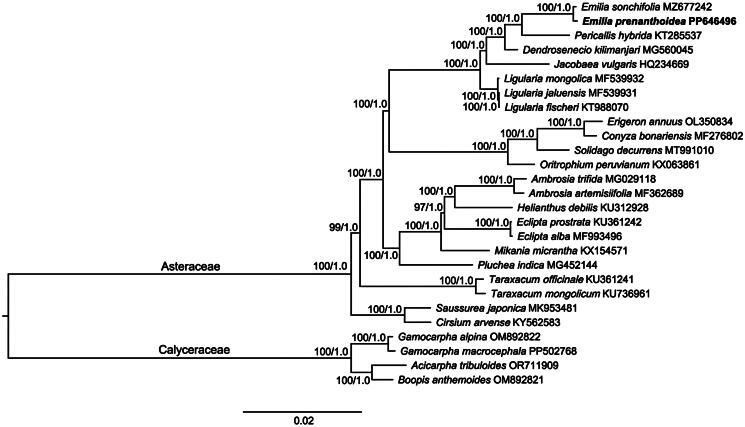
Emilia prenanthoidea (Emilia prenanthoidea DC. Prodr. (DC.), 1838) belongs to the Asteraceae family and is a popular Miao medicinal plant in Guizhou, China. It has anti-inflammatory and antitumor properties. It is often used as a medication for healing injury, clearing heat and detoxifying, boosting blood circulation and eliminating blood stasis, and lowering inflammation and diuresis. This is the first reported study on the complete chloroplast genome of E. prenanthoidea. The E. prenanthoidea chloroplast genome is 151, 406 bp long, contains a pair of inverted repeats (IRs 24,705 bp), and is separated into a large single-copy (84,010 bp) and a short single-copy (17,986 bp) region. One hundred thirty genes were predicted, including 85 protein-coding genes, 37 tRNA genes, and eight rRNA genes. Nine protein-coding genes (rps16, rpoC1, atpF, petB, petD, rpl16, rpl2, ndhB, ndhA) had a single intron, two protein-coding genes (ycf3, clpP) had two, and the remainder had none. The phylogenetic analysis found Emilia prenanthoidea and Emilia sonchifolia clustered on a single branch, with Pericallis hybrida as its sister group. This study enhances our understanding of the evolutionary relationships within the Asteraceae family and provides valuable insights for developing germplasm-specific molecular markers.
期刊介绍:
This open access journal publishes high-quality and concise research articles reporting the sequence of full mitochondrial genomes, and short communications focusing on the physical, chemical, and biochemical aspects of mtDNA and proteins involved in mtDNA metabolism and interactions.






 京公网安备 11010802042870号
京ICP备2023020795号-1
京公网安备 11010802042870号
京ICP备2023020795号-1

 分享
分享
 求助内容:
求助内容: 应助结果提醒方式:
 扫码关注我们
