Amalia Azzariti, Simona De Summa, Tommaso M Marvulli, Ivana De Risi, Giuseppe De Palma, Roberta Di Fonte, Rossella Fasano, Simona Serratì, Sabino Strippoli, Letizia Porcelli, Michele Guida
{"title":"使用液体活检生物标志物开发风险评分,用于选择免疫治疗应答者和转移性黑色素瘤患者的疾病进展风险分层。","authors":"Amalia Azzariti, Simona De Summa, Tommaso M Marvulli, Ivana De Risi, Giuseppe De Palma, Roberta Di Fonte, Rossella Fasano, Simona Serratì, Sabino Strippoli, Letizia Porcelli, Michele Guida","doi":"10.1186/s13046-025-03306-w","DOIUrl":null,"url":null,"abstract":"<p><strong>Background: </strong>Despite the high response rate to PD-1 blockade therapy in metastatic melanoma (MM) patients, a significant proportion of patients do not respond. Identifying biomarkers to predict patient response is crucial, ideally through non-invasive methods such as liquid biopsy.</p><p><strong>Methods: </strong>Soluble forms of PD1, PD-L1, LAG-3, CTLA-4, CD4, CD73, and CD74 were quantified using ELISA assay in plasma of a cohort of 110 MM patients, at baseline, to investigate possible correlations with clinical outcomes. A clinical risk prediction model was applied and validated in pilot studies.</p><p><strong>Results: </strong>No biomarker showed statistically significant differences between responders and non-responders. However, high number of significant correlations were observed among certain biomarkers in non-responders. Through univariate and multivariate Cox analyses, we identified sPD-L1, sCTLA-4, sCD73, and sCD74 as independent biomarkers predicting progression-free survival and overall survival. According to ROC analysis we discovered that, except for sCD73, values of sPD-L1, sCTLA-4, and sCD74 lower than the cut-off predicted lower disease progression and reduced mortality. A comprehensive risk score for predicting progression-free survival was developed by incorporating the values of the two identified independent factors, sCTLA-4 and sCD74, which significantly improved the accuracy of outcome prediction. Pilot validations highlighted the potential use of the risk score in treatment-naive individuals and long responders.</p><p><strong>Conclusion: </strong>In summary, risk score based on circulating sCTLA-4 and sCD74 reflects the response to immune checkpoint inhibitor (ICI) therapy in MM patients. If confirmed, through further validation, these findings could assist in recommending therapy to patients likely to experience a long-lasting response.</p>","PeriodicalId":50199,"journal":{"name":"Journal of Experimental & Clinical Cancer Research","volume":"44 1","pages":"40"},"PeriodicalIF":12.8000,"publicationDate":"2025-02-05","publicationTypes":"Journal Article","fieldsOfStudy":null,"isOpenAccess":false,"openAccessPdf":"https://www.ncbi.nlm.nih.gov/pmc/articles/PMC11796275/pdf/","citationCount":"0","resultStr":"{\"title\":\"Developing a risk score using liquid biopsy biomarkers for selecting Immunotherapy responders and stratifying disease progression risk in metastatic melanoma patients.\",\"authors\":\"Amalia Azzariti, Simona De Summa, Tommaso M Marvulli, Ivana De Risi, Giuseppe De Palma, Roberta Di Fonte, Rossella Fasano, Simona Serratì, Sabino Strippoli, Letizia Porcelli, Michele Guida\",\"doi\":\"10.1186/s13046-025-03306-w\",\"DOIUrl\":null,\"url\":null,\"abstract\":\"<p><strong>Background: </strong>Despite the high response rate to PD-1 blockade therapy in metastatic melanoma (MM) patients, a significant proportion of patients do not respond. Identifying biomarkers to predict patient response is crucial, ideally through non-invasive methods such as liquid biopsy.</p><p><strong>Methods: </strong>Soluble forms of PD1, PD-L1, LAG-3, CTLA-4, CD4, CD73, and CD74 were quantified using ELISA assay in plasma of a cohort of 110 MM patients, at baseline, to investigate possible correlations with clinical outcomes. A clinical risk prediction model was applied and validated in pilot studies.</p><p><strong>Results: </strong>No biomarker showed statistically significant differences between responders and non-responders. However, high number of significant correlations were observed among certain biomarkers in non-responders. Through univariate and multivariate Cox analyses, we identified sPD-L1, sCTLA-4, sCD73, and sCD74 as independent biomarkers predicting progression-free survival and overall survival. According to ROC analysis we discovered that, except for sCD73, values of sPD-L1, sCTLA-4, and sCD74 lower than the cut-off predicted lower disease progression and reduced mortality. A comprehensive risk score for predicting progression-free survival was developed by incorporating the values of the two identified independent factors, sCTLA-4 and sCD74, which significantly improved the accuracy of outcome prediction. Pilot validations highlighted the potential use of the risk score in treatment-naive individuals and long responders.</p><p><strong>Conclusion: </strong>In summary, risk score based on circulating sCTLA-4 and sCD74 reflects the response to immune checkpoint inhibitor (ICI) therapy in MM patients. If confirmed, through further validation, these findings could assist in recommending therapy to patients likely to experience a long-lasting response.</p>\",\"PeriodicalId\":50199,\"journal\":{\"name\":\"Journal of Experimental & Clinical Cancer Research\",\"volume\":\"44 1\",\"pages\":\"40\"},\"PeriodicalIF\":12.8000,\"publicationDate\":\"2025-02-05\",\"publicationTypes\":\"Journal Article\",\"fieldsOfStudy\":null,\"isOpenAccess\":false,\"openAccessPdf\":\"https://www.ncbi.nlm.nih.gov/pmc/articles/PMC11796275/pdf/\",\"citationCount\":\"0\",\"resultStr\":null,\"platform\":\"Semanticscholar\",\"paperid\":null,\"PeriodicalName\":\"Journal of Experimental & Clinical Cancer Research\",\"FirstCategoryId\":\"3\",\"ListUrlMain\":\"https://doi.org/10.1186/s13046-025-03306-w\",\"RegionNum\":1,\"RegionCategory\":\"医学\",\"ArticlePicture\":[],\"TitleCN\":null,\"AbstractTextCN\":null,\"PMCID\":null,\"EPubDate\":\"\",\"PubModel\":\"\",\"JCR\":\"Q1\",\"JCRName\":\"ONCOLOGY\",\"Score\":null,\"Total\":0}","platform":"Semanticscholar","paperid":null,"PeriodicalName":"Journal of Experimental & Clinical Cancer Research","FirstCategoryId":"3","ListUrlMain":"https://doi.org/10.1186/s13046-025-03306-w","RegionNum":1,"RegionCategory":"医学","ArticlePicture":[],"TitleCN":null,"AbstractTextCN":null,"PMCID":null,"EPubDate":"","PubModel":"","JCR":"Q1","JCRName":"ONCOLOGY","Score":null,"Total":0}
Developing a risk score using liquid biopsy biomarkers for selecting Immunotherapy responders and stratifying disease progression risk in metastatic melanoma patients.
Background: Despite the high response rate to PD-1 blockade therapy in metastatic melanoma (MM) patients, a significant proportion of patients do not respond. Identifying biomarkers to predict patient response is crucial, ideally through non-invasive methods such as liquid biopsy.
Methods: Soluble forms of PD1, PD-L1, LAG-3, CTLA-4, CD4, CD73, and CD74 were quantified using ELISA assay in plasma of a cohort of 110 MM patients, at baseline, to investigate possible correlations with clinical outcomes. A clinical risk prediction model was applied and validated in pilot studies.
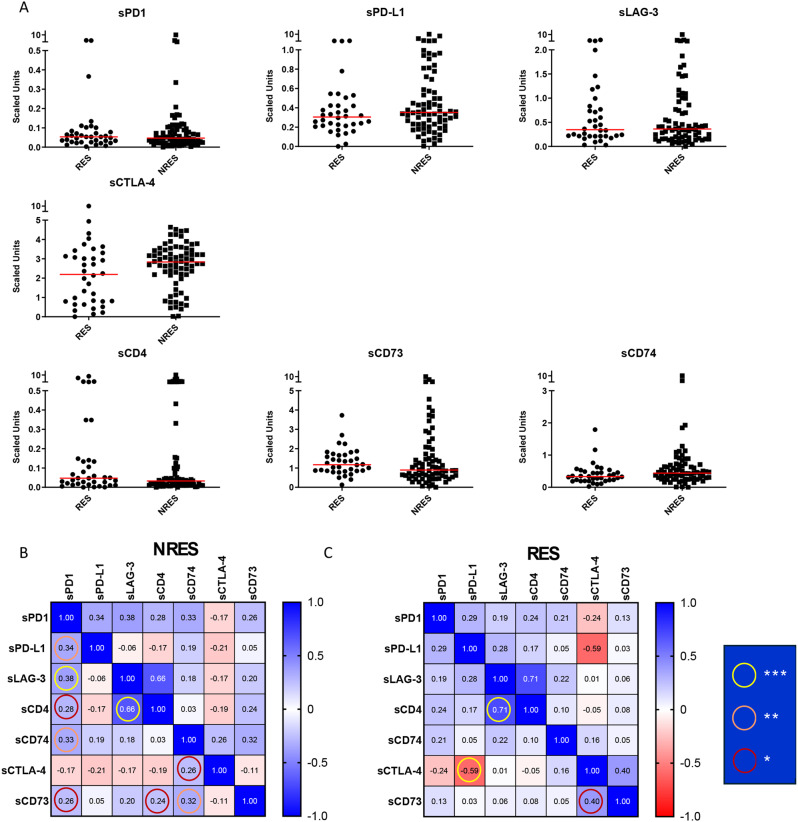
Results: No biomarker showed statistically significant differences between responders and non-responders. However, high number of significant correlations were observed among certain biomarkers in non-responders. Through univariate and multivariate Cox analyses, we identified sPD-L1, sCTLA-4, sCD73, and sCD74 as independent biomarkers predicting progression-free survival and overall survival. According to ROC analysis we discovered that, except for sCD73, values of sPD-L1, sCTLA-4, and sCD74 lower than the cut-off predicted lower disease progression and reduced mortality. A comprehensive risk score for predicting progression-free survival was developed by incorporating the values of the two identified independent factors, sCTLA-4 and sCD74, which significantly improved the accuracy of outcome prediction. Pilot validations highlighted the potential use of the risk score in treatment-naive individuals and long responders.
Conclusion: In summary, risk score based on circulating sCTLA-4 and sCD74 reflects the response to immune checkpoint inhibitor (ICI) therapy in MM patients. If confirmed, through further validation, these findings could assist in recommending therapy to patients likely to experience a long-lasting response.
期刊介绍:
The Journal of Experimental & Clinical Cancer Research is an esteemed peer-reviewed publication that focuses on cancer research, encompassing everything from fundamental discoveries to practical applications.
We welcome submissions that showcase groundbreaking advancements in the field of cancer research, especially those that bridge the gap between laboratory findings and clinical implementation. Our goal is to foster a deeper understanding of cancer, improve prevention and detection strategies, facilitate accurate diagnosis, and enhance treatment options.
We are particularly interested in manuscripts that shed light on the mechanisms behind the development and progression of cancer, including metastasis. Additionally, we encourage submissions that explore molecular alterations or biomarkers that can help predict the efficacy of different treatments or identify drug resistance. Translational research related to targeted therapies, personalized medicine, tumor immunotherapy, and innovative approaches applicable to clinical investigations are also of great interest to us.
We provide a platform for the dissemination of large-scale molecular characterizations of human tumors and encourage researchers to share their insights, discoveries, and methodologies with the wider scientific community.
By publishing high-quality research articles, reviews, and commentaries, the Journal of Experimental & Clinical Cancer Research strives to contribute to the continuous improvement of cancer care and make a meaningful impact on patients' lives.






 京公网安备 11010802042870号
京ICP备2023020795号-1
京公网安备 11010802042870号
京ICP备2023020795号-1

 分享
分享
 求助内容:
求助内容: 应助结果提醒方式:
 扫码关注我们
