Rashida Yasmeen, Sheikh M. S. Islam, Jincheng Du and Mohammad A. Omary
{"title":"去氟化FMOF-1的多功能功能化以增强碳捕获和分离:预测性分子模拟研究","authors":"Rashida Yasmeen, Sheikh M. S. Islam, Jincheng Du and Mohammad A. Omary","doi":"10.1039/D4DT03093A","DOIUrl":null,"url":null,"abstract":"<p >Fluorous metal–organic frameworks, FMOFs, represent a superhydrophobic class of MOFs containing –CF<small><sub>3</sub></small> or –F groups in their pores. The primary objective of this research is to computationally design functionalized FMOF-1-X with X = –OCH<small><sub>3</sub></small>, –CN, –OH, –COOH, and –NH<small><sub>2</sub></small> instead of –CF<small><sub>3</sub></small> and analyze their CO<small><sub>2</sub></small> adsorption and separation characteristics. Grand Canonical Monte Carlo (GCMC) simulations have been used to study the adsorption properties of CO<small><sub>2</sub></small>, CH<small><sub>4</sub></small>, and N<small><sub>2</sub></small> in all structures. Henry's constant (<em>K</em><small><sub>H</sub></small>) and isosteric heat of adsorption at infinite dilution (<em>Q</em><small><sub>st0</sub></small>) estimated from molecular Monte Carlo simulations plus the binding energy (BE) from Möller–Plesset second-order perturbation theory (MP2) quantum-mechanical simulations characterize adsorbate–adsorbent interaction strengths. Such simulations predict a systematic enhancement of all <em>K</em><small><sub>H</sub></small>, <em>Q</em><small><sub>st0</sub></small>, and BE values in X-functionalized MOFs <em>vs</em>. the parent FMOF-1. Among such functional MOFs, the X = –COOH structure is predicted to exhibit the largest CO<small><sub>2</sub></small> uptake in the low-pressure region due to the strongest CO<small><sub>2</sub></small>/–COOH interaction strength, as supported by the largest <em>K</em><small><sub>H</sub></small> value (1.02 × 10<small><sup>−4</sup></small> mol kg<small><sup>−1</sup></small> Pa<small><sup>−1</sup></small>). In contrast, at high pressures (30 bar), the X = –OH structure is predicted to exhibit the highest CO<small><sub>2</sub></small> uptake. Indeed, replacing the –CF<small><sub>3</sub></small> groups in FMOF-1 by any aforementioned X group is expected to afford higher CO<small><sub>2</sub></small> uptake in the GCMC-simulated adsorption isotherms compared to the parent material. The selective adsorption of CO<small><sub>2</sub></small> over CH<small><sub>4</sub></small> and N<small><sub>2</sub></small> was determined using the ideal adsorbed solution theory (IAST) method at 50 : 50 and 15 : 85 CO<small><sub>2</sub></small>/CH<small><sub>4</sub></small> and CO<small><sub>2</sub></small>/N<small><sub>2</sub></small> binary mixtures, respectively. The X = –COOH structure amounts to the largest selectivity (59.6 for CO<small><sub>2</sub></small>/CH<small><sub>4</sub></small> and 128.7 for CO<small><sub>2</sub></small>/N<small><sub>2</sub></small>), <em>i.e.</em>, nearly 40× and 43× higher <em>vs</em>. FMOF-1 (1.5 and 3 for CO<small><sub>2</sub></small>/CH<small><sub>4</sub></small> and CO<small><sub>2</sub></small>/N<small><sub>2</sub></small>, respectively) at 298 K and 0.1 bar. The study herein of functionalized MOFs for CO<small><sub>2</sub></small> separation, natural gas purification, landfill gas separation, and/or CO<small><sub>2</sub></small> flue gas capture suggest that X = –OH, –COOH, and –NH<small><sub>2</sub></small> are promising to enhance the adsorption capacity and selectivity.</p>","PeriodicalId":71,"journal":{"name":"Dalton Transactions","volume":" 19","pages":" 7659-7675"},"PeriodicalIF":3.3000,"publicationDate":"2025-02-07","publicationTypes":"Journal Article","fieldsOfStudy":null,"isOpenAccess":false,"openAccessPdf":"","citationCount":"0","resultStr":"{\"title\":\"Versatile functionalization of de-fluorinated FMOF-1 towards enhanced carbon capture and separation: a predictive molecular simulation study†\",\"authors\":\"Rashida Yasmeen, Sheikh M. S. Islam, Jincheng Du and Mohammad A. Omary\",\"doi\":\"10.1039/D4DT03093A\",\"DOIUrl\":null,\"url\":null,\"abstract\":\"<p >Fluorous metal–organic frameworks, FMOFs, represent a superhydrophobic class of MOFs containing –CF<small><sub>3</sub></small> or –F groups in their pores. The primary objective of this research is to computationally design functionalized FMOF-1-X with X = –OCH<small><sub>3</sub></small>, –CN, –OH, –COOH, and –NH<small><sub>2</sub></small> instead of –CF<small><sub>3</sub></small> and analyze their CO<small><sub>2</sub></small> adsorption and separation characteristics. Grand Canonical Monte Carlo (GCMC) simulations have been used to study the adsorption properties of CO<small><sub>2</sub></small>, CH<small><sub>4</sub></small>, and N<small><sub>2</sub></small> in all structures. Henry's constant (<em>K</em><small><sub>H</sub></small>) and isosteric heat of adsorption at infinite dilution (<em>Q</em><small><sub>st0</sub></small>) estimated from molecular Monte Carlo simulations plus the binding energy (BE) from Möller–Plesset second-order perturbation theory (MP2) quantum-mechanical simulations characterize adsorbate–adsorbent interaction strengths. Such simulations predict a systematic enhancement of all <em>K</em><small><sub>H</sub></small>, <em>Q</em><small><sub>st0</sub></small>, and BE values in X-functionalized MOFs <em>vs</em>. the parent FMOF-1. Among such functional MOFs, the X = –COOH structure is predicted to exhibit the largest CO<small><sub>2</sub></small> uptake in the low-pressure region due to the strongest CO<small><sub>2</sub></small>/–COOH interaction strength, as supported by the largest <em>K</em><small><sub>H</sub></small> value (1.02 × 10<small><sup>−4</sup></small> mol kg<small><sup>−1</sup></small> Pa<small><sup>−1</sup></small>). In contrast, at high pressures (30 bar), the X = –OH structure is predicted to exhibit the highest CO<small><sub>2</sub></small> uptake. Indeed, replacing the –CF<small><sub>3</sub></small> groups in FMOF-1 by any aforementioned X group is expected to afford higher CO<small><sub>2</sub></small> uptake in the GCMC-simulated adsorption isotherms compared to the parent material. The selective adsorption of CO<small><sub>2</sub></small> over CH<small><sub>4</sub></small> and N<small><sub>2</sub></small> was determined using the ideal adsorbed solution theory (IAST) method at 50 : 50 and 15 : 85 CO<small><sub>2</sub></small>/CH<small><sub>4</sub></small> and CO<small><sub>2</sub></small>/N<small><sub>2</sub></small> binary mixtures, respectively. The X = –COOH structure amounts to the largest selectivity (59.6 for CO<small><sub>2</sub></small>/CH<small><sub>4</sub></small> and 128.7 for CO<small><sub>2</sub></small>/N<small><sub>2</sub></small>), <em>i.e.</em>, nearly 40× and 43× higher <em>vs</em>. FMOF-1 (1.5 and 3 for CO<small><sub>2</sub></small>/CH<small><sub>4</sub></small> and CO<small><sub>2</sub></small>/N<small><sub>2</sub></small>, respectively) at 298 K and 0.1 bar. The study herein of functionalized MOFs for CO<small><sub>2</sub></small> separation, natural gas purification, landfill gas separation, and/or CO<small><sub>2</sub></small> flue gas capture suggest that X = –OH, –COOH, and –NH<small><sub>2</sub></small> are promising to enhance the adsorption capacity and selectivity.</p>\",\"PeriodicalId\":71,\"journal\":{\"name\":\"Dalton Transactions\",\"volume\":\" 19\",\"pages\":\" 7659-7675\"},\"PeriodicalIF\":3.3000,\"publicationDate\":\"2025-02-07\",\"publicationTypes\":\"Journal Article\",\"fieldsOfStudy\":null,\"isOpenAccess\":false,\"openAccessPdf\":\"\",\"citationCount\":\"0\",\"resultStr\":null,\"platform\":\"Semanticscholar\",\"paperid\":null,\"PeriodicalName\":\"Dalton Transactions\",\"FirstCategoryId\":\"92\",\"ListUrlMain\":\"https://pubs.rsc.org/en/content/articlelanding/2025/dt/d4dt03093a\",\"RegionNum\":3,\"RegionCategory\":\"化学\",\"ArticlePicture\":[],\"TitleCN\":null,\"AbstractTextCN\":null,\"PMCID\":null,\"EPubDate\":\"\",\"PubModel\":\"\",\"JCR\":\"Q2\",\"JCRName\":\"CHEMISTRY, INORGANIC & NUCLEAR\",\"Score\":null,\"Total\":0}","platform":"Semanticscholar","paperid":null,"PeriodicalName":"Dalton Transactions","FirstCategoryId":"92","ListUrlMain":"https://pubs.rsc.org/en/content/articlelanding/2025/dt/d4dt03093a","RegionNum":3,"RegionCategory":"化学","ArticlePicture":[],"TitleCN":null,"AbstractTextCN":null,"PMCID":null,"EPubDate":"","PubModel":"","JCR":"Q2","JCRName":"CHEMISTRY, INORGANIC & NUCLEAR","Score":null,"Total":0}
Versatile functionalization of de-fluorinated FMOF-1 towards enhanced carbon capture and separation: a predictive molecular simulation study†
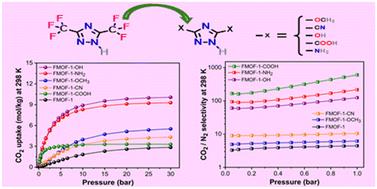
Fluorous metal–organic frameworks, FMOFs, represent a superhydrophobic class of MOFs containing –CF3 or –F groups in their pores. The primary objective of this research is to computationally design functionalized FMOF-1-X with X = –OCH3, –CN, –OH, –COOH, and –NH2 instead of –CF3 and analyze their CO2 adsorption and separation characteristics. Grand Canonical Monte Carlo (GCMC) simulations have been used to study the adsorption properties of CO2, CH4, and N2 in all structures. Henry's constant (KH) and isosteric heat of adsorption at infinite dilution (Qst0) estimated from molecular Monte Carlo simulations plus the binding energy (BE) from Möller–Plesset second-order perturbation theory (MP2) quantum-mechanical simulations characterize adsorbate–adsorbent interaction strengths. Such simulations predict a systematic enhancement of all KH, Qst0, and BE values in X-functionalized MOFs vs. the parent FMOF-1. Among such functional MOFs, the X = –COOH structure is predicted to exhibit the largest CO2 uptake in the low-pressure region due to the strongest CO2/–COOH interaction strength, as supported by the largest KH value (1.02 × 10⁻⁴ mol kg−1 Pa−1). In contrast, at high pressures (30 bar), the X = –OH structure is predicted to exhibit the highest CO2 uptake. Indeed, replacing the –CF3 groups in FMOF-1 by any aforementioned X group is expected to afford higher CO2 uptake in the GCMC-simulated adsorption isotherms compared to the parent material. The selective adsorption of CO2 over CH4 and N2 was determined using the ideal adsorbed solution theory (IAST) method at 50 : 50 and 15 : 85 CO2/CH4 and CO2/N2 binary mixtures, respectively. The X = –COOH structure amounts to the largest selectivity (59.6 for CO2/CH4 and 128.7 for CO2/N2), i.e., nearly 40× and 43× higher vs. FMOF-1 (1.5 and 3 for CO2/CH4 and CO2/N2, respectively) at 298 K and 0.1 bar. The study herein of functionalized MOFs for CO2 separation, natural gas purification, landfill gas separation, and/or CO2 flue gas capture suggest that X = –OH, –COOH, and –NH2 are promising to enhance the adsorption capacity and selectivity.
期刊介绍:
Dalton Transactions is a journal for all areas of inorganic chemistry, which encompasses the organometallic, bioinorganic and materials chemistry of the elements, with applications including synthesis, catalysis, energy conversion/storage, electrical devices and medicine. Dalton Transactions welcomes high-quality, original submissions in all of these areas and more, where the advancement of knowledge in inorganic chemistry is significant.




 京公网安备 11010802042870号
京ICP备2023020795号-1
京公网安备 11010802042870号
京ICP备2023020795号-1

 分享
分享
 求助内容:
求助内容: 应助结果提醒方式:
 扫码关注我们
