Zhenye Li, Jiefeng Xie, Wenquan Wang, Zhiyuan Yang, Lixuan Kan, Ming Zhang, Zaiyu Wang, Wenyu Yang, Feng Peng, Wenkai Zhong and Lei Ying
{"title":"通过客体聚合物辅助的形态纤化,在有机光伏电池中实现19.6%的效率","authors":"Zhenye Li, Jiefeng Xie, Wenquan Wang, Zhiyuan Yang, Lixuan Kan, Ming Zhang, Zaiyu Wang, Wenyu Yang, Feng Peng, Wenkai Zhong and Lei Ying","doi":"10.1039/D4EE03461A","DOIUrl":null,"url":null,"abstract":"<p >Achieving high-performance organic photovoltaics (OPVs) hinges on optimizing the phase separation and interfaces within the active layer, which is crucial for efficient charge generation and transport. While a fibril-like phase-separated network has been widely recognized as the desirable morphology across various blend systems, robust methods to consistently achieve this structure remain elusive, limiting further efficiency gains. Here, we introduce a morphological control strategy using an imide-functionalized benzotriazole polymer, PTzBI-dF, within a D18:L8-BO blend to enhance fibrillar morphology. PTzBI-dF exhibits preferential miscibility with D18, fostering π–π stacking and increasing crystallinity, which result in a well-defined fibrillar network that optimizes its electrical and photophysical properties. Therefore, the D18:PTzBI-dF:L8-BO device achieves a remarkable power conversion efficiency of 19.6% for 0.04 cm<small><sup>2</sup></small> devices and a certified 18.35% for 1 cm<small><sup>2</sup></small> devices, representing the highest value reported so far for 1 cm<small><sup>2</sup></small> devices. Furthermore, this guest-polymer-assisted fibrillization shows versatility across various blend systems, offering a promising approach for enhancing OPV performance.</p>","PeriodicalId":72,"journal":{"name":"Energy & Environmental Science","volume":" 6","pages":" 3026-3035"},"PeriodicalIF":30.8000,"publicationDate":"2025-02-06","publicationTypes":"Journal Article","fieldsOfStudy":null,"isOpenAccess":false,"openAccessPdf":"","citationCount":"0","resultStr":"{\"title\":\"Achieving 19.6% efficiency in organic photovoltaics through guest-polymer assisted morphological fibrillization†\",\"authors\":\"Zhenye Li, Jiefeng Xie, Wenquan Wang, Zhiyuan Yang, Lixuan Kan, Ming Zhang, Zaiyu Wang, Wenyu Yang, Feng Peng, Wenkai Zhong and Lei Ying\",\"doi\":\"10.1039/D4EE03461A\",\"DOIUrl\":null,\"url\":null,\"abstract\":\"<p >Achieving high-performance organic photovoltaics (OPVs) hinges on optimizing the phase separation and interfaces within the active layer, which is crucial for efficient charge generation and transport. While a fibril-like phase-separated network has been widely recognized as the desirable morphology across various blend systems, robust methods to consistently achieve this structure remain elusive, limiting further efficiency gains. Here, we introduce a morphological control strategy using an imide-functionalized benzotriazole polymer, PTzBI-dF, within a D18:L8-BO blend to enhance fibrillar morphology. PTzBI-dF exhibits preferential miscibility with D18, fostering π–π stacking and increasing crystallinity, which result in a well-defined fibrillar network that optimizes its electrical and photophysical properties. Therefore, the D18:PTzBI-dF:L8-BO device achieves a remarkable power conversion efficiency of 19.6% for 0.04 cm<small><sup>2</sup></small> devices and a certified 18.35% for 1 cm<small><sup>2</sup></small> devices, representing the highest value reported so far for 1 cm<small><sup>2</sup></small> devices. Furthermore, this guest-polymer-assisted fibrillization shows versatility across various blend systems, offering a promising approach for enhancing OPV performance.</p>\",\"PeriodicalId\":72,\"journal\":{\"name\":\"Energy & Environmental Science\",\"volume\":\" 6\",\"pages\":\" 3026-3035\"},\"PeriodicalIF\":30.8000,\"publicationDate\":\"2025-02-06\",\"publicationTypes\":\"Journal Article\",\"fieldsOfStudy\":null,\"isOpenAccess\":false,\"openAccessPdf\":\"\",\"citationCount\":\"0\",\"resultStr\":null,\"platform\":\"Semanticscholar\",\"paperid\":null,\"PeriodicalName\":\"Energy & Environmental Science\",\"FirstCategoryId\":\"88\",\"ListUrlMain\":\"https://pubs.rsc.org/en/content/articlelanding/2025/ee/d4ee03461a\",\"RegionNum\":1,\"RegionCategory\":\"材料科学\",\"ArticlePicture\":[],\"TitleCN\":null,\"AbstractTextCN\":null,\"PMCID\":null,\"EPubDate\":\"\",\"PubModel\":\"\",\"JCR\":\"Q1\",\"JCRName\":\"CHEMISTRY, MULTIDISCIPLINARY\",\"Score\":null,\"Total\":0}","platform":"Semanticscholar","paperid":null,"PeriodicalName":"Energy & Environmental Science","FirstCategoryId":"88","ListUrlMain":"https://pubs.rsc.org/en/content/articlelanding/2025/ee/d4ee03461a","RegionNum":1,"RegionCategory":"材料科学","ArticlePicture":[],"TitleCN":null,"AbstractTextCN":null,"PMCID":null,"EPubDate":"","PubModel":"","JCR":"Q1","JCRName":"CHEMISTRY, MULTIDISCIPLINARY","Score":null,"Total":0}
Achieving 19.6% efficiency in organic photovoltaics through guest-polymer assisted morphological fibrillization†
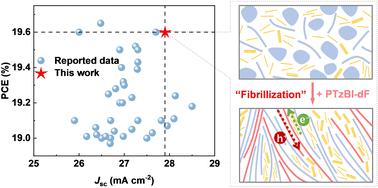
Achieving high-performance organic photovoltaics (OPVs) hinges on optimizing the phase separation and interfaces within the active layer, which is crucial for efficient charge generation and transport. While a fibril-like phase-separated network has been widely recognized as the desirable morphology across various blend systems, robust methods to consistently achieve this structure remain elusive, limiting further efficiency gains. Here, we introduce a morphological control strategy using an imide-functionalized benzotriazole polymer, PTzBI-dF, within a D18:L8-BO blend to enhance fibrillar morphology. PTzBI-dF exhibits preferential miscibility with D18, fostering π–π stacking and increasing crystallinity, which result in a well-defined fibrillar network that optimizes its electrical and photophysical properties. Therefore, the D18:PTzBI-dF:L8-BO device achieves a remarkable power conversion efficiency of 19.6% for 0.04 cm2 devices and a certified 18.35% for 1 cm2 devices, representing the highest value reported so far for 1 cm2 devices. Furthermore, this guest-polymer-assisted fibrillization shows versatility across various blend systems, offering a promising approach for enhancing OPV performance.
期刊介绍:
Energy & Environmental Science, a peer-reviewed scientific journal, publishes original research and review articles covering interdisciplinary topics in the (bio)chemical and (bio)physical sciences, as well as chemical engineering disciplines. Published monthly by the Royal Society of Chemistry (RSC), a not-for-profit publisher, Energy & Environmental Science is recognized as a leading journal. It boasts an impressive impact factor of 8.500 as of 2009, ranking 8th among 140 journals in the category "Chemistry, Multidisciplinary," second among 71 journals in "Energy & Fuels," second among 128 journals in "Engineering, Chemical," and first among 181 scientific journals in "Environmental Sciences."
Energy & Environmental Science publishes various types of articles, including Research Papers (original scientific work), Review Articles, Perspectives, and Minireviews (feature review-type articles of broad interest), Communications (original scientific work of an urgent nature), Opinions (personal, often speculative viewpoints or hypotheses on current topics), and Analysis Articles (in-depth examination of energy-related issues).




 京公网安备 11010802042870号
京ICP备2023020795号-1
京公网安备 11010802042870号
京ICP备2023020795号-1

 分享
分享
 求助内容:
求助内容: 应助结果提醒方式:
 扫码关注我们
