Fengping Yu , Jingtian Gao , Peng Zhang , Shike Tang , Hongjie Liu , Weiping Li
{"title":"不同金属氧化物纳米颗粒在水生环境中的分布、环境行为和生态毒性","authors":"Fengping Yu , Jingtian Gao , Peng Zhang , Shike Tang , Hongjie Liu , Weiping Li","doi":"10.1016/j.psep.2025.106856","DOIUrl":null,"url":null,"abstract":"<div><div>Metal oxide nanoparticles (MONPs) are inevitably released into environment during the life cycle. Transformation processes of MONPs such as aggregation, deposition, and dissolution in environment will dominate the occurrence forms. Occurrence forms of MONPs will influence their mobility, bioavailability, and toxicity. Transformation of MONPs under the impact of pH, ionic strength (IS), and natural organic matter (NOM) are summarized to thoroughly identify environmental behavior of MONPs. The effect of MONPs on physiological and biochemical properties of microalgae in freshwater systems are discussed, and the toxicity mechanisms of MONPs were analyzed. The relationship between transformed occurrence forms of MONPs and their ecotoxicity caused by the variation of water quality factors is emphasized. Noteworthily, the transformation pathway of MONPs under the influence of environmental factors is uncertain, which makes it difficult to predict their occurrence forms in surface waters. Therefore, it's crucial to consider the combined impact of these factors on MONPs behavior in natural aquatic environment. Overall, this review aims to enhance the comprehension of their environmental risks in aquatic settings and establish a scientific foundation for the sustainable progression of nanotechnology.</div></div>","PeriodicalId":20743,"journal":{"name":"Process Safety and Environmental Protection","volume":"196 ","pages":"Article 106856"},"PeriodicalIF":7.8000,"publicationDate":"2025-04-01","publicationTypes":"Journal Article","fieldsOfStudy":null,"isOpenAccess":false,"openAccessPdf":"","citationCount":"0","resultStr":"{\"title\":\"Distribution, environmental behavior, and ecotoxicity of different metal oxide nanoparticles in the aquatic environment\",\"authors\":\"Fengping Yu , Jingtian Gao , Peng Zhang , Shike Tang , Hongjie Liu , Weiping Li\",\"doi\":\"10.1016/j.psep.2025.106856\",\"DOIUrl\":null,\"url\":null,\"abstract\":\"<div><div>Metal oxide nanoparticles (MONPs) are inevitably released into environment during the life cycle. Transformation processes of MONPs such as aggregation, deposition, and dissolution in environment will dominate the occurrence forms. Occurrence forms of MONPs will influence their mobility, bioavailability, and toxicity. Transformation of MONPs under the impact of pH, ionic strength (IS), and natural organic matter (NOM) are summarized to thoroughly identify environmental behavior of MONPs. The effect of MONPs on physiological and biochemical properties of microalgae in freshwater systems are discussed, and the toxicity mechanisms of MONPs were analyzed. The relationship between transformed occurrence forms of MONPs and their ecotoxicity caused by the variation of water quality factors is emphasized. Noteworthily, the transformation pathway of MONPs under the influence of environmental factors is uncertain, which makes it difficult to predict their occurrence forms in surface waters. Therefore, it's crucial to consider the combined impact of these factors on MONPs behavior in natural aquatic environment. Overall, this review aims to enhance the comprehension of their environmental risks in aquatic settings and establish a scientific foundation for the sustainable progression of nanotechnology.</div></div>\",\"PeriodicalId\":20743,\"journal\":{\"name\":\"Process Safety and Environmental Protection\",\"volume\":\"196 \",\"pages\":\"Article 106856\"},\"PeriodicalIF\":7.8000,\"publicationDate\":\"2025-04-01\",\"publicationTypes\":\"Journal Article\",\"fieldsOfStudy\":null,\"isOpenAccess\":false,\"openAccessPdf\":\"\",\"citationCount\":\"0\",\"resultStr\":null,\"platform\":\"Semanticscholar\",\"paperid\":null,\"PeriodicalName\":\"Process Safety and Environmental Protection\",\"FirstCategoryId\":\"93\",\"ListUrlMain\":\"https://www.sciencedirect.com/science/article/pii/S0957582025001235\",\"RegionNum\":2,\"RegionCategory\":\"环境科学与生态学\",\"ArticlePicture\":[],\"TitleCN\":null,\"AbstractTextCN\":null,\"PMCID\":null,\"EPubDate\":\"2025/2/4 0:00:00\",\"PubModel\":\"Epub\",\"JCR\":\"Q1\",\"JCRName\":\"ENGINEERING, CHEMICAL\",\"Score\":null,\"Total\":0}","platform":"Semanticscholar","paperid":null,"PeriodicalName":"Process Safety and Environmental Protection","FirstCategoryId":"93","ListUrlMain":"https://www.sciencedirect.com/science/article/pii/S0957582025001235","RegionNum":2,"RegionCategory":"环境科学与生态学","ArticlePicture":[],"TitleCN":null,"AbstractTextCN":null,"PMCID":null,"EPubDate":"2025/2/4 0:00:00","PubModel":"Epub","JCR":"Q1","JCRName":"ENGINEERING, CHEMICAL","Score":null,"Total":0}
Distribution, environmental behavior, and ecotoxicity of different metal oxide nanoparticles in the aquatic environment
Metal oxide nanoparticles (MONPs) are inevitably released into environment during the life cycle. Transformation processes of MONPs such as aggregation, deposition, and dissolution in environment will dominate the occurrence forms. Occurrence forms of MONPs will influence their mobility, bioavailability, and toxicity. Transformation of MONPs under the impact of pH, ionic strength (IS), and natural organic matter (NOM) are summarized to thoroughly identify environmental behavior of MONPs. The effect of MONPs on physiological and biochemical properties of microalgae in freshwater systems are discussed, and the toxicity mechanisms of MONPs were analyzed. The relationship between transformed occurrence forms of MONPs and their ecotoxicity caused by the variation of water quality factors is emphasized. Noteworthily, the transformation pathway of MONPs under the influence of environmental factors is uncertain, which makes it difficult to predict their occurrence forms in surface waters. Therefore, it's crucial to consider the combined impact of these factors on MONPs behavior in natural aquatic environment. Overall, this review aims to enhance the comprehension of their environmental risks in aquatic settings and establish a scientific foundation for the sustainable progression of nanotechnology.
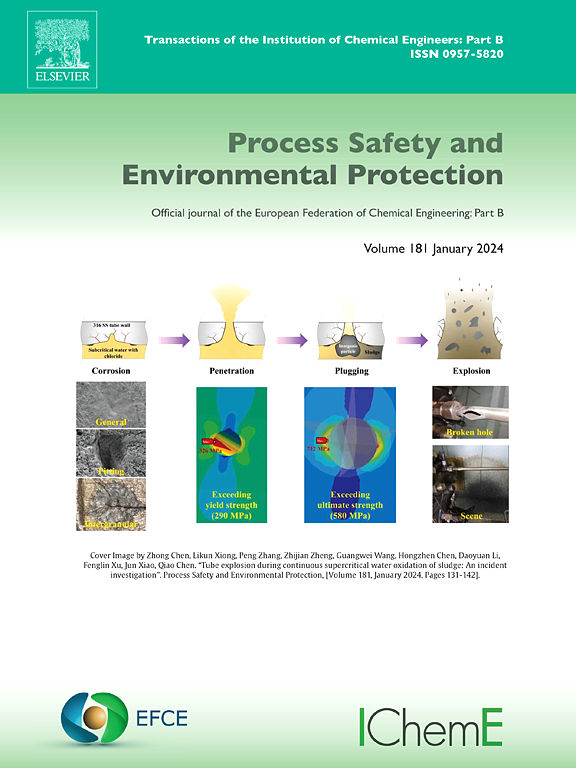
期刊介绍:
The Process Safety and Environmental Protection (PSEP) journal is a leading international publication that focuses on the publication of high-quality, original research papers in the field of engineering, specifically those related to the safety of industrial processes and environmental protection. The journal encourages submissions that present new developments in safety and environmental aspects, particularly those that show how research findings can be applied in process engineering design and practice.
PSEP is particularly interested in research that brings fresh perspectives to established engineering principles, identifies unsolved problems, or suggests directions for future research. The journal also values contributions that push the boundaries of traditional engineering and welcomes multidisciplinary papers.
PSEP's articles are abstracted and indexed by a range of databases and services, which helps to ensure that the journal's research is accessible and recognized in the academic and professional communities. These databases include ANTE, Chemical Abstracts, Chemical Hazards in Industry, Current Contents, Elsevier Engineering Information database, Pascal Francis, Web of Science, Scopus, Engineering Information Database EnCompass LIT (Elsevier), and INSPEC. This wide coverage facilitates the dissemination of the journal's content to a global audience interested in process safety and environmental engineering.




 京公网安备 11010802042870号
京ICP备2023020795号-1
京公网安备 11010802042870号
京ICP备2023020795号-1

 分享
分享
 求助内容:
求助内容: 应助结果提醒方式:
 扫码关注我们
