Xiangjun Gong , Wei Guo , Zhiping Zhao , Changmei Sun , Ying Zhang , Rongjun Qu , Yunxia Shen , Ying Wang
{"title":"原位溶液聚合法制备芳纶纳米材料及其在聚氯乙烯增强中的应用","authors":"Xiangjun Gong , Wei Guo , Zhiping Zhao , Changmei Sun , Ying Zhang , Rongjun Qu , Yunxia Shen , Ying Wang","doi":"10.1016/j.eurpolymj.2024.113618","DOIUrl":null,"url":null,"abstract":"<div><div>Traditionally, aramid fibers or nanofibers (ANFs) consist of poly-<em>p</em>-phenylene terephthanlamide (PPTA) molecules, which can be used to reinforce polar polymers containing the same polar groups (e.g., C = O and –NH-). In this paper, aramid nanomaterials (ANM) were synthesized directly from polyvinyl chloride (PVC) matrix solution using “bottom-up” in-situ method to improve the poor toughness of PVC. Transmission electron microscopy (TEM) showed that ANM was uniformly dispersed in PVC matrix, and the morphology of ANM synthesized in different solvents was different, with slightly different modification effects. ANM shows two characteristic peaks of 1536 cm<sup>−1</sup> and 1339 cm<sup>−1</sup> in Fourier transform infrared spectroscopy (FTIR), which are characteristic of PPTA, and shows the same 2θ angles of 18°, 22°, and 27° as PPTA in X-ray diffraction (XRD). In terms of the mechanical properties of the composites, the addition of ANM can significantly increase the toughness and strength of PVC and improve the corrosion resistance of the material, in which the toughness increase rate of ANM/PVC/DMF-4 is 861.7 %.</div></div>","PeriodicalId":315,"journal":{"name":"European Polymer Journal","volume":"223 ","pages":"Article 113618"},"PeriodicalIF":6.3000,"publicationDate":"2025-01-16","publicationTypes":"Journal Article","fieldsOfStudy":null,"isOpenAccess":false,"openAccessPdf":"","citationCount":"0","resultStr":"{\"title\":\"Synthesis of aramid nanomaterials by in-situ solution polymerization and application in reinforcement of polyvinyl chloride\",\"authors\":\"Xiangjun Gong , Wei Guo , Zhiping Zhao , Changmei Sun , Ying Zhang , Rongjun Qu , Yunxia Shen , Ying Wang\",\"doi\":\"10.1016/j.eurpolymj.2024.113618\",\"DOIUrl\":null,\"url\":null,\"abstract\":\"<div><div>Traditionally, aramid fibers or nanofibers (ANFs) consist of poly-<em>p</em>-phenylene terephthanlamide (PPTA) molecules, which can be used to reinforce polar polymers containing the same polar groups (e.g., C = O and –NH-). In this paper, aramid nanomaterials (ANM) were synthesized directly from polyvinyl chloride (PVC) matrix solution using “bottom-up” in-situ method to improve the poor toughness of PVC. Transmission electron microscopy (TEM) showed that ANM was uniformly dispersed in PVC matrix, and the morphology of ANM synthesized in different solvents was different, with slightly different modification effects. ANM shows two characteristic peaks of 1536 cm<sup>−1</sup> and 1339 cm<sup>−1</sup> in Fourier transform infrared spectroscopy (FTIR), which are characteristic of PPTA, and shows the same 2θ angles of 18°, 22°, and 27° as PPTA in X-ray diffraction (XRD). In terms of the mechanical properties of the composites, the addition of ANM can significantly increase the toughness and strength of PVC and improve the corrosion resistance of the material, in which the toughness increase rate of ANM/PVC/DMF-4 is 861.7 %.</div></div>\",\"PeriodicalId\":315,\"journal\":{\"name\":\"European Polymer Journal\",\"volume\":\"223 \",\"pages\":\"Article 113618\"},\"PeriodicalIF\":6.3000,\"publicationDate\":\"2025-01-16\",\"publicationTypes\":\"Journal Article\",\"fieldsOfStudy\":null,\"isOpenAccess\":false,\"openAccessPdf\":\"\",\"citationCount\":\"0\",\"resultStr\":null,\"platform\":\"Semanticscholar\",\"paperid\":null,\"PeriodicalName\":\"European Polymer Journal\",\"FirstCategoryId\":\"92\",\"ListUrlMain\":\"https://www.sciencedirect.com/science/article/pii/S0014305724008796\",\"RegionNum\":2,\"RegionCategory\":\"化学\",\"ArticlePicture\":[],\"TitleCN\":null,\"AbstractTextCN\":null,\"PMCID\":null,\"EPubDate\":\"2024/12/10 0:00:00\",\"PubModel\":\"Epub\",\"JCR\":\"Q1\",\"JCRName\":\"POLYMER SCIENCE\",\"Score\":null,\"Total\":0}","platform":"Semanticscholar","paperid":null,"PeriodicalName":"European Polymer Journal","FirstCategoryId":"92","ListUrlMain":"https://www.sciencedirect.com/science/article/pii/S0014305724008796","RegionNum":2,"RegionCategory":"化学","ArticlePicture":[],"TitleCN":null,"AbstractTextCN":null,"PMCID":null,"EPubDate":"2024/12/10 0:00:00","PubModel":"Epub","JCR":"Q1","JCRName":"POLYMER SCIENCE","Score":null,"Total":0}
Synthesis of aramid nanomaterials by in-situ solution polymerization and application in reinforcement of polyvinyl chloride
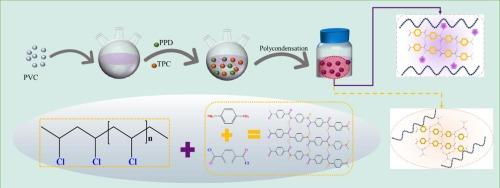
Traditionally, aramid fibers or nanofibers (ANFs) consist of poly-p-phenylene terephthanlamide (PPTA) molecules, which can be used to reinforce polar polymers containing the same polar groups (e.g., C = O and –NH-). In this paper, aramid nanomaterials (ANM) were synthesized directly from polyvinyl chloride (PVC) matrix solution using “bottom-up” in-situ method to improve the poor toughness of PVC. Transmission electron microscopy (TEM) showed that ANM was uniformly dispersed in PVC matrix, and the morphology of ANM synthesized in different solvents was different, with slightly different modification effects. ANM shows two characteristic peaks of 1536 cm−1 and 1339 cm−1 in Fourier transform infrared spectroscopy (FTIR), which are characteristic of PPTA, and shows the same 2θ angles of 18°, 22°, and 27° as PPTA in X-ray diffraction (XRD). In terms of the mechanical properties of the composites, the addition of ANM can significantly increase the toughness and strength of PVC and improve the corrosion resistance of the material, in which the toughness increase rate of ANM/PVC/DMF-4 is 861.7 %.
期刊介绍:
European Polymer Journal is dedicated to publishing work on fundamental and applied polymer chemistry and macromolecular materials. The journal covers all aspects of polymer synthesis, including polymerization mechanisms and chemical functional transformations, with a focus on novel polymers and the relationships between molecular structure and polymer properties. In addition, we welcome submissions on bio-based or renewable polymers, stimuli-responsive systems and polymer bio-hybrids. European Polymer Journal also publishes research on the biomedical application of polymers, including drug delivery and regenerative medicine. The main scope is covered but not limited to the following core research areas:
Polymer synthesis and functionalization
• Novel synthetic routes for polymerization, functional modification, controlled/living polymerization and precision polymers.
Stimuli-responsive polymers
• Including shape memory and self-healing polymers.
Supramolecular polymers and self-assembly
• Molecular recognition and higher order polymer structures.
Renewable and sustainable polymers
• Bio-based, biodegradable and anti-microbial polymers and polymeric bio-nanocomposites.
Polymers at interfaces and surfaces
• Chemistry and engineering of surfaces with biological relevance, including patterning, antifouling polymers and polymers for membrane applications.
Biomedical applications and nanomedicine
• Polymers for regenerative medicine, drug delivery molecular release and gene therapy
The scope of European Polymer Journal no longer includes Polymer Physics.




 京公网安备 11010802042870号
京ICP备2023020795号-1
京公网安备 11010802042870号
京ICP备2023020795号-1

 分享
分享
 求助内容:
求助内容: 应助结果提醒方式:
 扫码关注我们
