{"title":"衣康酸在偶极非质子溶剂中的自由基聚合−高单体浓度的影响","authors":"Kacper Mielczarek , Hynek Beneš , Szczepan Bednarz","doi":"10.1016/j.eurpolymj.2024.113632","DOIUrl":null,"url":null,"abstract":"<div><div>In this study, the dipolar aprotic solvents were used as reaction systems for homopolymerization of itaconic acid (IA). The influence of the dipolar aprotic solvent properties, as represented by the Kamlet-Taft parameters, on the solubility of IA was elucidated using the Linear Solvation Energy Relationships (LSER). Hydrogen bonding in IA solutions was investigated through FT-IR spectroscopy and viscosity measurements. It was found that high IA solubility caused by strong hydrogen bond basicity of the solvents, is a key factor affecting its radical polymerization process, as evidenced by the exponential increase in the molecular weight of the resulting poly(itaconic acid) (PIA) with increasing initial IA concentration. This phenomenon can be explained by diffusion controlled termination of polymerization caused by viscosity of the reaction system. Among the solvents tested, DMSO was identified as the most suitable solvent for IA polymerization due to its high solubility. By using this solvent, average molecular weight of the resulting PIA could be tuned over a wide range from 1 000 to 100<!--> <!-->000 g/mol.</div></div>","PeriodicalId":315,"journal":{"name":"European Polymer Journal","volume":"223 ","pages":"Article 113632"},"PeriodicalIF":6.8000,"publicationDate":"2025-01-16","publicationTypes":"Journal Article","fieldsOfStudy":null,"isOpenAccess":false,"openAccessPdf":"","citationCount":"0","resultStr":"{\"title\":\"Radical polymerization of itaconic acid in dipolar aprotic solvents − The effect of high monomer concentration\",\"authors\":\"Kacper Mielczarek , Hynek Beneš , Szczepan Bednarz\",\"doi\":\"10.1016/j.eurpolymj.2024.113632\",\"DOIUrl\":null,\"url\":null,\"abstract\":\"<div><div>In this study, the dipolar aprotic solvents were used as reaction systems for homopolymerization of itaconic acid (IA). The influence of the dipolar aprotic solvent properties, as represented by the Kamlet-Taft parameters, on the solubility of IA was elucidated using the Linear Solvation Energy Relationships (LSER). Hydrogen bonding in IA solutions was investigated through FT-IR spectroscopy and viscosity measurements. It was found that high IA solubility caused by strong hydrogen bond basicity of the solvents, is a key factor affecting its radical polymerization process, as evidenced by the exponential increase in the molecular weight of the resulting poly(itaconic acid) (PIA) with increasing initial IA concentration. This phenomenon can be explained by diffusion controlled termination of polymerization caused by viscosity of the reaction system. Among the solvents tested, DMSO was identified as the most suitable solvent for IA polymerization due to its high solubility. By using this solvent, average molecular weight of the resulting PIA could be tuned over a wide range from 1 000 to 100<!--> <!-->000 g/mol.</div></div>\",\"PeriodicalId\":315,\"journal\":{\"name\":\"European Polymer Journal\",\"volume\":\"223 \",\"pages\":\"Article 113632\"},\"PeriodicalIF\":6.8000,\"publicationDate\":\"2025-01-16\",\"publicationTypes\":\"Journal Article\",\"fieldsOfStudy\":null,\"isOpenAccess\":false,\"openAccessPdf\":\"\",\"citationCount\":\"0\",\"resultStr\":null,\"platform\":\"Semanticscholar\",\"paperid\":null,\"PeriodicalName\":\"European Polymer Journal\",\"FirstCategoryId\":\"92\",\"ListUrlMain\":\"https://www.sciencedirect.com/science/article/pii/S0014305724008930\",\"RegionNum\":2,\"RegionCategory\":\"化学\",\"ArticlePicture\":[],\"TitleCN\":null,\"AbstractTextCN\":null,\"PMCID\":null,\"EPubDate\":\"2024/12/9 0:00:00\",\"PubModel\":\"Epub\",\"JCR\":\"Q1\",\"JCRName\":\"POLYMER SCIENCE\",\"Score\":null,\"Total\":0}","platform":"Semanticscholar","paperid":null,"PeriodicalName":"European Polymer Journal","FirstCategoryId":"92","ListUrlMain":"https://www.sciencedirect.com/science/article/pii/S0014305724008930","RegionNum":2,"RegionCategory":"化学","ArticlePicture":[],"TitleCN":null,"AbstractTextCN":null,"PMCID":null,"EPubDate":"2024/12/9 0:00:00","PubModel":"Epub","JCR":"Q1","JCRName":"POLYMER SCIENCE","Score":null,"Total":0}
Radical polymerization of itaconic acid in dipolar aprotic solvents − The effect of high monomer concentration
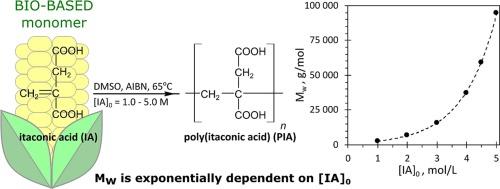
In this study, the dipolar aprotic solvents were used as reaction systems for homopolymerization of itaconic acid (IA). The influence of the dipolar aprotic solvent properties, as represented by the Kamlet-Taft parameters, on the solubility of IA was elucidated using the Linear Solvation Energy Relationships (LSER). Hydrogen bonding in IA solutions was investigated through FT-IR spectroscopy and viscosity measurements. It was found that high IA solubility caused by strong hydrogen bond basicity of the solvents, is a key factor affecting its radical polymerization process, as evidenced by the exponential increase in the molecular weight of the resulting poly(itaconic acid) (PIA) with increasing initial IA concentration. This phenomenon can be explained by diffusion controlled termination of polymerization caused by viscosity of the reaction system. Among the solvents tested, DMSO was identified as the most suitable solvent for IA polymerization due to its high solubility. By using this solvent, average molecular weight of the resulting PIA could be tuned over a wide range from 1 000 to 100 000 g/mol.
期刊介绍:
European Polymer Journal is dedicated to publishing work on fundamental and applied polymer chemistry and macromolecular materials. The journal covers all aspects of polymer synthesis, including polymerization mechanisms and chemical functional transformations, with a focus on novel polymers and the relationships between molecular structure and polymer properties. In addition, we welcome submissions on bio-based or renewable polymers, stimuli-responsive systems and polymer bio-hybrids. European Polymer Journal also publishes research on the biomedical application of polymers, including drug delivery and regenerative medicine. The main scope is covered but not limited to the following core research areas:
Polymer synthesis and functionalization
• Novel synthetic routes for polymerization, functional modification, controlled/living polymerization and precision polymers.
Stimuli-responsive polymers
• Including shape memory and self-healing polymers.
Supramolecular polymers and self-assembly
• Molecular recognition and higher order polymer structures.
Renewable and sustainable polymers
• Bio-based, biodegradable and anti-microbial polymers and polymeric bio-nanocomposites.
Polymers at interfaces and surfaces
• Chemistry and engineering of surfaces with biological relevance, including patterning, antifouling polymers and polymers for membrane applications.
Biomedical applications and nanomedicine
• Polymers for regenerative medicine, drug delivery molecular release and gene therapy
The scope of European Polymer Journal no longer includes Polymer Physics.




 京公网安备 11010802042870号
京ICP备2023020795号-1
京公网安备 11010802042870号
京ICP备2023020795号-1

 分享
分享
 求助内容:
求助内容: 应助结果提醒方式:
 扫码关注我们
