Seoyeong Ahn , Hyewon Yun , Jieun Oh , Sooyoung Kim , Hyemin Jang , Yejin Kim , Cinoo Kang , Sojin Ahn , Ayoung Kim , Dohoon Kwon , Jinah Park , Insung Song , Jeongmin Moon , Ejin Kim , Jieun Min , Ho Kim , Whanhee Lee
{"title":"短期暴露于暖季臭氧、心血管死亡率和新型高危人群:一项全国时间分层病例交叉研究","authors":"Seoyeong Ahn , Hyewon Yun , Jieun Oh , Sooyoung Kim , Hyemin Jang , Yejin Kim , Cinoo Kang , Sojin Ahn , Ayoung Kim , Dohoon Kwon , Jinah Park , Insung Song , Jeongmin Moon , Ejin Kim , Jieun Min , Ho Kim , Whanhee Lee","doi":"10.1016/j.atmosenv.2025.121031","DOIUrl":null,"url":null,"abstract":"<div><div>A considerable number of previous studies have limitations in evaluating the population-representative relationship between ozone and cardiovascular disease (CVD) mortality risk and revealing high-risk populations due to the limited data availability that could not cover unmonitored areas. To estimate the population-representative association between warm-season (Apr–Sep) ozone and CVD mortality and examine high-risk populations, this study conducted a nationwide case-crossover study in South Korea from 2015 to 2019. Stratified analyses and meta-regression were also performed for each cause of death and demographic characteristics to find high-risk populations. As an exposure, daily modeled warm-season ozone estimated by a machine learning-based ensemble model was used (R<sup>2</sup> > 0.92). In the total population, warm-season ozone was associated with an increased risk of total CVD death (OR: 1.010, 95% CI: 1.002–1.018), and mortality due to ischemic heart disease showed the highest OR (1.019, 1.003–1.035). The warm-season ozone-related CVD death risk was the highest in younger age groups (0–59 y) across all causes of CVD deaths, except for cerebrovascular disease death. The higher accessibility to hospital beds per 1000 was associated with a lower ozone risk of CVD mortality. The estimated excess CVD mortality fractions and years of life lost from mortality (YLL) attributable to warm-season ozone were 5.10% and 119,353.37 years. Our findings suggest that younger populations should be recognized as novel high-risk populations related to warm-season ozone and CVD mortality, and this study also provides potential benefits for constructing stricter ozone mitigation action plans.</div></div>","PeriodicalId":250,"journal":{"name":"Atmospheric Environment","volume":"345 ","pages":"Article 121031"},"PeriodicalIF":3.7000,"publicationDate":"2025-03-05","publicationTypes":"Journal Article","fieldsOfStudy":null,"isOpenAccess":false,"openAccessPdf":"","citationCount":"0","resultStr":"{\"title\":\"Short-term exposure to warm-season ozone, cardiovascular mortality, and novel high-risk populations: A nationwide time-stratified case-crossover study\",\"authors\":\"Seoyeong Ahn , Hyewon Yun , Jieun Oh , Sooyoung Kim , Hyemin Jang , Yejin Kim , Cinoo Kang , Sojin Ahn , Ayoung Kim , Dohoon Kwon , Jinah Park , Insung Song , Jeongmin Moon , Ejin Kim , Jieun Min , Ho Kim , Whanhee Lee\",\"doi\":\"10.1016/j.atmosenv.2025.121031\",\"DOIUrl\":null,\"url\":null,\"abstract\":\"<div><div>A considerable number of previous studies have limitations in evaluating the population-representative relationship between ozone and cardiovascular disease (CVD) mortality risk and revealing high-risk populations due to the limited data availability that could not cover unmonitored areas. To estimate the population-representative association between warm-season (Apr–Sep) ozone and CVD mortality and examine high-risk populations, this study conducted a nationwide case-crossover study in South Korea from 2015 to 2019. Stratified analyses and meta-regression were also performed for each cause of death and demographic characteristics to find high-risk populations. As an exposure, daily modeled warm-season ozone estimated by a machine learning-based ensemble model was used (R<sup>2</sup> > 0.92). In the total population, warm-season ozone was associated with an increased risk of total CVD death (OR: 1.010, 95% CI: 1.002–1.018), and mortality due to ischemic heart disease showed the highest OR (1.019, 1.003–1.035). The warm-season ozone-related CVD death risk was the highest in younger age groups (0–59 y) across all causes of CVD deaths, except for cerebrovascular disease death. The higher accessibility to hospital beds per 1000 was associated with a lower ozone risk of CVD mortality. The estimated excess CVD mortality fractions and years of life lost from mortality (YLL) attributable to warm-season ozone were 5.10% and 119,353.37 years. Our findings suggest that younger populations should be recognized as novel high-risk populations related to warm-season ozone and CVD mortality, and this study also provides potential benefits for constructing stricter ozone mitigation action plans.</div></div>\",\"PeriodicalId\":250,\"journal\":{\"name\":\"Atmospheric Environment\",\"volume\":\"345 \",\"pages\":\"Article 121031\"},\"PeriodicalIF\":3.7000,\"publicationDate\":\"2025-03-05\",\"publicationTypes\":\"Journal Article\",\"fieldsOfStudy\":null,\"isOpenAccess\":false,\"openAccessPdf\":\"\",\"citationCount\":\"0\",\"resultStr\":null,\"platform\":\"Semanticscholar\",\"paperid\":null,\"PeriodicalName\":\"Atmospheric Environment\",\"FirstCategoryId\":\"93\",\"ListUrlMain\":\"https://www.sciencedirect.com/science/article/pii/S1352231025000068\",\"RegionNum\":2,\"RegionCategory\":\"环境科学与生态学\",\"ArticlePicture\":[],\"TitleCN\":null,\"AbstractTextCN\":null,\"PMCID\":null,\"EPubDate\":\"2025/1/8 0:00:00\",\"PubModel\":\"Epub\",\"JCR\":\"Q2\",\"JCRName\":\"ENVIRONMENTAL SCIENCES\",\"Score\":null,\"Total\":0}","platform":"Semanticscholar","paperid":null,"PeriodicalName":"Atmospheric Environment","FirstCategoryId":"93","ListUrlMain":"https://www.sciencedirect.com/science/article/pii/S1352231025000068","RegionNum":2,"RegionCategory":"环境科学与生态学","ArticlePicture":[],"TitleCN":null,"AbstractTextCN":null,"PMCID":null,"EPubDate":"2025/1/8 0:00:00","PubModel":"Epub","JCR":"Q2","JCRName":"ENVIRONMENTAL SCIENCES","Score":null,"Total":0}
Short-term exposure to warm-season ozone, cardiovascular mortality, and novel high-risk populations: A nationwide time-stratified case-crossover study
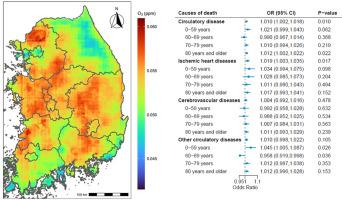
A considerable number of previous studies have limitations in evaluating the population-representative relationship between ozone and cardiovascular disease (CVD) mortality risk and revealing high-risk populations due to the limited data availability that could not cover unmonitored areas. To estimate the population-representative association between warm-season (Apr–Sep) ozone and CVD mortality and examine high-risk populations, this study conducted a nationwide case-crossover study in South Korea from 2015 to 2019. Stratified analyses and meta-regression were also performed for each cause of death and demographic characteristics to find high-risk populations. As an exposure, daily modeled warm-season ozone estimated by a machine learning-based ensemble model was used (R2 > 0.92). In the total population, warm-season ozone was associated with an increased risk of total CVD death (OR: 1.010, 95% CI: 1.002–1.018), and mortality due to ischemic heart disease showed the highest OR (1.019, 1.003–1.035). The warm-season ozone-related CVD death risk was the highest in younger age groups (0–59 y) across all causes of CVD deaths, except for cerebrovascular disease death. The higher accessibility to hospital beds per 1000 was associated with a lower ozone risk of CVD mortality. The estimated excess CVD mortality fractions and years of life lost from mortality (YLL) attributable to warm-season ozone were 5.10% and 119,353.37 years. Our findings suggest that younger populations should be recognized as novel high-risk populations related to warm-season ozone and CVD mortality, and this study also provides potential benefits for constructing stricter ozone mitigation action plans.
期刊介绍:
Atmospheric Environment has an open access mirror journal Atmospheric Environment: X, sharing the same aims and scope, editorial team, submission system and rigorous peer review.
Atmospheric Environment is the international journal for scientists in different disciplines related to atmospheric composition and its impacts. The journal publishes scientific articles with atmospheric relevance of emissions and depositions of gaseous and particulate compounds, chemical processes and physical effects in the atmosphere, as well as impacts of the changing atmospheric composition on human health, air quality, climate change, and ecosystems.




 京公网安备 11010802042870号
京ICP备2023020795号-1
京公网安备 11010802042870号
京ICP备2023020795号-1

 分享
分享
 求助内容:
求助内容: 应助结果提醒方式:
 扫码关注我们
