Tian-wen Chen , Shi-jiong Han , Yan-chen Yang , Gen-wen He , Zhao-yang Song , Zi-jian Zeng
{"title":"南岭东成矿带牛星坝银铅锌矿床岩浆作用与成矿作用:锆石U-Pb和闪锌矿Rb-Sr定年、地球化学和H-O-S-Pb同位素地球化学的制约","authors":"Tian-wen Chen , Shi-jiong Han , Yan-chen Yang , Gen-wen He , Zhao-yang Song , Zi-jian Zeng","doi":"10.1016/j.oregeorev.2025.106467","DOIUrl":null,"url":null,"abstract":"<div><div>The Niuxingba deposit, a recently discovered large-scale Ag–Pb–Zn deposit in the eastern Nanling metallogenic belt (NMB), South China, contains proven metal reserves of 124,982 tons Pb, 291,585 tons Zn, and 488.3 tons Ag. The orebodies mainly consist of vein-like sulfides, and occur in the volcanoclastic sedimentary rocks of Neoproterozoic Kuli Formation. The Ag–Pb–Zn orebodies yielded a sphalerite Rb-Sr isochronal age of 158.6 ± 2.2 Ma. Zircon LA–ICP–MS U–Pb dating revealed that the ore-related granodiorite porphyry was formed at 160.7 ± 1.9 Ma, suggesting the Late Jurassic magmatism and mineralization. Ore-related granodiorite porphyry at Niuxingba exhibits light hydrothermal alterations with loss on ignition values (LOI) of 4.62 %–7.07 %. The fluid immobile elements indicate that it is geochemically akin to the granitoids linked to Pb–Zn polymetallic mineralization in the NMB, and genetically belongs to weakly peraluminous high-K I-type granite. The Hf isotope compositions indicate that the magma probably originated from the partial melting of low crustal basement, with a minor contribution from juvenile crustal melts. H–O isotope characteristics indicate a magmatic source for ore-forming fluids, with less input from meteoric water. Additionally, the narrow δ<sup>34</sup>S values (−3.8 ‰ to −0.3 ‰) of sulfides from mineralization stages II and IV are consistent with other Pb–Zn polymetallic deposits in the Shi-Hang Belt, suggesting a magmatic source. The Pb isotopic data indicate the ore-forming materials at Niuxingba derived from a crust-mantle mixing source. Combined with the regional tectonic setting, we propose that the Niuxingba deposit is a magmatic-hydrothermal deposit that formed in an extensional setting related to Paleo-Pacific plate subduction.</div></div>","PeriodicalId":19644,"journal":{"name":"Ore Geology Reviews","volume":"178 ","pages":"Article 106467"},"PeriodicalIF":3.6000,"publicationDate":"2025-03-01","publicationTypes":"Journal Article","fieldsOfStudy":null,"isOpenAccess":false,"openAccessPdf":"","citationCount":"0","resultStr":"{\"title\":\"Magmatism and mineralization of the Niuxingba Ag–Pb–Zn deposit in the eastern Nanling metallogenic belt, South China: Constrains from zircon U–Pb and sphalerite Rb–Sr dating, geochemistry and H–O–S–Pb isotope geochemistry\",\"authors\":\"Tian-wen Chen , Shi-jiong Han , Yan-chen Yang , Gen-wen He , Zhao-yang Song , Zi-jian Zeng\",\"doi\":\"10.1016/j.oregeorev.2025.106467\",\"DOIUrl\":null,\"url\":null,\"abstract\":\"<div><div>The Niuxingba deposit, a recently discovered large-scale Ag–Pb–Zn deposit in the eastern Nanling metallogenic belt (NMB), South China, contains proven metal reserves of 124,982 tons Pb, 291,585 tons Zn, and 488.3 tons Ag. The orebodies mainly consist of vein-like sulfides, and occur in the volcanoclastic sedimentary rocks of Neoproterozoic Kuli Formation. The Ag–Pb–Zn orebodies yielded a sphalerite Rb-Sr isochronal age of 158.6 ± 2.2 Ma. Zircon LA–ICP–MS U–Pb dating revealed that the ore-related granodiorite porphyry was formed at 160.7 ± 1.9 Ma, suggesting the Late Jurassic magmatism and mineralization. Ore-related granodiorite porphyry at Niuxingba exhibits light hydrothermal alterations with loss on ignition values (LOI) of 4.62 %–7.07 %. The fluid immobile elements indicate that it is geochemically akin to the granitoids linked to Pb–Zn polymetallic mineralization in the NMB, and genetically belongs to weakly peraluminous high-K I-type granite. The Hf isotope compositions indicate that the magma probably originated from the partial melting of low crustal basement, with a minor contribution from juvenile crustal melts. H–O isotope characteristics indicate a magmatic source for ore-forming fluids, with less input from meteoric water. Additionally, the narrow δ<sup>34</sup>S values (−3.8 ‰ to −0.3 ‰) of sulfides from mineralization stages II and IV are consistent with other Pb–Zn polymetallic deposits in the Shi-Hang Belt, suggesting a magmatic source. The Pb isotopic data indicate the ore-forming materials at Niuxingba derived from a crust-mantle mixing source. Combined with the regional tectonic setting, we propose that the Niuxingba deposit is a magmatic-hydrothermal deposit that formed in an extensional setting related to Paleo-Pacific plate subduction.</div></div>\",\"PeriodicalId\":19644,\"journal\":{\"name\":\"Ore Geology Reviews\",\"volume\":\"178 \",\"pages\":\"Article 106467\"},\"PeriodicalIF\":3.6000,\"publicationDate\":\"2025-03-01\",\"publicationTypes\":\"Journal Article\",\"fieldsOfStudy\":null,\"isOpenAccess\":false,\"openAccessPdf\":\"\",\"citationCount\":\"0\",\"resultStr\":null,\"platform\":\"Semanticscholar\",\"paperid\":null,\"PeriodicalName\":\"Ore Geology Reviews\",\"FirstCategoryId\":\"89\",\"ListUrlMain\":\"https://www.sciencedirect.com/science/article/pii/S0169136825000277\",\"RegionNum\":2,\"RegionCategory\":\"地球科学\",\"ArticlePicture\":[],\"TitleCN\":null,\"AbstractTextCN\":null,\"PMCID\":null,\"EPubDate\":\"2025/2/1 0:00:00\",\"PubModel\":\"Epub\",\"JCR\":\"Q1\",\"JCRName\":\"GEOLOGY\",\"Score\":null,\"Total\":0}","platform":"Semanticscholar","paperid":null,"PeriodicalName":"Ore Geology Reviews","FirstCategoryId":"89","ListUrlMain":"https://www.sciencedirect.com/science/article/pii/S0169136825000277","RegionNum":2,"RegionCategory":"地球科学","ArticlePicture":[],"TitleCN":null,"AbstractTextCN":null,"PMCID":null,"EPubDate":"2025/2/1 0:00:00","PubModel":"Epub","JCR":"Q1","JCRName":"GEOLOGY","Score":null,"Total":0}
Magmatism and mineralization of the Niuxingba Ag–Pb–Zn deposit in the eastern Nanling metallogenic belt, South China: Constrains from zircon U–Pb and sphalerite Rb–Sr dating, geochemistry and H–O–S–Pb isotope geochemistry
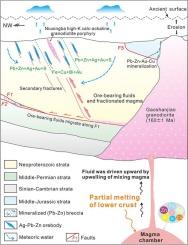
The Niuxingba deposit, a recently discovered large-scale Ag–Pb–Zn deposit in the eastern Nanling metallogenic belt (NMB), South China, contains proven metal reserves of 124,982 tons Pb, 291,585 tons Zn, and 488.3 tons Ag. The orebodies mainly consist of vein-like sulfides, and occur in the volcanoclastic sedimentary rocks of Neoproterozoic Kuli Formation. The Ag–Pb–Zn orebodies yielded a sphalerite Rb-Sr isochronal age of 158.6 ± 2.2 Ma. Zircon LA–ICP–MS U–Pb dating revealed that the ore-related granodiorite porphyry was formed at 160.7 ± 1.9 Ma, suggesting the Late Jurassic magmatism and mineralization. Ore-related granodiorite porphyry at Niuxingba exhibits light hydrothermal alterations with loss on ignition values (LOI) of 4.62 %–7.07 %. The fluid immobile elements indicate that it is geochemically akin to the granitoids linked to Pb–Zn polymetallic mineralization in the NMB, and genetically belongs to weakly peraluminous high-K I-type granite. The Hf isotope compositions indicate that the magma probably originated from the partial melting of low crustal basement, with a minor contribution from juvenile crustal melts. H–O isotope characteristics indicate a magmatic source for ore-forming fluids, with less input from meteoric water. Additionally, the narrow δ34S values (−3.8 ‰ to −0.3 ‰) of sulfides from mineralization stages II and IV are consistent with other Pb–Zn polymetallic deposits in the Shi-Hang Belt, suggesting a magmatic source. The Pb isotopic data indicate the ore-forming materials at Niuxingba derived from a crust-mantle mixing source. Combined with the regional tectonic setting, we propose that the Niuxingba deposit is a magmatic-hydrothermal deposit that formed in an extensional setting related to Paleo-Pacific plate subduction.
期刊介绍:
Ore Geology Reviews aims to familiarize all earth scientists with recent advances in a number of interconnected disciplines related to the study of, and search for, ore deposits. The reviews range from brief to longer contributions, but the journal preferentially publishes manuscripts that fill the niche between the commonly shorter journal articles and the comprehensive book coverages, and thus has a special appeal to many authors and readers.




 京公网安备 11010802042870号
京ICP备2023020795号-1
京公网安备 11010802042870号
京ICP备2023020795号-1

 分享
分享
 求助内容:
求助内容: 应助结果提醒方式:
 扫码关注我们
