Chenfei Wang , Bing Yu , Tong Zhao , Fan Yang , Muhua Chen , Xinbao Zhu , Zhengchun Cai , Bo Fu
{"title":"壳聚糖低温剂加入植酸改性UiO-66-NH2增强阻燃性能","authors":"Chenfei Wang , Bing Yu , Tong Zhao , Fan Yang , Muhua Chen , Xinbao Zhu , Zhengchun Cai , Bo Fu","doi":"10.1016/j.carbpol.2025.123259","DOIUrl":null,"url":null,"abstract":"<div><div>In this work, chitosan (CS) was used as the skeleton to synthesize flame-retardant composite cryogels. Phytic acid (PA)-modified Zr-based metal-organic framework (PA-UiO-66-NH<sub>2</sub>) was integrated into the CS network to enhance flame retardant performance. The vertical combustion test (UL-94) grade was V-0, and the limiting oxygen index (LOI) value reached 39 % when the flame retardant (PA-UiO-66-NH<sub>2</sub>) addition content was 15 %. Cone calorimetry tests demonstrated that the inclusion of PA-UiO-66-NH<sub>2</sub> significantly decreased the heat release and smoke generation, facilitating the formation of a compact carbon layer on the cryogels. With a thermal conductivity of 0.03447 W/(m·K), the modified CS-15PA-UiO-66-NH<sub>2</sub> cryogels maintained their superior thermal insulating capabilities as compared to the pristine cryogels. The water contact angle of the cryogels hydrophobically modified with methyl trichlorosilane (MTCS) was 135.3° ± 2.3°. This study presents cryogels with excellent flame retardancy, and such material is expected to replace conventional petroleum products in energy storage and building insulation.</div></div>","PeriodicalId":261,"journal":{"name":"Carbohydrate Polymers","volume":"353 ","pages":"Article 123259"},"PeriodicalIF":12.5000,"publicationDate":"2025-04-01","publicationTypes":"Journal Article","fieldsOfStudy":null,"isOpenAccess":false,"openAccessPdf":"","citationCount":"0","resultStr":"{\"title\":\"Chitosan cryogels incorporated with phytic acid-modified UiO-66-NH2 for enhanced flame-retardant performance\",\"authors\":\"Chenfei Wang , Bing Yu , Tong Zhao , Fan Yang , Muhua Chen , Xinbao Zhu , Zhengchun Cai , Bo Fu\",\"doi\":\"10.1016/j.carbpol.2025.123259\",\"DOIUrl\":null,\"url\":null,\"abstract\":\"<div><div>In this work, chitosan (CS) was used as the skeleton to synthesize flame-retardant composite cryogels. Phytic acid (PA)-modified Zr-based metal-organic framework (PA-UiO-66-NH<sub>2</sub>) was integrated into the CS network to enhance flame retardant performance. The vertical combustion test (UL-94) grade was V-0, and the limiting oxygen index (LOI) value reached 39 % when the flame retardant (PA-UiO-66-NH<sub>2</sub>) addition content was 15 %. Cone calorimetry tests demonstrated that the inclusion of PA-UiO-66-NH<sub>2</sub> significantly decreased the heat release and smoke generation, facilitating the formation of a compact carbon layer on the cryogels. With a thermal conductivity of 0.03447 W/(m·K), the modified CS-15PA-UiO-66-NH<sub>2</sub> cryogels maintained their superior thermal insulating capabilities as compared to the pristine cryogels. The water contact angle of the cryogels hydrophobically modified with methyl trichlorosilane (MTCS) was 135.3° ± 2.3°. This study presents cryogels with excellent flame retardancy, and such material is expected to replace conventional petroleum products in energy storage and building insulation.</div></div>\",\"PeriodicalId\":261,\"journal\":{\"name\":\"Carbohydrate Polymers\",\"volume\":\"353 \",\"pages\":\"Article 123259\"},\"PeriodicalIF\":12.5000,\"publicationDate\":\"2025-04-01\",\"publicationTypes\":\"Journal Article\",\"fieldsOfStudy\":null,\"isOpenAccess\":false,\"openAccessPdf\":\"\",\"citationCount\":\"0\",\"resultStr\":null,\"platform\":\"Semanticscholar\",\"paperid\":null,\"PeriodicalName\":\"Carbohydrate Polymers\",\"FirstCategoryId\":\"92\",\"ListUrlMain\":\"https://www.sciencedirect.com/science/article/pii/S0144861725000402\",\"RegionNum\":1,\"RegionCategory\":\"化学\",\"ArticlePicture\":[],\"TitleCN\":null,\"AbstractTextCN\":null,\"PMCID\":null,\"EPubDate\":\"2025/1/9 0:00:00\",\"PubModel\":\"Epub\",\"JCR\":\"Q1\",\"JCRName\":\"CHEMISTRY, APPLIED\",\"Score\":null,\"Total\":0}","platform":"Semanticscholar","paperid":null,"PeriodicalName":"Carbohydrate Polymers","FirstCategoryId":"92","ListUrlMain":"https://www.sciencedirect.com/science/article/pii/S0144861725000402","RegionNum":1,"RegionCategory":"化学","ArticlePicture":[],"TitleCN":null,"AbstractTextCN":null,"PMCID":null,"EPubDate":"2025/1/9 0:00:00","PubModel":"Epub","JCR":"Q1","JCRName":"CHEMISTRY, APPLIED","Score":null,"Total":0}
Chitosan cryogels incorporated with phytic acid-modified UiO-66-NH2 for enhanced flame-retardant performance
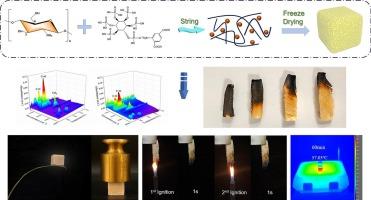
In this work, chitosan (CS) was used as the skeleton to synthesize flame-retardant composite cryogels. Phytic acid (PA)-modified Zr-based metal-organic framework (PA-UiO-66-NH2) was integrated into the CS network to enhance flame retardant performance. The vertical combustion test (UL-94) grade was V-0, and the limiting oxygen index (LOI) value reached 39 % when the flame retardant (PA-UiO-66-NH2) addition content was 15 %. Cone calorimetry tests demonstrated that the inclusion of PA-UiO-66-NH2 significantly decreased the heat release and smoke generation, facilitating the formation of a compact carbon layer on the cryogels. With a thermal conductivity of 0.03447 W/(m·K), the modified CS-15PA-UiO-66-NH2 cryogels maintained their superior thermal insulating capabilities as compared to the pristine cryogels. The water contact angle of the cryogels hydrophobically modified with methyl trichlorosilane (MTCS) was 135.3° ± 2.3°. This study presents cryogels with excellent flame retardancy, and such material is expected to replace conventional petroleum products in energy storage and building insulation.
期刊介绍:
Carbohydrate Polymers stands as a prominent journal in the glycoscience field, dedicated to exploring and harnessing the potential of polysaccharides with applications spanning bioenergy, bioplastics, biomaterials, biorefining, chemistry, drug delivery, food, health, nanotechnology, packaging, paper, pharmaceuticals, medicine, oil recovery, textiles, tissue engineering, wood, and various aspects of glycoscience.
The journal emphasizes the central role of well-characterized carbohydrate polymers, highlighting their significance as the primary focus rather than a peripheral topic. Each paper must prominently feature at least one named carbohydrate polymer, evident in both citation and title, with a commitment to innovative research that advances scientific knowledge.




 京公网安备 11010802042870号
京ICP备2023020795号-1
京公网安备 11010802042870号
京ICP备2023020795号-1

 分享
分享
 求助内容:
求助内容: 应助结果提醒方式:
 扫码关注我们
