Zuliang Shao , Guicheng He , He Liu , Qibin Lin , Lei Sun , Yulong Zhao , Liuke Huang
{"title":"热水诱导水合物解离传热传质特性的数值研究","authors":"Zuliang Shao , Guicheng He , He Liu , Qibin Lin , Lei Sun , Yulong Zhao , Liuke Huang","doi":"10.1016/j.ijheatmasstransfer.2025.126776","DOIUrl":null,"url":null,"abstract":"<div><div>Natural gas hydrate (NGH) has been regarded as one of the most potential alternative energy sources in the 21st century. Thermal stimulation has been regarded as an effective method to recover gas from NGH reservoir. In this paper, a one-dimensional model which considers the reformation of NGH was built to simulate hydrate dissociation by hot water injection. The results indicate that, NGH reformation occurs within a short distance ahead of the dissociation front where exists a suitable thermodynamic environment that can accommodate NGH stably. The gas recovery from NGH can be divided into four stages: no gas production at the first stage, and then the gas production rate increases at a sharp rate to the peak followed by a slow decrease, it will decrease rapidly to zero at the last stage. The water production rapidly increases to its peak in the first few days and then fluctuates around the speed of hot water injection influenced by gas-liquid two phases flow. The dissociation front moves forward almost at a constant rate during the process of hot water injection and the whole model can be divided into four sections. The dissociation front moves faster with the increase of the speeds or the temperatures of hot water injection and it is mainly influenced by the hot water injection speed rather than hot water injection temperature. The Energy efficiency ratios (EERs) are 5.90 and 5.02 as the hot water injection speed is 1 m<sup>3</sup>/day, temperatures are 30 °C and 50 °C, respectively while their production efficiencies (PEs) are very low. By contrast, the EER is 4.66, but the PE improves significantly with hot water injection speed of 2 m<sup>3</sup>/day, temperature of 50 °C. Thus, to improve the EER and PE, it is suggested to exploit NGH by injecting hot water with relatively higher speed and lower temperature.</div></div>","PeriodicalId":336,"journal":{"name":"International Journal of Heat and Mass Transfer","volume":"241 ","pages":"Article 126776"},"PeriodicalIF":5.8000,"publicationDate":"2025-05-15","publicationTypes":"Journal Article","fieldsOfStudy":null,"isOpenAccess":false,"openAccessPdf":"","citationCount":"0","resultStr":"{\"title\":\"Numerical study on heat and mass transfer characteristics of hot water-induced hydrate dissociation\",\"authors\":\"Zuliang Shao , Guicheng He , He Liu , Qibin Lin , Lei Sun , Yulong Zhao , Liuke Huang\",\"doi\":\"10.1016/j.ijheatmasstransfer.2025.126776\",\"DOIUrl\":null,\"url\":null,\"abstract\":\"<div><div>Natural gas hydrate (NGH) has been regarded as one of the most potential alternative energy sources in the 21st century. Thermal stimulation has been regarded as an effective method to recover gas from NGH reservoir. In this paper, a one-dimensional model which considers the reformation of NGH was built to simulate hydrate dissociation by hot water injection. The results indicate that, NGH reformation occurs within a short distance ahead of the dissociation front where exists a suitable thermodynamic environment that can accommodate NGH stably. The gas recovery from NGH can be divided into four stages: no gas production at the first stage, and then the gas production rate increases at a sharp rate to the peak followed by a slow decrease, it will decrease rapidly to zero at the last stage. The water production rapidly increases to its peak in the first few days and then fluctuates around the speed of hot water injection influenced by gas-liquid two phases flow. The dissociation front moves forward almost at a constant rate during the process of hot water injection and the whole model can be divided into four sections. The dissociation front moves faster with the increase of the speeds or the temperatures of hot water injection and it is mainly influenced by the hot water injection speed rather than hot water injection temperature. The Energy efficiency ratios (EERs) are 5.90 and 5.02 as the hot water injection speed is 1 m<sup>3</sup>/day, temperatures are 30 °C and 50 °C, respectively while their production efficiencies (PEs) are very low. By contrast, the EER is 4.66, but the PE improves significantly with hot water injection speed of 2 m<sup>3</sup>/day, temperature of 50 °C. Thus, to improve the EER and PE, it is suggested to exploit NGH by injecting hot water with relatively higher speed and lower temperature.</div></div>\",\"PeriodicalId\":336,\"journal\":{\"name\":\"International Journal of Heat and Mass Transfer\",\"volume\":\"241 \",\"pages\":\"Article 126776\"},\"PeriodicalIF\":5.8000,\"publicationDate\":\"2025-05-15\",\"publicationTypes\":\"Journal Article\",\"fieldsOfStudy\":null,\"isOpenAccess\":false,\"openAccessPdf\":\"\",\"citationCount\":\"0\",\"resultStr\":null,\"platform\":\"Semanticscholar\",\"paperid\":null,\"PeriodicalName\":\"International Journal of Heat and Mass Transfer\",\"FirstCategoryId\":\"5\",\"ListUrlMain\":\"https://www.sciencedirect.com/science/article/pii/S0017931025001176\",\"RegionNum\":2,\"RegionCategory\":\"工程技术\",\"ArticlePicture\":[],\"TitleCN\":null,\"AbstractTextCN\":null,\"PMCID\":null,\"EPubDate\":\"2025/2/6 0:00:00\",\"PubModel\":\"Epub\",\"JCR\":\"Q1\",\"JCRName\":\"ENGINEERING, MECHANICAL\",\"Score\":null,\"Total\":0}","platform":"Semanticscholar","paperid":null,"PeriodicalName":"International Journal of Heat and Mass Transfer","FirstCategoryId":"5","ListUrlMain":"https://www.sciencedirect.com/science/article/pii/S0017931025001176","RegionNum":2,"RegionCategory":"工程技术","ArticlePicture":[],"TitleCN":null,"AbstractTextCN":null,"PMCID":null,"EPubDate":"2025/2/6 0:00:00","PubModel":"Epub","JCR":"Q1","JCRName":"ENGINEERING, MECHANICAL","Score":null,"Total":0}
Numerical study on heat and mass transfer characteristics of hot water-induced hydrate dissociation
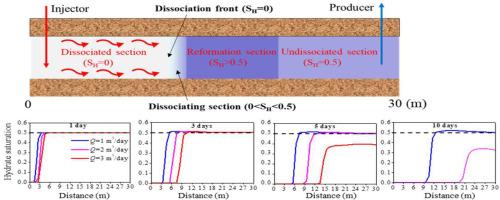
Natural gas hydrate (NGH) has been regarded as one of the most potential alternative energy sources in the 21st century. Thermal stimulation has been regarded as an effective method to recover gas from NGH reservoir. In this paper, a one-dimensional model which considers the reformation of NGH was built to simulate hydrate dissociation by hot water injection. The results indicate that, NGH reformation occurs within a short distance ahead of the dissociation front where exists a suitable thermodynamic environment that can accommodate NGH stably. The gas recovery from NGH can be divided into four stages: no gas production at the first stage, and then the gas production rate increases at a sharp rate to the peak followed by a slow decrease, it will decrease rapidly to zero at the last stage. The water production rapidly increases to its peak in the first few days and then fluctuates around the speed of hot water injection influenced by gas-liquid two phases flow. The dissociation front moves forward almost at a constant rate during the process of hot water injection and the whole model can be divided into four sections. The dissociation front moves faster with the increase of the speeds or the temperatures of hot water injection and it is mainly influenced by the hot water injection speed rather than hot water injection temperature. The Energy efficiency ratios (EERs) are 5.90 and 5.02 as the hot water injection speed is 1 m3/day, temperatures are 30 °C and 50 °C, respectively while their production efficiencies (PEs) are very low. By contrast, the EER is 4.66, but the PE improves significantly with hot water injection speed of 2 m3/day, temperature of 50 °C. Thus, to improve the EER and PE, it is suggested to exploit NGH by injecting hot water with relatively higher speed and lower temperature.
期刊介绍:
International Journal of Heat and Mass Transfer is the vehicle for the exchange of basic ideas in heat and mass transfer between research workers and engineers throughout the world. It focuses on both analytical and experimental research, with an emphasis on contributions which increase the basic understanding of transfer processes and their application to engineering problems.
Topics include:
-New methods of measuring and/or correlating transport-property data
-Energy engineering
-Environmental applications of heat and/or mass transfer




 京公网安备 11010802042870号
京ICP备2023020795号-1
京公网安备 11010802042870号
京ICP备2023020795号-1

 分享
分享
 求助内容:
求助内容: 应助结果提醒方式:
 扫码关注我们
