Ahsan Ahmed, Mubashir Ali Siddiqui, Syed Muhammad Ammar
{"title":"基于利用系数的城市屋顶光伏综合能源、经济和环境(3E)分析","authors":"Ahsan Ahmed, Mubashir Ali Siddiqui, Syed Muhammad Ammar","doi":"10.1016/j.rser.2025.115433","DOIUrl":null,"url":null,"abstract":"<div><div>With increasing prices of grid electricity, the necessity for sustainable and cheaper PV electricity generation also increases. The aim of this research is to examine the overall energy, economic and environmental benefits of urban scale rooftop PV applications. The investigation focuses on PV utilizability with a total study area of 246 km<sup>2</sup>. The PV energy potential is computed as 5,335.6 GWh/year for villas and 2,316.2 GWh/year for apartments with average utilization factors (UFs) of 30 % and 21 %, respectively. By comparing the UFs with studies of different countries, it is concluded that the findings of this study can be applied to buildings in other regions with comparable conditions and structural characteristics. It is extracted that PV application on villas and apartments can offset 87 % and 15 % of total grid load, respectively. It is found that the cooling load can be reduced to 4.5 % with average UF. Economic viability is also assessed at an interest rate of 22 % using factors like life cycle cost (LCC), levelized cost of electricity (LCOE), payback period (PP) and benefits to cost ratio (B/C). The LCC, LCOE, PP and B/C for city scale PV application are determined as USD 4.24 billion, USD 0.0221/kWh, 8.1 years and 1.2, respectively. It is also found that city-scale PV application can save 90.48 million tons of CO<sub>2</sub>, 2,678.2 tons of CH<sub>4</sub>, 382.6 tons of N<sub>2</sub>0, 1.38 million tons of SO<sub>2</sub> and 0.84 tons of NO during the useful life of project.</div></div>","PeriodicalId":418,"journal":{"name":"Renewable and Sustainable Energy Reviews","volume":"212 ","pages":"Article 115433"},"PeriodicalIF":18.0000,"publicationDate":"2025-04-01","publicationTypes":"Journal Article","fieldsOfStudy":null,"isOpenAccess":false,"openAccessPdf":"","citationCount":"0","resultStr":"{\"title\":\"Comprehensive energy, economic, and environmental (3E) analyses for rooftop photovoltaic integration in urban regions employing utilization factor\",\"authors\":\"Ahsan Ahmed, Mubashir Ali Siddiqui, Syed Muhammad Ammar\",\"doi\":\"10.1016/j.rser.2025.115433\",\"DOIUrl\":null,\"url\":null,\"abstract\":\"<div><div>With increasing prices of grid electricity, the necessity for sustainable and cheaper PV electricity generation also increases. The aim of this research is to examine the overall energy, economic and environmental benefits of urban scale rooftop PV applications. The investigation focuses on PV utilizability with a total study area of 246 km<sup>2</sup>. The PV energy potential is computed as 5,335.6 GWh/year for villas and 2,316.2 GWh/year for apartments with average utilization factors (UFs) of 30 % and 21 %, respectively. By comparing the UFs with studies of different countries, it is concluded that the findings of this study can be applied to buildings in other regions with comparable conditions and structural characteristics. It is extracted that PV application on villas and apartments can offset 87 % and 15 % of total grid load, respectively. It is found that the cooling load can be reduced to 4.5 % with average UF. Economic viability is also assessed at an interest rate of 22 % using factors like life cycle cost (LCC), levelized cost of electricity (LCOE), payback period (PP) and benefits to cost ratio (B/C). The LCC, LCOE, PP and B/C for city scale PV application are determined as USD 4.24 billion, USD 0.0221/kWh, 8.1 years and 1.2, respectively. It is also found that city-scale PV application can save 90.48 million tons of CO<sub>2</sub>, 2,678.2 tons of CH<sub>4</sub>, 382.6 tons of N<sub>2</sub>0, 1.38 million tons of SO<sub>2</sub> and 0.84 tons of NO during the useful life of project.</div></div>\",\"PeriodicalId\":418,\"journal\":{\"name\":\"Renewable and Sustainable Energy Reviews\",\"volume\":\"212 \",\"pages\":\"Article 115433\"},\"PeriodicalIF\":18.0000,\"publicationDate\":\"2025-04-01\",\"publicationTypes\":\"Journal Article\",\"fieldsOfStudy\":null,\"isOpenAccess\":false,\"openAccessPdf\":\"\",\"citationCount\":\"0\",\"resultStr\":null,\"platform\":\"Semanticscholar\",\"paperid\":null,\"PeriodicalName\":\"Renewable and Sustainable Energy Reviews\",\"FirstCategoryId\":\"1\",\"ListUrlMain\":\"https://www.sciencedirect.com/science/article/pii/S1364032125001066\",\"RegionNum\":1,\"RegionCategory\":\"工程技术\",\"ArticlePicture\":[],\"TitleCN\":null,\"AbstractTextCN\":null,\"PMCID\":null,\"EPubDate\":\"2025/2/4 0:00:00\",\"PubModel\":\"Epub\",\"JCR\":\"Q1\",\"JCRName\":\"ENERGY & FUELS\",\"Score\":null,\"Total\":0}","platform":"Semanticscholar","paperid":null,"PeriodicalName":"Renewable and Sustainable Energy Reviews","FirstCategoryId":"1","ListUrlMain":"https://www.sciencedirect.com/science/article/pii/S1364032125001066","RegionNum":1,"RegionCategory":"工程技术","ArticlePicture":[],"TitleCN":null,"AbstractTextCN":null,"PMCID":null,"EPubDate":"2025/2/4 0:00:00","PubModel":"Epub","JCR":"Q1","JCRName":"ENERGY & FUELS","Score":null,"Total":0}
Comprehensive energy, economic, and environmental (3E) analyses for rooftop photovoltaic integration in urban regions employing utilization factor
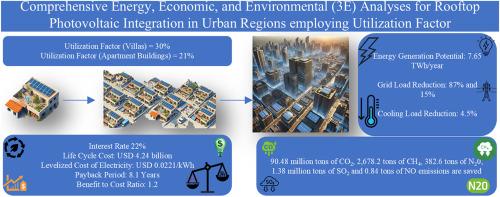
With increasing prices of grid electricity, the necessity for sustainable and cheaper PV electricity generation also increases. The aim of this research is to examine the overall energy, economic and environmental benefits of urban scale rooftop PV applications. The investigation focuses on PV utilizability with a total study area of 246 km2. The PV energy potential is computed as 5,335.6 GWh/year for villas and 2,316.2 GWh/year for apartments with average utilization factors (UFs) of 30 % and 21 %, respectively. By comparing the UFs with studies of different countries, it is concluded that the findings of this study can be applied to buildings in other regions with comparable conditions and structural characteristics. It is extracted that PV application on villas and apartments can offset 87 % and 15 % of total grid load, respectively. It is found that the cooling load can be reduced to 4.5 % with average UF. Economic viability is also assessed at an interest rate of 22 % using factors like life cycle cost (LCC), levelized cost of electricity (LCOE), payback period (PP) and benefits to cost ratio (B/C). The LCC, LCOE, PP and B/C for city scale PV application are determined as USD 4.24 billion, USD 0.0221/kWh, 8.1 years and 1.2, respectively. It is also found that city-scale PV application can save 90.48 million tons of CO2, 2,678.2 tons of CH4, 382.6 tons of N20, 1.38 million tons of SO2 and 0.84 tons of NO during the useful life of project.
期刊介绍:
The mission of Renewable and Sustainable Energy Reviews is to disseminate the most compelling and pertinent critical insights in renewable and sustainable energy, fostering collaboration among the research community, private sector, and policy and decision makers. The journal aims to exchange challenges, solutions, innovative concepts, and technologies, contributing to sustainable development, the transition to a low-carbon future, and the attainment of emissions targets outlined by the United Nations Framework Convention on Climate Change.
Renewable and Sustainable Energy Reviews publishes a diverse range of content, including review papers, original research, case studies, and analyses of new technologies, all featuring a substantial review component such as critique, comparison, or analysis. Introducing a distinctive paper type, Expert Insights, the journal presents commissioned mini-reviews authored by field leaders, addressing topics of significant interest. Case studies undergo consideration only if they showcase the work's applicability to other regions or contribute valuable insights to the broader field of renewable and sustainable energy. Notably, a bibliographic or literature review lacking critical analysis is deemed unsuitable for publication.




 京公网安备 11010802042870号
京ICP备2023020795号-1
京公网安备 11010802042870号
京ICP备2023020795号-1

 分享
分享
 求助内容:
求助内容: 应助结果提醒方式:
 扫码关注我们
