Shivbrat Upadhyay , Rumana Ahmad , Sneha Ghildiyal , Manjari Baluni , Alok Singh , Ishrat Husain , Imran Ahmad , Saurabh Pal , Lamjed Mansour , Sahabjada Siddiqui
{"title":"大蒜对三阴性乳腺癌细胞的抗癌潜力:来自ros介导的细胞周期阻滞和凋亡的证据","authors":"Shivbrat Upadhyay , Rumana Ahmad , Sneha Ghildiyal , Manjari Baluni , Alok Singh , Ishrat Husain , Imran Ahmad , Saurabh Pal , Lamjed Mansour , Sahabjada Siddiqui","doi":"10.1016/j.sajb.2025.01.039","DOIUrl":null,"url":null,"abstract":"<div><div>Breast cancer is a common disease that impacts the women population worldwide and therefore requires effective treatment strategies. <em>Allium sativum</em> L. (<em>A. sativum</em>) has been consumed in conventional remedies since antiquity owing to its extensive medicinal value. This study set out to analyse the primary phytocomponents in the active fraction of <em>A. sativum</em> and to evaluate its <em>in vitro</em> anticancer potential against triple-negative breast cancer (TNBC) MDA-MB-231 cells. Nonpolar to polar fractions of <em>A. sativum</em> extract were subjected to MTT assay, and the active fraction was selected for ROS estimation, apoptosis studies, mitochondrial membrane potential (MMP) assessment and cell cycle analysis. The active fraction was characterized phytochemically using the HPLC technique. The ethyl acetate fraction from <em>A. sativum</em> (EAFAS) was identified as the active fraction based on the MTT screening test. HPLC investigation confirmed two main organosulfur compounds, <em>allicin</em> and <em>alliin</em> in EAFAS. EAFAS treated MDA-MB-231 cells exhibited apoptotic-like morphology; however, no any substantial cytotoxicity toward the normal epithelial cell line Vero was observed. Fluorescence microscope and flow cytometry analysis confirmed both apoptotic and necrotic cell death in TNBC cells. Notably, EAFAS showed a low amount of MMP and a high level of ROS production. A cell-cycle study showed that exposure to the EAFAS enhanced the proportion of cells in the S and G2/M stages. These findings provide crucial new insights into the potential of EAFAS as a medicinal candidate for the treatment of TNBC.</div></div>","PeriodicalId":21919,"journal":{"name":"South African Journal of Botany","volume":"179 ","pages":"Pages 31-38"},"PeriodicalIF":2.7000,"publicationDate":"2025-04-01","publicationTypes":"Journal Article","fieldsOfStudy":null,"isOpenAccess":false,"openAccessPdf":"","citationCount":"0","resultStr":"{\"title\":\"Anticancer potential of Allium sativum against triple-negative breast cancer cells: Evidence from ROS-mediated cell cycle arrest and apoptosis\",\"authors\":\"Shivbrat Upadhyay , Rumana Ahmad , Sneha Ghildiyal , Manjari Baluni , Alok Singh , Ishrat Husain , Imran Ahmad , Saurabh Pal , Lamjed Mansour , Sahabjada Siddiqui\",\"doi\":\"10.1016/j.sajb.2025.01.039\",\"DOIUrl\":null,\"url\":null,\"abstract\":\"<div><div>Breast cancer is a common disease that impacts the women population worldwide and therefore requires effective treatment strategies. <em>Allium sativum</em> L. (<em>A. sativum</em>) has been consumed in conventional remedies since antiquity owing to its extensive medicinal value. This study set out to analyse the primary phytocomponents in the active fraction of <em>A. sativum</em> and to evaluate its <em>in vitro</em> anticancer potential against triple-negative breast cancer (TNBC) MDA-MB-231 cells. Nonpolar to polar fractions of <em>A. sativum</em> extract were subjected to MTT assay, and the active fraction was selected for ROS estimation, apoptosis studies, mitochondrial membrane potential (MMP) assessment and cell cycle analysis. The active fraction was characterized phytochemically using the HPLC technique. The ethyl acetate fraction from <em>A. sativum</em> (EAFAS) was identified as the active fraction based on the MTT screening test. HPLC investigation confirmed two main organosulfur compounds, <em>allicin</em> and <em>alliin</em> in EAFAS. EAFAS treated MDA-MB-231 cells exhibited apoptotic-like morphology; however, no any substantial cytotoxicity toward the normal epithelial cell line Vero was observed. Fluorescence microscope and flow cytometry analysis confirmed both apoptotic and necrotic cell death in TNBC cells. Notably, EAFAS showed a low amount of MMP and a high level of ROS production. A cell-cycle study showed that exposure to the EAFAS enhanced the proportion of cells in the S and G2/M stages. These findings provide crucial new insights into the potential of EAFAS as a medicinal candidate for the treatment of TNBC.</div></div>\",\"PeriodicalId\":21919,\"journal\":{\"name\":\"South African Journal of Botany\",\"volume\":\"179 \",\"pages\":\"Pages 31-38\"},\"PeriodicalIF\":2.7000,\"publicationDate\":\"2025-04-01\",\"publicationTypes\":\"Journal Article\",\"fieldsOfStudy\":null,\"isOpenAccess\":false,\"openAccessPdf\":\"\",\"citationCount\":\"0\",\"resultStr\":null,\"platform\":\"Semanticscholar\",\"paperid\":null,\"PeriodicalName\":\"South African Journal of Botany\",\"FirstCategoryId\":\"99\",\"ListUrlMain\":\"https://www.sciencedirect.com/science/article/pii/S0254629925000523\",\"RegionNum\":3,\"RegionCategory\":\"生物学\",\"ArticlePicture\":[],\"TitleCN\":null,\"AbstractTextCN\":null,\"PMCID\":null,\"EPubDate\":\"2025/2/8 0:00:00\",\"PubModel\":\"Epub\",\"JCR\":\"Q2\",\"JCRName\":\"PLANT SCIENCES\",\"Score\":null,\"Total\":0}","platform":"Semanticscholar","paperid":null,"PeriodicalName":"South African Journal of Botany","FirstCategoryId":"99","ListUrlMain":"https://www.sciencedirect.com/science/article/pii/S0254629925000523","RegionNum":3,"RegionCategory":"生物学","ArticlePicture":[],"TitleCN":null,"AbstractTextCN":null,"PMCID":null,"EPubDate":"2025/2/8 0:00:00","PubModel":"Epub","JCR":"Q2","JCRName":"PLANT SCIENCES","Score":null,"Total":0}
引用次数: 0
摘要
乳腺癌是影响全世界妇女人口的一种常见疾病,因此需要有效的治疗策略。由于其广泛的药用价值,自古代以来,Allium sativum L. (A. sativum)一直被用于常规疗法中。本研究旨在分析苜蓿活性部位的主要植物成分,并评估其对三阴性乳腺癌(TNBC) MDA-MB-231细胞的体外抗癌潜力。采用MTT法对芥蓝提取物的非极性组分和极性组分进行检测,选取活性组分进行活性氧评估、细胞凋亡研究、线粒体膜电位(MMP)评估和细胞周期分析。采用高效液相色谱法对活性部位进行了植物化学表征。通过MTT筛选试验,确定苜蓿乙酸乙酯部位为活性部位。高效液相色谱法证实了EAFAS中主要有两种有机硫化合物:大蒜素和大蒜素。EAFAS处理的MDA-MB-231细胞呈现凋亡样形态;然而,对正常上皮细胞系Vero没有明显的细胞毒性作用。荧光显微镜和流式细胞术分析证实TNBC细胞凋亡和坏死细胞死亡。值得注意的是,EAFAS显示出低量的MMP和高水平的ROS生成。细胞周期研究表明,暴露于EAFAS增加了S期和G2/M期细胞的比例。这些发现为EAFAS作为治疗TNBC的候选药物的潜力提供了重要的新见解。
Anticancer potential of Allium sativum against triple-negative breast cancer cells: Evidence from ROS-mediated cell cycle arrest and apoptosis
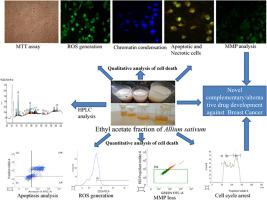
Breast cancer is a common disease that impacts the women population worldwide and therefore requires effective treatment strategies. Allium sativum L. (A. sativum) has been consumed in conventional remedies since antiquity owing to its extensive medicinal value. This study set out to analyse the primary phytocomponents in the active fraction of A. sativum and to evaluate its in vitro anticancer potential against triple-negative breast cancer (TNBC) MDA-MB-231 cells. Nonpolar to polar fractions of A. sativum extract were subjected to MTT assay, and the active fraction was selected for ROS estimation, apoptosis studies, mitochondrial membrane potential (MMP) assessment and cell cycle analysis. The active fraction was characterized phytochemically using the HPLC technique. The ethyl acetate fraction from A. sativum (EAFAS) was identified as the active fraction based on the MTT screening test. HPLC investigation confirmed two main organosulfur compounds, allicin and alliin in EAFAS. EAFAS treated MDA-MB-231 cells exhibited apoptotic-like morphology; however, no any substantial cytotoxicity toward the normal epithelial cell line Vero was observed. Fluorescence microscope and flow cytometry analysis confirmed both apoptotic and necrotic cell death in TNBC cells. Notably, EAFAS showed a low amount of MMP and a high level of ROS production. A cell-cycle study showed that exposure to the EAFAS enhanced the proportion of cells in the S and G2/M stages. These findings provide crucial new insights into the potential of EAFAS as a medicinal candidate for the treatment of TNBC.
期刊介绍:
The South African Journal of Botany publishes original papers that deal with the classification, biodiversity, morphology, physiology, molecular biology, ecology, biotechnology, ethnobotany and other botanically related aspects of species that are of importance to southern Africa. Manuscripts dealing with significant new findings on other species of the world and general botanical principles will also be considered and are encouraged.




 京公网安备 11010802042870号
京ICP备2023020795号-1
京公网安备 11010802042870号
京ICP备2023020795号-1

 分享
分享
 求助内容:
求助内容: 应助结果提醒方式:
 扫码关注我们
