{"title":"一种灵活的多环化学传感器,可根据不同的配位模式同时识别Ni2+和Cd2+","authors":"Ziyu Chen, Qianxin Long, Wen Li, Zhiyun Zhang, Jianhua Su, Lifang Guo","doi":"10.1016/j.saa.2025.125830","DOIUrl":null,"url":null,"abstract":"<div><div>Herein, we present a paradigm of a flexible molecular system for simultaneous discernment of Ni<sup>2+</sup> and Cd<sup>2+</sup>, depending on distinct chemical coordination manners. By incorporating two functional pyridine groups at different positions on the flexible DPAC framework (9,14-diphenyl-9,14-Dihydrodibenzo [a,c]phenazine), two derivatives are prepared as <strong>27Py-DPAC</strong> and <strong>36Py-DPAC</strong>. The results show that <strong>27Py-DPAC</strong> can chemically coordinate with Ni<sup>2+</sup> (intermolecular coordination) and Cd<sup>2+</sup> (intramolecular coordination), generating fluorescence turn-off and -on behaviors, respectively. The key factors leading to the different coordination ways are the ionic radius and the substituted positions of pyridine groups. Demonstrably, <strong>36Py-DPAC</strong> can respond to Ni<sup>2+</sup> abiding by the principle of the <strong>27Py-DPAC</strong> sensor, but it cannot sense Cd<sup>2+</sup> because of the difficulty in forming an effective intramolecular coordination resulted from the large distance between two nitrogen atoms on pyridine and the central heterocyclic ring. Based on the ionic response properties of the two compounds, logic circuits were developed to simulate logical operations and facilitate ion detection. This research expands the applicability of flexible polycyclic conjugated molecules in chemical sensing and underscores the influence of different modification sites of functional groups on ion binding mechanisms.</div></div>","PeriodicalId":433,"journal":{"name":"Spectrochimica Acta Part A: Molecular and Biomolecular Spectroscopy","volume":"332 ","pages":"Article 125830"},"PeriodicalIF":4.6000,"publicationDate":"2025-05-05","publicationTypes":"Journal Article","fieldsOfStudy":null,"isOpenAccess":false,"openAccessPdf":"","citationCount":"0","resultStr":"{\"title\":\"A flexible polycyclic chemosensor for simultaneous discernment of Ni2+ and Cd2+ depending on distinct coordination modes\",\"authors\":\"Ziyu Chen, Qianxin Long, Wen Li, Zhiyun Zhang, Jianhua Su, Lifang Guo\",\"doi\":\"10.1016/j.saa.2025.125830\",\"DOIUrl\":null,\"url\":null,\"abstract\":\"<div><div>Herein, we present a paradigm of a flexible molecular system for simultaneous discernment of Ni<sup>2+</sup> and Cd<sup>2+</sup>, depending on distinct chemical coordination manners. By incorporating two functional pyridine groups at different positions on the flexible DPAC framework (9,14-diphenyl-9,14-Dihydrodibenzo [a,c]phenazine), two derivatives are prepared as <strong>27Py-DPAC</strong> and <strong>36Py-DPAC</strong>. The results show that <strong>27Py-DPAC</strong> can chemically coordinate with Ni<sup>2+</sup> (intermolecular coordination) and Cd<sup>2+</sup> (intramolecular coordination), generating fluorescence turn-off and -on behaviors, respectively. The key factors leading to the different coordination ways are the ionic radius and the substituted positions of pyridine groups. Demonstrably, <strong>36Py-DPAC</strong> can respond to Ni<sup>2+</sup> abiding by the principle of the <strong>27Py-DPAC</strong> sensor, but it cannot sense Cd<sup>2+</sup> because of the difficulty in forming an effective intramolecular coordination resulted from the large distance between two nitrogen atoms on pyridine and the central heterocyclic ring. Based on the ionic response properties of the two compounds, logic circuits were developed to simulate logical operations and facilitate ion detection. This research expands the applicability of flexible polycyclic conjugated molecules in chemical sensing and underscores the influence of different modification sites of functional groups on ion binding mechanisms.</div></div>\",\"PeriodicalId\":433,\"journal\":{\"name\":\"Spectrochimica Acta Part A: Molecular and Biomolecular Spectroscopy\",\"volume\":\"332 \",\"pages\":\"Article 125830\"},\"PeriodicalIF\":4.6000,\"publicationDate\":\"2025-05-05\",\"publicationTypes\":\"Journal Article\",\"fieldsOfStudy\":null,\"isOpenAccess\":false,\"openAccessPdf\":\"\",\"citationCount\":\"0\",\"resultStr\":null,\"platform\":\"Semanticscholar\",\"paperid\":null,\"PeriodicalName\":\"Spectrochimica Acta Part A: Molecular and Biomolecular Spectroscopy\",\"FirstCategoryId\":\"92\",\"ListUrlMain\":\"https://www.sciencedirect.com/science/article/pii/S1386142525001362\",\"RegionNum\":2,\"RegionCategory\":\"化学\",\"ArticlePicture\":[],\"TitleCN\":null,\"AbstractTextCN\":null,\"PMCID\":null,\"EPubDate\":\"2025/1/31 0:00:00\",\"PubModel\":\"Epub\",\"JCR\":\"Q1\",\"JCRName\":\"SPECTROSCOPY\",\"Score\":null,\"Total\":0}","platform":"Semanticscholar","paperid":null,"PeriodicalName":"Spectrochimica Acta Part A: Molecular and Biomolecular Spectroscopy","FirstCategoryId":"92","ListUrlMain":"https://www.sciencedirect.com/science/article/pii/S1386142525001362","RegionNum":2,"RegionCategory":"化学","ArticlePicture":[],"TitleCN":null,"AbstractTextCN":null,"PMCID":null,"EPubDate":"2025/1/31 0:00:00","PubModel":"Epub","JCR":"Q1","JCRName":"SPECTROSCOPY","Score":null,"Total":0}
A flexible polycyclic chemosensor for simultaneous discernment of Ni2+ and Cd2+ depending on distinct coordination modes
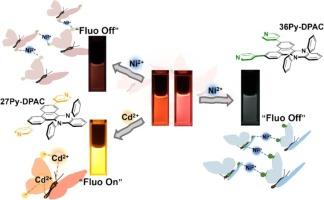
Herein, we present a paradigm of a flexible molecular system for simultaneous discernment of Ni2+ and Cd2+, depending on distinct chemical coordination manners. By incorporating two functional pyridine groups at different positions on the flexible DPAC framework (9,14-diphenyl-9,14-Dihydrodibenzo [a,c]phenazine), two derivatives are prepared as 27Py-DPAC and 36Py-DPAC. The results show that 27Py-DPAC can chemically coordinate with Ni2+ (intermolecular coordination) and Cd2+ (intramolecular coordination), generating fluorescence turn-off and -on behaviors, respectively. The key factors leading to the different coordination ways are the ionic radius and the substituted positions of pyridine groups. Demonstrably, 36Py-DPAC can respond to Ni2+ abiding by the principle of the 27Py-DPAC sensor, but it cannot sense Cd2+ because of the difficulty in forming an effective intramolecular coordination resulted from the large distance between two nitrogen atoms on pyridine and the central heterocyclic ring. Based on the ionic response properties of the two compounds, logic circuits were developed to simulate logical operations and facilitate ion detection. This research expands the applicability of flexible polycyclic conjugated molecules in chemical sensing and underscores the influence of different modification sites of functional groups on ion binding mechanisms.
期刊介绍:
Spectrochimica Acta, Part A: Molecular and Biomolecular Spectroscopy (SAA) is an interdisciplinary journal which spans from basic to applied aspects of optical spectroscopy in chemistry, medicine, biology, and materials science.
The journal publishes original scientific papers that feature high-quality spectroscopic data and analysis. From the broad range of optical spectroscopies, the emphasis is on electronic, vibrational or rotational spectra of molecules, rather than on spectroscopy based on magnetic moments.
Criteria for publication in SAA are novelty, uniqueness, and outstanding quality. Routine applications of spectroscopic techniques and computational methods are not appropriate.
Topics of particular interest of Spectrochimica Acta Part A include, but are not limited to:
Spectroscopy and dynamics of bioanalytical, biomedical, environmental, and atmospheric sciences,
Novel experimental techniques or instrumentation for molecular spectroscopy,
Novel theoretical and computational methods,
Novel applications in photochemistry and photobiology,
Novel interpretational approaches as well as advances in data analysis based on electronic or vibrational spectroscopy.




 京公网安备 11010802042870号
京ICP备2023020795号-1
京公网安备 11010802042870号
京ICP备2023020795号-1

 分享
分享
 求助内容:
求助内容: 应助结果提醒方式:
 扫码关注我们
