Yang Zhao , Junhao Ning , Quanchao Wang , Guilong Liu , Xin Xu , Rongjie Chen , Chunde Wang , Xia Lu
{"title":"LMNA在促进大型Argopecten扇贝寿命中的潜在作用","authors":"Yang Zhao , Junhao Ning , Quanchao Wang , Guilong Liu , Xin Xu , Rongjie Chen , Chunde Wang , Xia Lu","doi":"10.1016/j.aquaculture.2025.742254","DOIUrl":null,"url":null,"abstract":"<div><div>Bay scallops, <em>Argopecten irradians</em>, are a commercial bivalve species, but their small size, short longevity, and serious inbreeding depression make it difficult to further promote the farming of this species. Compared with bay scallops, some interspecific hybrids bay scallops and Peruvian scallops (<em>A. purpuratus</em>) have extraordinary growth advantages, such as longer longevity and greater sizes, which can be attributed to the longevity genes of Peruvian scallops (7–10 years). Lamin A/C (LMNA) is a nuclear scaffold protein that interacts with specific histone deacetylases (HDAC) to maintain their activity and regulate gene expression. <em>LMNA</em> mutations can lead to premature aging, and altered levels of <em>LMNA</em> are found in diverse diseases in most vertebrates; however, its roles in regulating senescence remains largely unknown in mollusk species. In this study, we cloned <em>LMNA</em> open reading frames (ORFs) from two closely correlated <em>Argopecten</em> scallops with different lifespans and explored their capacity to modulate longevity. One hundred and twenty-eight variations and one InDel of three nucleotides were discovered in <em>ApLMNA</em> and <em>AiLMNA</em> at the nucleotide sequence level, with 109 synonymous and 19 non-synonymous SNPs, leading to 16 amino acid variations and the absence of S16 in <em>AiLMNA</em>. Tissue distribution analysis revealed that these two genes exhibited different trends during the development and aging of the two scallops. A yeast two-hybrid assays revealed a stronger interaction between LMNA and SIRT1 in <em>A. purpuratus</em> than in <em>A. irradians</em>. RNA interference (RNAi) of <em>ApLMNA</em> at 6 h significantly upregulated the expression of its downstream gene, <em>SIRT1</em>; however, <em>SIRT1</em> was downregulated after RNAi of <em>AiLMNA</em>. The <em>SIRT1-</em>targeted genes <em>FoxO</em>, <em>Mn-SOD</em>, and <em>CAT</em> also showed different expression patterns. Transcriptome analysis revealed that the longevity pathways in Peruvian scallops were activated after RNAi. Overall, our study provides interesting avenues to understand the mechanism of longevity through <em>LMNA</em> genes and will help produce long-lived and large crossbred offsprings to maintain fisheries and aquaculture going.</div></div>","PeriodicalId":8375,"journal":{"name":"Aquaculture","volume":"600 ","pages":"Article 742254"},"PeriodicalIF":3.9000,"publicationDate":"2025-04-30","publicationTypes":"Journal Article","fieldsOfStudy":null,"isOpenAccess":false,"openAccessPdf":"","citationCount":"0","resultStr":"{\"title\":\"Potential roles of LMNA in promoting longevity for larger Argopecten scallops\",\"authors\":\"Yang Zhao , Junhao Ning , Quanchao Wang , Guilong Liu , Xin Xu , Rongjie Chen , Chunde Wang , Xia Lu\",\"doi\":\"10.1016/j.aquaculture.2025.742254\",\"DOIUrl\":null,\"url\":null,\"abstract\":\"<div><div>Bay scallops, <em>Argopecten irradians</em>, are a commercial bivalve species, but their small size, short longevity, and serious inbreeding depression make it difficult to further promote the farming of this species. Compared with bay scallops, some interspecific hybrids bay scallops and Peruvian scallops (<em>A. purpuratus</em>) have extraordinary growth advantages, such as longer longevity and greater sizes, which can be attributed to the longevity genes of Peruvian scallops (7–10 years). Lamin A/C (LMNA) is a nuclear scaffold protein that interacts with specific histone deacetylases (HDAC) to maintain their activity and regulate gene expression. <em>LMNA</em> mutations can lead to premature aging, and altered levels of <em>LMNA</em> are found in diverse diseases in most vertebrates; however, its roles in regulating senescence remains largely unknown in mollusk species. In this study, we cloned <em>LMNA</em> open reading frames (ORFs) from two closely correlated <em>Argopecten</em> scallops with different lifespans and explored their capacity to modulate longevity. One hundred and twenty-eight variations and one InDel of three nucleotides were discovered in <em>ApLMNA</em> and <em>AiLMNA</em> at the nucleotide sequence level, with 109 synonymous and 19 non-synonymous SNPs, leading to 16 amino acid variations and the absence of S16 in <em>AiLMNA</em>. Tissue distribution analysis revealed that these two genes exhibited different trends during the development and aging of the two scallops. A yeast two-hybrid assays revealed a stronger interaction between LMNA and SIRT1 in <em>A. purpuratus</em> than in <em>A. irradians</em>. RNA interference (RNAi) of <em>ApLMNA</em> at 6 h significantly upregulated the expression of its downstream gene, <em>SIRT1</em>; however, <em>SIRT1</em> was downregulated after RNAi of <em>AiLMNA</em>. The <em>SIRT1-</em>targeted genes <em>FoxO</em>, <em>Mn-SOD</em>, and <em>CAT</em> also showed different expression patterns. Transcriptome analysis revealed that the longevity pathways in Peruvian scallops were activated after RNAi. Overall, our study provides interesting avenues to understand the mechanism of longevity through <em>LMNA</em> genes and will help produce long-lived and large crossbred offsprings to maintain fisheries and aquaculture going.</div></div>\",\"PeriodicalId\":8375,\"journal\":{\"name\":\"Aquaculture\",\"volume\":\"600 \",\"pages\":\"Article 742254\"},\"PeriodicalIF\":3.9000,\"publicationDate\":\"2025-04-30\",\"publicationTypes\":\"Journal Article\",\"fieldsOfStudy\":null,\"isOpenAccess\":false,\"openAccessPdf\":\"\",\"citationCount\":\"0\",\"resultStr\":null,\"platform\":\"Semanticscholar\",\"paperid\":null,\"PeriodicalName\":\"Aquaculture\",\"FirstCategoryId\":\"97\",\"ListUrlMain\":\"https://www.sciencedirect.com/science/article/pii/S0044848625001401\",\"RegionNum\":1,\"RegionCategory\":\"农林科学\",\"ArticlePicture\":[],\"TitleCN\":null,\"AbstractTextCN\":null,\"PMCID\":null,\"EPubDate\":\"2025/2/1 0:00:00\",\"PubModel\":\"Epub\",\"JCR\":\"Q1\",\"JCRName\":\"FISHERIES\",\"Score\":null,\"Total\":0}","platform":"Semanticscholar","paperid":null,"PeriodicalName":"Aquaculture","FirstCategoryId":"97","ListUrlMain":"https://www.sciencedirect.com/science/article/pii/S0044848625001401","RegionNum":1,"RegionCategory":"农林科学","ArticlePicture":[],"TitleCN":null,"AbstractTextCN":null,"PMCID":null,"EPubDate":"2025/2/1 0:00:00","PubModel":"Epub","JCR":"Q1","JCRName":"FISHERIES","Score":null,"Total":0}
Potential roles of LMNA in promoting longevity for larger Argopecten scallops
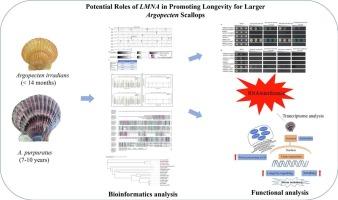
Bay scallops, Argopecten irradians, are a commercial bivalve species, but their small size, short longevity, and serious inbreeding depression make it difficult to further promote the farming of this species. Compared with bay scallops, some interspecific hybrids bay scallops and Peruvian scallops (A. purpuratus) have extraordinary growth advantages, such as longer longevity and greater sizes, which can be attributed to the longevity genes of Peruvian scallops (7–10 years). Lamin A/C (LMNA) is a nuclear scaffold protein that interacts with specific histone deacetylases (HDAC) to maintain their activity and regulate gene expression. LMNA mutations can lead to premature aging, and altered levels of LMNA are found in diverse diseases in most vertebrates; however, its roles in regulating senescence remains largely unknown in mollusk species. In this study, we cloned LMNA open reading frames (ORFs) from two closely correlated Argopecten scallops with different lifespans and explored their capacity to modulate longevity. One hundred and twenty-eight variations and one InDel of three nucleotides were discovered in ApLMNA and AiLMNA at the nucleotide sequence level, with 109 synonymous and 19 non-synonymous SNPs, leading to 16 amino acid variations and the absence of S16 in AiLMNA. Tissue distribution analysis revealed that these two genes exhibited different trends during the development and aging of the two scallops. A yeast two-hybrid assays revealed a stronger interaction between LMNA and SIRT1 in A. purpuratus than in A. irradians. RNA interference (RNAi) of ApLMNA at 6 h significantly upregulated the expression of its downstream gene, SIRT1; however, SIRT1 was downregulated after RNAi of AiLMNA. The SIRT1-targeted genes FoxO, Mn-SOD, and CAT also showed different expression patterns. Transcriptome analysis revealed that the longevity pathways in Peruvian scallops were activated after RNAi. Overall, our study provides interesting avenues to understand the mechanism of longevity through LMNA genes and will help produce long-lived and large crossbred offsprings to maintain fisheries and aquaculture going.
期刊介绍:
Aquaculture is an international journal for the exploration, improvement and management of all freshwater and marine food resources. It publishes novel and innovative research of world-wide interest on farming of aquatic organisms, which includes finfish, mollusks, crustaceans and aquatic plants for human consumption. Research on ornamentals is not a focus of the Journal. Aquaculture only publishes papers with a clear relevance to improving aquaculture practices or a potential application.





 京公网安备 11010802042870号
京ICP备2023020795号-1
京公网安备 11010802042870号
京ICP备2023020795号-1

 分享
分享
 求助内容:
求助内容: 应助结果提醒方式:
 扫码关注我们
