Dr. Binbin Qian, Ruiqian Zhang, Dr. Amir Said, Dr. Ke Xu, Prof. Dr. Sridhar Komarneni, Prof. Dr. Dongfeng Xue
{"title":"电催化水裂解粘土基材料的研究进展","authors":"Dr. Binbin Qian, Ruiqian Zhang, Dr. Amir Said, Dr. Ke Xu, Prof. Dr. Sridhar Komarneni, Prof. Dr. Dongfeng Xue","doi":"10.1002/cctc.202401431","DOIUrl":null,"url":null,"abstract":"<p>Clay-based materials are an emerging family of earth-abundant and low-cost inorganic functional materials with an modifiable layered-structure mode similar to hydroxides. They are considered as competitive electrocatalysts for water splitting due to their variable intra-layer ions, exchangeable interlayer molecules/ions, and large reaction surfaces, which demonstrate fascinating engineering opportunities at the microscale, mesoscale, and macroscale levels. We systematically summarized the research progress of clay-based materials by classifying clay-like compounds, clay-based composites, and clay-based derivatives, from the viewpoint of structural geometries towards optimizing functionalities. The design strategies for regulating and optimizing clay-based materials to meet the requirements of electrocatalysts with excellent activity and stability were outlined through representative examples. In addition, the hydrogen production applications of these clay-based materials were discussed reasonably including recent advances. Finally, the future perspectives of clay-based materials for electrocatalytic water splitting were demonstrated.</p>","PeriodicalId":141,"journal":{"name":"ChemCatChem","volume":"17 3","pages":""},"PeriodicalIF":4.1000,"publicationDate":"2024-10-22","publicationTypes":"Journal Article","fieldsOfStudy":null,"isOpenAccess":false,"openAccessPdf":"","citationCount":"0","resultStr":"{\"title\":\"Research Progress on Clay-Based Materials for Electrocatalytic Water Splitting\",\"authors\":\"Dr. Binbin Qian, Ruiqian Zhang, Dr. Amir Said, Dr. Ke Xu, Prof. Dr. Sridhar Komarneni, Prof. Dr. Dongfeng Xue\",\"doi\":\"10.1002/cctc.202401431\",\"DOIUrl\":null,\"url\":null,\"abstract\":\"<p>Clay-based materials are an emerging family of earth-abundant and low-cost inorganic functional materials with an modifiable layered-structure mode similar to hydroxides. They are considered as competitive electrocatalysts for water splitting due to their variable intra-layer ions, exchangeable interlayer molecules/ions, and large reaction surfaces, which demonstrate fascinating engineering opportunities at the microscale, mesoscale, and macroscale levels. We systematically summarized the research progress of clay-based materials by classifying clay-like compounds, clay-based composites, and clay-based derivatives, from the viewpoint of structural geometries towards optimizing functionalities. The design strategies for regulating and optimizing clay-based materials to meet the requirements of electrocatalysts with excellent activity and stability were outlined through representative examples. In addition, the hydrogen production applications of these clay-based materials were discussed reasonably including recent advances. Finally, the future perspectives of clay-based materials for electrocatalytic water splitting were demonstrated.</p>\",\"PeriodicalId\":141,\"journal\":{\"name\":\"ChemCatChem\",\"volume\":\"17 3\",\"pages\":\"\"},\"PeriodicalIF\":4.1000,\"publicationDate\":\"2024-10-22\",\"publicationTypes\":\"Journal Article\",\"fieldsOfStudy\":null,\"isOpenAccess\":false,\"openAccessPdf\":\"\",\"citationCount\":\"0\",\"resultStr\":null,\"platform\":\"Semanticscholar\",\"paperid\":null,\"PeriodicalName\":\"ChemCatChem\",\"FirstCategoryId\":\"92\",\"ListUrlMain\":\"https://chemistry-europe.onlinelibrary.wiley.com/doi/10.1002/cctc.202401431\",\"RegionNum\":3,\"RegionCategory\":\"化学\",\"ArticlePicture\":[],\"TitleCN\":null,\"AbstractTextCN\":null,\"PMCID\":null,\"EPubDate\":\"\",\"PubModel\":\"\",\"JCR\":\"Q2\",\"JCRName\":\"CHEMISTRY, PHYSICAL\",\"Score\":null,\"Total\":0}","platform":"Semanticscholar","paperid":null,"PeriodicalName":"ChemCatChem","FirstCategoryId":"92","ListUrlMain":"https://chemistry-europe.onlinelibrary.wiley.com/doi/10.1002/cctc.202401431","RegionNum":3,"RegionCategory":"化学","ArticlePicture":[],"TitleCN":null,"AbstractTextCN":null,"PMCID":null,"EPubDate":"","PubModel":"","JCR":"Q2","JCRName":"CHEMISTRY, PHYSICAL","Score":null,"Total":0}
Research Progress on Clay-Based Materials for Electrocatalytic Water Splitting
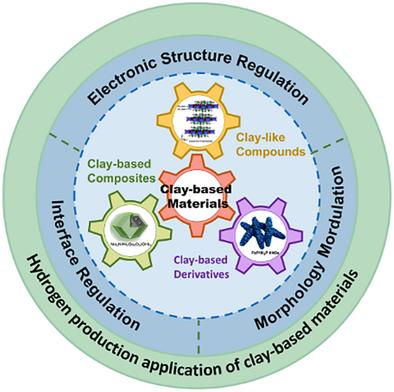
Clay-based materials are an emerging family of earth-abundant and low-cost inorganic functional materials with an modifiable layered-structure mode similar to hydroxides. They are considered as competitive electrocatalysts for water splitting due to their variable intra-layer ions, exchangeable interlayer molecules/ions, and large reaction surfaces, which demonstrate fascinating engineering opportunities at the microscale, mesoscale, and macroscale levels. We systematically summarized the research progress of clay-based materials by classifying clay-like compounds, clay-based composites, and clay-based derivatives, from the viewpoint of structural geometries towards optimizing functionalities. The design strategies for regulating and optimizing clay-based materials to meet the requirements of electrocatalysts with excellent activity and stability were outlined through representative examples. In addition, the hydrogen production applications of these clay-based materials were discussed reasonably including recent advances. Finally, the future perspectives of clay-based materials for electrocatalytic water splitting were demonstrated.
期刊介绍:
With an impact factor of 4.495 (2018), ChemCatChem is one of the premier journals in the field of catalysis. The journal provides primary research papers and critical secondary information on heterogeneous, homogeneous and bio- and nanocatalysis. The journal is well placed to strengthen cross-communication within between these communities. Its authors and readers come from academia, the chemical industry, and government laboratories across the world. It is published on behalf of Chemistry Europe, an association of 16 European chemical societies, and is supported by the German Catalysis Society.







 京公网安备 11010802042870号
京ICP备2023020795号-1
京公网安备 11010802042870号
京ICP备2023020795号-1

 分享
分享
 求助内容:
求助内容: 应助结果提醒方式:
 扫码关注我们
