Dr. Hathaichanok Seelajaroen, Felix Mayr, Dr. Dominik Wielend, Dr. Munise Cobet, Dr. Christoph Ulbricht, Prof. Niyazi Serdar Sariciftci, Dr. Serpil Tekoglu
{"title":"多酶包埋及生物相容性氧化还原介质的可持续一锅电化学方法。","authors":"Dr. Hathaichanok Seelajaroen, Felix Mayr, Dr. Dominik Wielend, Dr. Munise Cobet, Dr. Christoph Ulbricht, Prof. Niyazi Serdar Sariciftci, Dr. Serpil Tekoglu","doi":"10.1002/cplu.202400577","DOIUrl":null,"url":null,"abstract":"<p>Enzyme immobilization is regarded as a key factor for their effective utilization in various fields such as biofuel production, wastewater treatment, and biosensors. Designing new electrodes with biocompatible support matrices is essential to improve the stability in bioelectrocatalysis. Modified carbon felt electrodes were prepared and tested as bioelectrocatalyst under mild conditions – aqueous media at room temperature and basically neutral pH. Co-immobilization of dehydrogenase enzymes and neutral red (NR) dye at carbon felt electrodes was successfully achieved during electropolymerization of pyrrole in a facile one-step approach. Neutral red was incorporated to operate as a redox mediator supporting efficient electron transfer to the enzymes’ active sites. Electrodes modified with alcohol dehydrogenase (ADH) have been employed to reduce acetaldehyde to ethanol in a chronoamperometic setting with Faradaic efficiency (FE) of up to <b>33 %</b>. By incorporating the cascade reaction with three enzymes – ADH, formate dehydrogenase, and formaldehyde dehydrogenase – an electroreduction sequence could be established to produce methanol from CO<sub>2</sub> reaching a FE of <b>10 %</b>. The proposed approach shows good stability. Together with the simple implementation and application, this process is promising for employment in enzymatic electrocatalysis.</p>","PeriodicalId":148,"journal":{"name":"ChemPlusChem","volume":"90 5","pages":""},"PeriodicalIF":3.1000,"publicationDate":"2025-02-07","publicationTypes":"Journal Article","fieldsOfStudy":null,"isOpenAccess":false,"openAccessPdf":"https://onlinelibrary.wiley.com/doi/epdf/10.1002/cplu.202400577","citationCount":"0","resultStr":"{\"title\":\"Sustainable One-Pot Electrochemical Approach for Entrapment of Multi-Enzymes and Biocompatible Redox Mediator\",\"authors\":\"Dr. Hathaichanok Seelajaroen, Felix Mayr, Dr. Dominik Wielend, Dr. Munise Cobet, Dr. Christoph Ulbricht, Prof. Niyazi Serdar Sariciftci, Dr. Serpil Tekoglu\",\"doi\":\"10.1002/cplu.202400577\",\"DOIUrl\":null,\"url\":null,\"abstract\":\"<p>Enzyme immobilization is regarded as a key factor for their effective utilization in various fields such as biofuel production, wastewater treatment, and biosensors. Designing new electrodes with biocompatible support matrices is essential to improve the stability in bioelectrocatalysis. Modified carbon felt electrodes were prepared and tested as bioelectrocatalyst under mild conditions – aqueous media at room temperature and basically neutral pH. Co-immobilization of dehydrogenase enzymes and neutral red (NR) dye at carbon felt electrodes was successfully achieved during electropolymerization of pyrrole in a facile one-step approach. Neutral red was incorporated to operate as a redox mediator supporting efficient electron transfer to the enzymes’ active sites. Electrodes modified with alcohol dehydrogenase (ADH) have been employed to reduce acetaldehyde to ethanol in a chronoamperometic setting with Faradaic efficiency (FE) of up to <b>33 %</b>. By incorporating the cascade reaction with three enzymes – ADH, formate dehydrogenase, and formaldehyde dehydrogenase – an electroreduction sequence could be established to produce methanol from CO<sub>2</sub> reaching a FE of <b>10 %</b>. The proposed approach shows good stability. Together with the simple implementation and application, this process is promising for employment in enzymatic electrocatalysis.</p>\",\"PeriodicalId\":148,\"journal\":{\"name\":\"ChemPlusChem\",\"volume\":\"90 5\",\"pages\":\"\"},\"PeriodicalIF\":3.1000,\"publicationDate\":\"2025-02-07\",\"publicationTypes\":\"Journal Article\",\"fieldsOfStudy\":null,\"isOpenAccess\":false,\"openAccessPdf\":\"https://onlinelibrary.wiley.com/doi/epdf/10.1002/cplu.202400577\",\"citationCount\":\"0\",\"resultStr\":null,\"platform\":\"Semanticscholar\",\"paperid\":null,\"PeriodicalName\":\"ChemPlusChem\",\"FirstCategoryId\":\"92\",\"ListUrlMain\":\"https://chemistry-europe.onlinelibrary.wiley.com/doi/10.1002/cplu.202400577\",\"RegionNum\":4,\"RegionCategory\":\"化学\",\"ArticlePicture\":[],\"TitleCN\":null,\"AbstractTextCN\":null,\"PMCID\":null,\"EPubDate\":\"\",\"PubModel\":\"\",\"JCR\":\"Q2\",\"JCRName\":\"CHEMISTRY, MULTIDISCIPLINARY\",\"Score\":null,\"Total\":0}","platform":"Semanticscholar","paperid":null,"PeriodicalName":"ChemPlusChem","FirstCategoryId":"92","ListUrlMain":"https://chemistry-europe.onlinelibrary.wiley.com/doi/10.1002/cplu.202400577","RegionNum":4,"RegionCategory":"化学","ArticlePicture":[],"TitleCN":null,"AbstractTextCN":null,"PMCID":null,"EPubDate":"","PubModel":"","JCR":"Q2","JCRName":"CHEMISTRY, MULTIDISCIPLINARY","Score":null,"Total":0}
Sustainable One-Pot Electrochemical Approach for Entrapment of Multi-Enzymes and Biocompatible Redox Mediator
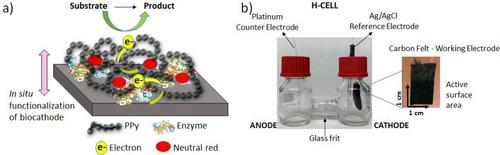
Enzyme immobilization is regarded as a key factor for their effective utilization in various fields such as biofuel production, wastewater treatment, and biosensors. Designing new electrodes with biocompatible support matrices is essential to improve the stability in bioelectrocatalysis. Modified carbon felt electrodes were prepared and tested as bioelectrocatalyst under mild conditions – aqueous media at room temperature and basically neutral pH. Co-immobilization of dehydrogenase enzymes and neutral red (NR) dye at carbon felt electrodes was successfully achieved during electropolymerization of pyrrole in a facile one-step approach. Neutral red was incorporated to operate as a redox mediator supporting efficient electron transfer to the enzymes’ active sites. Electrodes modified with alcohol dehydrogenase (ADH) have been employed to reduce acetaldehyde to ethanol in a chronoamperometic setting with Faradaic efficiency (FE) of up to 33 %. By incorporating the cascade reaction with three enzymes – ADH, formate dehydrogenase, and formaldehyde dehydrogenase – an electroreduction sequence could be established to produce methanol from CO2 reaching a FE of 10 %. The proposed approach shows good stability. Together with the simple implementation and application, this process is promising for employment in enzymatic electrocatalysis.
期刊介绍:
ChemPlusChem is a peer-reviewed, general chemistry journal that brings readers the very best in multidisciplinary research centering on chemistry. It is published on behalf of Chemistry Europe, an association of 16 European chemical societies.
Fully comprehensive in its scope, ChemPlusChem publishes articles covering new results from at least two different aspects (subfields) of chemistry or one of chemistry and one of another scientific discipline (one chemistry topic plus another one, hence the title ChemPlusChem). All suitable submissions undergo balanced peer review by experts in the field to ensure the highest quality, originality, relevance, significance, and validity.






 京公网安备 11010802042870号
京ICP备2023020795号-1
京公网安备 11010802042870号
京ICP备2023020795号-1

 分享
分享
 求助内容:
求助内容: 应助结果提醒方式:
 扫码关注我们
