Lufan Li, Nan Zhang, Xiaoqin Wang, Qingsong Wu, Rui Li, Rong Huang, Lan Yu, Yang Liu, Xiaomin Chen, Weijuan Zeng, Yixin Hu, Fang Li, Wenjing Li, Yue Fu, Bin Jiang, Liang Liang, Min Ke
{"title":"从出生年份看中部地区眼轴长度和角膜曲率的变化。","authors":"Lufan Li, Nan Zhang, Xiaoqin Wang, Qingsong Wu, Rui Li, Rong Huang, Lan Yu, Yang Liu, Xiaomin Chen, Weijuan Zeng, Yixin Hu, Fang Li, Wenjing Li, Yue Fu, Bin Jiang, Liang Liang, Min Ke","doi":"10.1038/s41433-025-03652-1","DOIUrl":null,"url":null,"abstract":"To explore the changes in eye structures over time in the Chinese population from the perspective of birth year. We collected measurement data of intraocular lens Master from patients who underwent intraocular lens Master biometry for a routine cataract or refractive examination (ametropia and presbyopia) between April 2012 and October 2023, then screened them. Selected patients were divided into ten groups of 10 years each according to their year of birth (called birth decades). Birth-year–dependent changes in axial length and corneal curvature were compared between the groups. The average axial length increased from 23.52 mm to 25.95 mm, and the corneal curvature dropped from 44.20 D to 43.33 D in patients born in before-1930 and 1990s. The proportion of short average axial length and steep corneal curvature decreased, whereas the proportion of long average axial length increased with the birth decade. The proportion of patients with corneal curvature < 40 D was 4.18% in 1970s, 5.73% in 1980s, and 3.38% in 1990s, which were significantly higher than those of other age groups. The average axial length of the eyes among primary school students was 23.96 mm, and among college students, it was 25.86 mm. Overall, with the birth decade, average axial length increased and corneal curvature decreased. There were generational differences in ocular biological parameters, changes in the eye might affect the incidence of eye diseases such as glaucoma and fundus diseases, which in turn might lead to changes in the spectrum of eye diseases.","PeriodicalId":12125,"journal":{"name":"Eye","volume":"39 7","pages":"1373-1379"},"PeriodicalIF":3.2000,"publicationDate":"2025-02-06","publicationTypes":"Journal Article","fieldsOfStudy":null,"isOpenAccess":false,"openAccessPdf":"","citationCount":"0","resultStr":"{\"title\":\"Changes in eye axis length and corneal curvature in central China from the perspective of birth year\",\"authors\":\"Lufan Li, Nan Zhang, Xiaoqin Wang, Qingsong Wu, Rui Li, Rong Huang, Lan Yu, Yang Liu, Xiaomin Chen, Weijuan Zeng, Yixin Hu, Fang Li, Wenjing Li, Yue Fu, Bin Jiang, Liang Liang, Min Ke\",\"doi\":\"10.1038/s41433-025-03652-1\",\"DOIUrl\":null,\"url\":null,\"abstract\":\"To explore the changes in eye structures over time in the Chinese population from the perspective of birth year. We collected measurement data of intraocular lens Master from patients who underwent intraocular lens Master biometry for a routine cataract or refractive examination (ametropia and presbyopia) between April 2012 and October 2023, then screened them. Selected patients were divided into ten groups of 10 years each according to their year of birth (called birth decades). Birth-year–dependent changes in axial length and corneal curvature were compared between the groups. The average axial length increased from 23.52 mm to 25.95 mm, and the corneal curvature dropped from 44.20 D to 43.33 D in patients born in before-1930 and 1990s. The proportion of short average axial length and steep corneal curvature decreased, whereas the proportion of long average axial length increased with the birth decade. The proportion of patients with corneal curvature < 40 D was 4.18% in 1970s, 5.73% in 1980s, and 3.38% in 1990s, which were significantly higher than those of other age groups. The average axial length of the eyes among primary school students was 23.96 mm, and among college students, it was 25.86 mm. Overall, with the birth decade, average axial length increased and corneal curvature decreased. There were generational differences in ocular biological parameters, changes in the eye might affect the incidence of eye diseases such as glaucoma and fundus diseases, which in turn might lead to changes in the spectrum of eye diseases.\",\"PeriodicalId\":12125,\"journal\":{\"name\":\"Eye\",\"volume\":\"39 7\",\"pages\":\"1373-1379\"},\"PeriodicalIF\":3.2000,\"publicationDate\":\"2025-02-06\",\"publicationTypes\":\"Journal Article\",\"fieldsOfStudy\":null,\"isOpenAccess\":false,\"openAccessPdf\":\"\",\"citationCount\":\"0\",\"resultStr\":null,\"platform\":\"Semanticscholar\",\"paperid\":null,\"PeriodicalName\":\"Eye\",\"FirstCategoryId\":\"3\",\"ListUrlMain\":\"https://www.nature.com/articles/s41433-025-03652-1\",\"RegionNum\":3,\"RegionCategory\":\"医学\",\"ArticlePicture\":[],\"TitleCN\":null,\"AbstractTextCN\":null,\"PMCID\":null,\"EPubDate\":\"\",\"PubModel\":\"\",\"JCR\":\"Q1\",\"JCRName\":\"OPHTHALMOLOGY\",\"Score\":null,\"Total\":0}","platform":"Semanticscholar","paperid":null,"PeriodicalName":"Eye","FirstCategoryId":"3","ListUrlMain":"https://www.nature.com/articles/s41433-025-03652-1","RegionNum":3,"RegionCategory":"医学","ArticlePicture":[],"TitleCN":null,"AbstractTextCN":null,"PMCID":null,"EPubDate":"","PubModel":"","JCR":"Q1","JCRName":"OPHTHALMOLOGY","Score":null,"Total":0}
Changes in eye axis length and corneal curvature in central China from the perspective of birth year
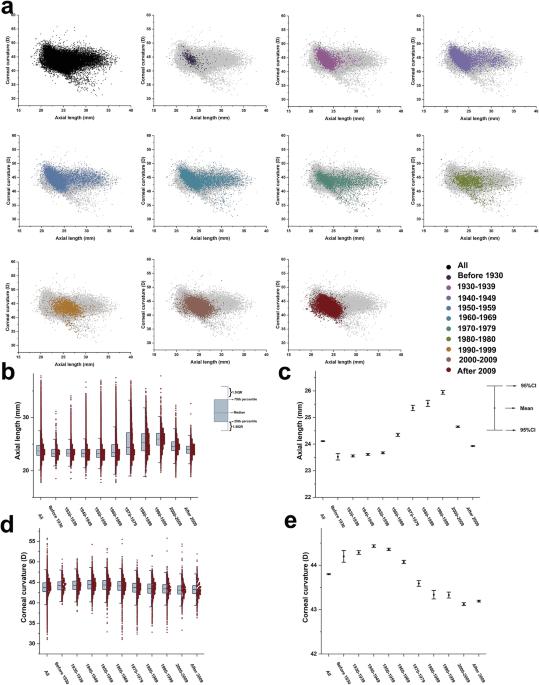
To explore the changes in eye structures over time in the Chinese population from the perspective of birth year. We collected measurement data of intraocular lens Master from patients who underwent intraocular lens Master biometry for a routine cataract or refractive examination (ametropia and presbyopia) between April 2012 and October 2023, then screened them. Selected patients were divided into ten groups of 10 years each according to their year of birth (called birth decades). Birth-year–dependent changes in axial length and corneal curvature were compared between the groups. The average axial length increased from 23.52 mm to 25.95 mm, and the corneal curvature dropped from 44.20 D to 43.33 D in patients born in before-1930 and 1990s. The proportion of short average axial length and steep corneal curvature decreased, whereas the proportion of long average axial length increased with the birth decade. The proportion of patients with corneal curvature < 40 D was 4.18% in 1970s, 5.73% in 1980s, and 3.38% in 1990s, which were significantly higher than those of other age groups. The average axial length of the eyes among primary school students was 23.96 mm, and among college students, it was 25.86 mm. Overall, with the birth decade, average axial length increased and corneal curvature decreased. There were generational differences in ocular biological parameters, changes in the eye might affect the incidence of eye diseases such as glaucoma and fundus diseases, which in turn might lead to changes in the spectrum of eye diseases.
期刊介绍:
Eye seeks to provide the international practising ophthalmologist with high quality articles, of academic rigour, on the latest global clinical and laboratory based research. Its core aim is to advance the science and practice of ophthalmology with the latest clinical- and scientific-based research. Whilst principally aimed at the practising clinician, the journal contains material of interest to a wider readership including optometrists, orthoptists, other health care professionals and research workers in all aspects of the field of visual science worldwide. Eye is the official journal of The Royal College of Ophthalmologists.
Eye encourages the submission of original articles covering all aspects of ophthalmology including: external eye disease; oculo-plastic surgery; orbital and lacrimal disease; ocular surface and corneal disorders; paediatric ophthalmology and strabismus; glaucoma; medical and surgical retina; neuro-ophthalmology; cataract and refractive surgery; ocular oncology; ophthalmic pathology; ophthalmic genetics.




 京公网安备 11010802042870号
京ICP备2023020795号-1
京公网安备 11010802042870号
京ICP备2023020795号-1

 分享
分享
 求助内容:
求助内容: 应助结果提醒方式:
 扫码关注我们
