Christian Rose, Emily Shearer, Isabela Woller, Ashley Foster, Nicholas Ashenburg, Ireh Kim, Jennifer Newberry
{"title":"确定高精度急诊医学的高优先级伦理挑战:名义组研究。","authors":"Christian Rose, Emily Shearer, Isabela Woller, Ashley Foster, Nicholas Ashenburg, Ireh Kim, Jennifer Newberry","doi":"10.2196/68371","DOIUrl":null,"url":null,"abstract":"<p><strong>Background: </strong>Precision medicine promises to revolutionize health care by providing the right care to the right patient at the right time. However, the emergency department's unique mandate to treat \"anyone, anywhere, anytime\" creates critical tensions with precision medicine's requirements for comprehensive patient data and computational analysis. As emergency departments serve as health care's safety net and provide a growing proportion of acute care in America, identifying and addressing the ethical challenges of implementing precision medicine in this setting is crucial to prevent exacerbation of existing health care disparities. The rapid advancement of precision medicine technologies makes it imperative to understand these challenges before widespread implementation in emergency care settings.</p><p><strong>Objective: </strong>This study aimed to identify high priority ethical concerns facing the implementation of precision medicine in the emergency department.</p><p><strong>Methods: </strong>We conducted a qualitative study using a modified nominal group technique (NGT) with emergency physicians who had previous knowledge of precision medicine concepts. The NGT process consisted of four phases: (1) silent generation of ideas, (2) round-robin sharing of ideas, (3) structured discussion and clarification, and (4) thematic grouping of priorities. Participants represented diverse practice settings (county hospital, community hospital, academic center, and integrated managed care consortium) and subspecialties (education, ethics, pediatrics, diversity, equity, inclusion, and informatics) across various career stages from residents to late-career physicians.</p><p><strong>Results: </strong>A total of 12 emergency physicians identified 82 initial challenges during individual ideation, which were consolidated to 48 unique challenges after removing duplicates and combining related items. The average participant contributed 6.8 (SD 2.9) challenges. These challenges were organized into a framework with 3 themes: values, privacy, and justice. The framework identified the need to address these themes across 3 time points of the precision medicine process: acquisition of data, actualization in the care setting, and the after effects of its use. This systematic organization revealed interrelated concerns spanning from data collection and bias to implementation challenges and long-term consequences for health care equity.</p><p><strong>Conclusions: </strong>Our study developed a novel framework that maps critical ethical challenges across 3 domains (values, privacy, and justice) and 3 temporal stages of precision medicine implementation. This framework identifies high-priority areas for future research and policy development, particularly around data representation, privacy protection, and equitable access. Successfully addressing these challenges is essential to realize precision medicine's potential while preserving emergency medicine's core mission as health care's safety net.</p>","PeriodicalId":14841,"journal":{"name":"JMIR Formative Research","volume":"9 ","pages":"e68371"},"PeriodicalIF":2.4000,"publicationDate":"2025-02-06","publicationTypes":"Journal Article","fieldsOfStudy":null,"isOpenAccess":false,"openAccessPdf":"https://www.ncbi.nlm.nih.gov/pmc/articles/PMC11825900/pdf/","citationCount":"0","resultStr":"{\"title\":\"Identifying High-Priority Ethical Challenges for Precision Emergency Medicine: Nominal Group Study.\",\"authors\":\"Christian Rose, Emily Shearer, Isabela Woller, Ashley Foster, Nicholas Ashenburg, Ireh Kim, Jennifer Newberry\",\"doi\":\"10.2196/68371\",\"DOIUrl\":null,\"url\":null,\"abstract\":\"<p><strong>Background: </strong>Precision medicine promises to revolutionize health care by providing the right care to the right patient at the right time. However, the emergency department's unique mandate to treat \\\"anyone, anywhere, anytime\\\" creates critical tensions with precision medicine's requirements for comprehensive patient data and computational analysis. As emergency departments serve as health care's safety net and provide a growing proportion of acute care in America, identifying and addressing the ethical challenges of implementing precision medicine in this setting is crucial to prevent exacerbation of existing health care disparities. The rapid advancement of precision medicine technologies makes it imperative to understand these challenges before widespread implementation in emergency care settings.</p><p><strong>Objective: </strong>This study aimed to identify high priority ethical concerns facing the implementation of precision medicine in the emergency department.</p><p><strong>Methods: </strong>We conducted a qualitative study using a modified nominal group technique (NGT) with emergency physicians who had previous knowledge of precision medicine concepts. The NGT process consisted of four phases: (1) silent generation of ideas, (2) round-robin sharing of ideas, (3) structured discussion and clarification, and (4) thematic grouping of priorities. Participants represented diverse practice settings (county hospital, community hospital, academic center, and integrated managed care consortium) and subspecialties (education, ethics, pediatrics, diversity, equity, inclusion, and informatics) across various career stages from residents to late-career physicians.</p><p><strong>Results: </strong>A total of 12 emergency physicians identified 82 initial challenges during individual ideation, which were consolidated to 48 unique challenges after removing duplicates and combining related items. The average participant contributed 6.8 (SD 2.9) challenges. These challenges were organized into a framework with 3 themes: values, privacy, and justice. The framework identified the need to address these themes across 3 time points of the precision medicine process: acquisition of data, actualization in the care setting, and the after effects of its use. This systematic organization revealed interrelated concerns spanning from data collection and bias to implementation challenges and long-term consequences for health care equity.</p><p><strong>Conclusions: </strong>Our study developed a novel framework that maps critical ethical challenges across 3 domains (values, privacy, and justice) and 3 temporal stages of precision medicine implementation. This framework identifies high-priority areas for future research and policy development, particularly around data representation, privacy protection, and equitable access. Successfully addressing these challenges is essential to realize precision medicine's potential while preserving emergency medicine's core mission as health care's safety net.</p>\",\"PeriodicalId\":14841,\"journal\":{\"name\":\"JMIR Formative Research\",\"volume\":\"9 \",\"pages\":\"e68371\"},\"PeriodicalIF\":2.4000,\"publicationDate\":\"2025-02-06\",\"publicationTypes\":\"Journal Article\",\"fieldsOfStudy\":null,\"isOpenAccess\":false,\"openAccessPdf\":\"https://www.ncbi.nlm.nih.gov/pmc/articles/PMC11825900/pdf/\",\"citationCount\":\"0\",\"resultStr\":null,\"platform\":\"Semanticscholar\",\"paperid\":null,\"PeriodicalName\":\"JMIR Formative Research\",\"FirstCategoryId\":\"1085\",\"ListUrlMain\":\"https://doi.org/10.2196/68371\",\"RegionNum\":0,\"RegionCategory\":null,\"ArticlePicture\":[],\"TitleCN\":null,\"AbstractTextCN\":null,\"PMCID\":null,\"EPubDate\":\"\",\"PubModel\":\"\",\"JCR\":\"Q3\",\"JCRName\":\"HEALTH CARE SCIENCES & SERVICES\",\"Score\":null,\"Total\":0}","platform":"Semanticscholar","paperid":null,"PeriodicalName":"JMIR Formative Research","FirstCategoryId":"1085","ListUrlMain":"https://doi.org/10.2196/68371","RegionNum":0,"RegionCategory":null,"ArticlePicture":[],"TitleCN":null,"AbstractTextCN":null,"PMCID":null,"EPubDate":"","PubModel":"","JCR":"Q3","JCRName":"HEALTH CARE SCIENCES & SERVICES","Score":null,"Total":0}
Identifying High-Priority Ethical Challenges for Precision Emergency Medicine: Nominal Group Study.
Background: Precision medicine promises to revolutionize health care by providing the right care to the right patient at the right time. However, the emergency department's unique mandate to treat "anyone, anywhere, anytime" creates critical tensions with precision medicine's requirements for comprehensive patient data and computational analysis. As emergency departments serve as health care's safety net and provide a growing proportion of acute care in America, identifying and addressing the ethical challenges of implementing precision medicine in this setting is crucial to prevent exacerbation of existing health care disparities. The rapid advancement of precision medicine technologies makes it imperative to understand these challenges before widespread implementation in emergency care settings.
Objective: This study aimed to identify high priority ethical concerns facing the implementation of precision medicine in the emergency department.
Methods: We conducted a qualitative study using a modified nominal group technique (NGT) with emergency physicians who had previous knowledge of precision medicine concepts. The NGT process consisted of four phases: (1) silent generation of ideas, (2) round-robin sharing of ideas, (3) structured discussion and clarification, and (4) thematic grouping of priorities. Participants represented diverse practice settings (county hospital, community hospital, academic center, and integrated managed care consortium) and subspecialties (education, ethics, pediatrics, diversity, equity, inclusion, and informatics) across various career stages from residents to late-career physicians.
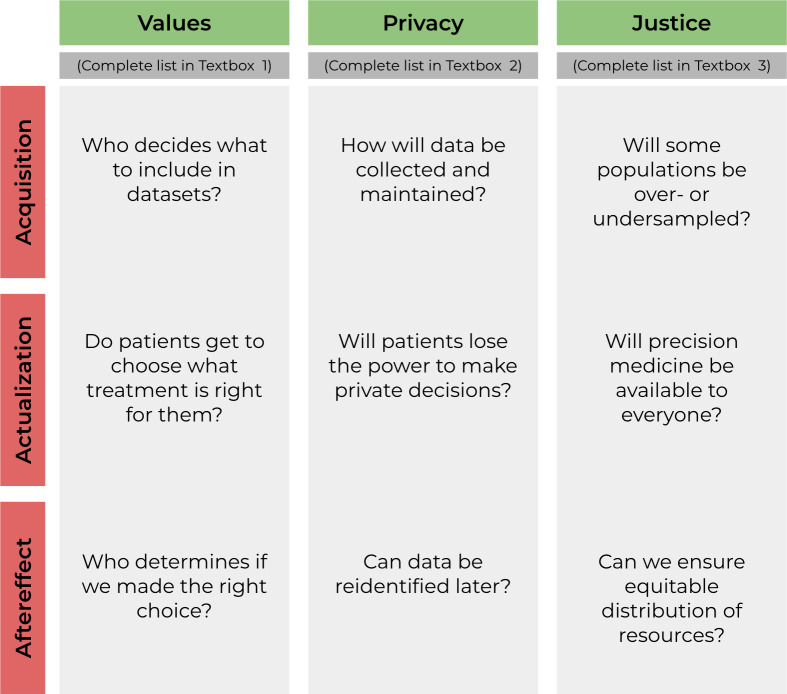
Results: A total of 12 emergency physicians identified 82 initial challenges during individual ideation, which were consolidated to 48 unique challenges after removing duplicates and combining related items. The average participant contributed 6.8 (SD 2.9) challenges. These challenges were organized into a framework with 3 themes: values, privacy, and justice. The framework identified the need to address these themes across 3 time points of the precision medicine process: acquisition of data, actualization in the care setting, and the after effects of its use. This systematic organization revealed interrelated concerns spanning from data collection and bias to implementation challenges and long-term consequences for health care equity.
Conclusions: Our study developed a novel framework that maps critical ethical challenges across 3 domains (values, privacy, and justice) and 3 temporal stages of precision medicine implementation. This framework identifies high-priority areas for future research and policy development, particularly around data representation, privacy protection, and equitable access. Successfully addressing these challenges is essential to realize precision medicine's potential while preserving emergency medicine's core mission as health care's safety net.






 京公网安备 11010802042870号
京ICP备2023020795号-1
京公网安备 11010802042870号
京ICP备2023020795号-1

 分享
分享
 求助内容:
求助内容: 应助结果提醒方式:
 扫码关注我们
