David Salvatierra , Mohammed Ariful Islam , María Pilar González , Julián Blasco , Cristiano V.M. Araújo
{"title":"异质性多生境分析系统(HeMHAS):一个非强制生态毒理学测试系统,从景观和应激生态学的角度研究污染驱动的生境选择行为","authors":"David Salvatierra , Mohammed Ariful Islam , María Pilar González , Julián Blasco , Cristiano V.M. Araújo","doi":"10.1016/j.envpol.2025.125818","DOIUrl":null,"url":null,"abstract":"<div><div>In ecotoxicology, the non-forced exposure approach provides a complementary perspective to traditional ecotoxicity tests by giving the organisms an opportunity to flee to adjacent, less contaminated areas, thus allowing them to escape from any toxic effects. This approach recognizes the chemical heterogeneity among connected habitats with different levels of contamination. The Heterogeneous Multi-Habitat Assay System (HeMHAS) is a non-forced aquatic assay system that allows the free movement of the organisms throughout various compartments with the possibility to select an area according to its attractiveness or aversiveness. This system expands the environmental risk assessment (ERA) by studying the habitat selection response based on the organism's ability to perceive the surrounding environment. This represents a new frontier in ERA, where different factors other than just contamination can be integrated to assess the cost-benefits balance when a habitat is selected. Thus, the HeMHAS has become a valuable habitat-selection based approach to assess the factors driving the spatial distribution of organisms in connected ecosystems with different levels of contamination. The aim of the current work is to describe the different types of HeMHAS, their ecological relevance, technical advantages and disadvantages, and to critically discuss its applicability and results that have been published in line with landscape and stress ecology.</div></div>","PeriodicalId":311,"journal":{"name":"Environmental Pollution","volume":"368 ","pages":"Article 125818"},"PeriodicalIF":7.3000,"publicationDate":"2025-03-01","publicationTypes":"Journal Article","fieldsOfStudy":null,"isOpenAccess":false,"openAccessPdf":"","citationCount":"0","resultStr":"{\"title\":\"The Heterogeneous Multi-Habitat Assay System (HeMHAS): A non-forced ecotoxicology test system to study contamination-driven habitat selection behavior from landscape and stress ecology perspectives\",\"authors\":\"David Salvatierra , Mohammed Ariful Islam , María Pilar González , Julián Blasco , Cristiano V.M. Araújo\",\"doi\":\"10.1016/j.envpol.2025.125818\",\"DOIUrl\":null,\"url\":null,\"abstract\":\"<div><div>In ecotoxicology, the non-forced exposure approach provides a complementary perspective to traditional ecotoxicity tests by giving the organisms an opportunity to flee to adjacent, less contaminated areas, thus allowing them to escape from any toxic effects. This approach recognizes the chemical heterogeneity among connected habitats with different levels of contamination. The Heterogeneous Multi-Habitat Assay System (HeMHAS) is a non-forced aquatic assay system that allows the free movement of the organisms throughout various compartments with the possibility to select an area according to its attractiveness or aversiveness. This system expands the environmental risk assessment (ERA) by studying the habitat selection response based on the organism's ability to perceive the surrounding environment. This represents a new frontier in ERA, where different factors other than just contamination can be integrated to assess the cost-benefits balance when a habitat is selected. Thus, the HeMHAS has become a valuable habitat-selection based approach to assess the factors driving the spatial distribution of organisms in connected ecosystems with different levels of contamination. The aim of the current work is to describe the different types of HeMHAS, their ecological relevance, technical advantages and disadvantages, and to critically discuss its applicability and results that have been published in line with landscape and stress ecology.</div></div>\",\"PeriodicalId\":311,\"journal\":{\"name\":\"Environmental Pollution\",\"volume\":\"368 \",\"pages\":\"Article 125818\"},\"PeriodicalIF\":7.3000,\"publicationDate\":\"2025-03-01\",\"publicationTypes\":\"Journal Article\",\"fieldsOfStudy\":null,\"isOpenAccess\":false,\"openAccessPdf\":\"\",\"citationCount\":\"0\",\"resultStr\":null,\"platform\":\"Semanticscholar\",\"paperid\":null,\"PeriodicalName\":\"Environmental Pollution\",\"FirstCategoryId\":\"93\",\"ListUrlMain\":\"https://www.sciencedirect.com/science/article/pii/S0269749125001915\",\"RegionNum\":2,\"RegionCategory\":\"环境科学与生态学\",\"ArticlePicture\":[],\"TitleCN\":null,\"AbstractTextCN\":null,\"PMCID\":null,\"EPubDate\":\"2025/2/8 0:00:00\",\"PubModel\":\"Epub\",\"JCR\":\"Q1\",\"JCRName\":\"ENVIRONMENTAL SCIENCES\",\"Score\":null,\"Total\":0}","platform":"Semanticscholar","paperid":null,"PeriodicalName":"Environmental Pollution","FirstCategoryId":"93","ListUrlMain":"https://www.sciencedirect.com/science/article/pii/S0269749125001915","RegionNum":2,"RegionCategory":"环境科学与生态学","ArticlePicture":[],"TitleCN":null,"AbstractTextCN":null,"PMCID":null,"EPubDate":"2025/2/8 0:00:00","PubModel":"Epub","JCR":"Q1","JCRName":"ENVIRONMENTAL SCIENCES","Score":null,"Total":0}
The Heterogeneous Multi-Habitat Assay System (HeMHAS): A non-forced ecotoxicology test system to study contamination-driven habitat selection behavior from landscape and stress ecology perspectives
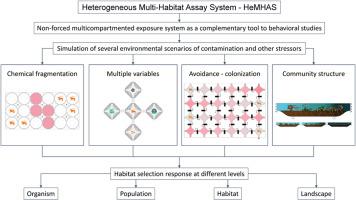
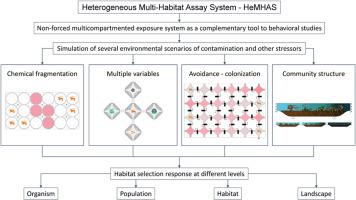
In ecotoxicology, the non-forced exposure approach provides a complementary perspective to traditional ecotoxicity tests by giving the organisms an opportunity to flee to adjacent, less contaminated areas, thus allowing them to escape from any toxic effects. This approach recognizes the chemical heterogeneity among connected habitats with different levels of contamination. The Heterogeneous Multi-Habitat Assay System (HeMHAS) is a non-forced aquatic assay system that allows the free movement of the organisms throughout various compartments with the possibility to select an area according to its attractiveness or aversiveness. This system expands the environmental risk assessment (ERA) by studying the habitat selection response based on the organism's ability to perceive the surrounding environment. This represents a new frontier in ERA, where different factors other than just contamination can be integrated to assess the cost-benefits balance when a habitat is selected. Thus, the HeMHAS has become a valuable habitat-selection based approach to assess the factors driving the spatial distribution of organisms in connected ecosystems with different levels of contamination. The aim of the current work is to describe the different types of HeMHAS, their ecological relevance, technical advantages and disadvantages, and to critically discuss its applicability and results that have been published in line with landscape and stress ecology.
期刊介绍:
Environmental Pollution is an international peer-reviewed journal that publishes high-quality research papers and review articles covering all aspects of environmental pollution and its impacts on ecosystems and human health.
Subject areas include, but are not limited to:
• Sources and occurrences of pollutants that are clearly defined and measured in environmental compartments, food and food-related items, and human bodies;
• Interlinks between contaminant exposure and biological, ecological, and human health effects, including those of climate change;
• Contaminants of emerging concerns (including but not limited to antibiotic resistant microorganisms or genes, microplastics/nanoplastics, electronic wastes, light, and noise) and/or their biological, ecological, or human health effects;
• Laboratory and field studies on the remediation/mitigation of environmental pollution via new techniques and with clear links to biological, ecological, or human health effects;
• Modeling of pollution processes, patterns, or trends that is of clear environmental and/or human health interest;
• New techniques that measure and examine environmental occurrences, transport, behavior, and effects of pollutants within the environment or the laboratory, provided that they can be clearly used to address problems within regional or global environmental compartments.




 京公网安备 11010802042870号
京ICP备2023020795号-1
京公网安备 11010802042870号
京ICP备2023020795号-1

 分享
分享
 求助内容:
求助内容: 应助结果提醒方式:
 扫码关注我们
