Louisien Lebrun, Cédric Lenoir, Caterina Leone, Emanuel N van den Broeke, Ombretta Caspani, Andreas Schilder, Bernhard Pelz, Andrea Truini, Rolf-Detlef Treede, André Mouraux
{"title":"高频电刺激足部与健康志愿者掌侧前臂引起的继发性痛觉过敏的强度、程度和持续时间","authors":"Louisien Lebrun, Cédric Lenoir, Caterina Leone, Emanuel N van den Broeke, Ombretta Caspani, Andreas Schilder, Bernhard Pelz, Andrea Truini, Rolf-Detlef Treede, André Mouraux","doi":"10.1371/journal.pone.0318934","DOIUrl":null,"url":null,"abstract":"<p><p>High-frequency electrical stimulation (HFS) of the skin using a multi-pin electrode activating epidermal nociceptors is used to explore spinal central sensitization in humans. Most previous studies applied HFS to the volar forearm. To prepare for clinical applications in which HFS could be applied to different body sites, this study compared the secondary hyperalgesia induced by stimulation of the foot dorsum vs. the forearm in 32 healthy volunteers. HFS consisted in five 1-s trains of 100 Hz pulses (inter-train interval: 10 s; intensity: 20x detection threshold) delivered via a novel electrode optimized for stimulation of different body sites (ten 0.25 mm pins in a 5-mm circle). Pinprick sensitivity was assessed before HFS and 30-240 minutes after HFS, at the treated site and the corresponding contralateral site. The area of hyperalgesia was quantified. HFS to the foot induced a significant increase in pinprick sensitivity of the surrounding skin, similar in magnitude to the increase at the forearm, and decaying similarly over time (half-lives 150 vs. 221 min). The radius of secondary hyperalgesia was smaller at the foot (22 mm) compared to the forearm (38 mm, p < 0.001), and decreased more rapidly over time (53 vs. 87 min, p < 0.01). Our results show that strength of HFS-induced secondary hyperalgesia can be used as indicator of spinal central sensitization across body sites, and thereby profile patients with localized or regional pain conditions. The size of the area of hyperalgesia may depend on innervation density and peripheral receptive field sizes.</p>","PeriodicalId":20189,"journal":{"name":"PLoS ONE","volume":"20 2","pages":"e0318934"},"PeriodicalIF":2.6000,"publicationDate":"2025-02-07","publicationTypes":"Journal Article","fieldsOfStudy":null,"isOpenAccess":false,"openAccessPdf":"https://www.ncbi.nlm.nih.gov/pmc/articles/PMC11805354/pdf/","citationCount":"0","resultStr":"{\"title\":\"Strength, extent and duration of secondary hyperalgesia induced by high-frequency electrical stimulation of the foot compared to the volar forearm of healthy human volunteers.\",\"authors\":\"Louisien Lebrun, Cédric Lenoir, Caterina Leone, Emanuel N van den Broeke, Ombretta Caspani, Andreas Schilder, Bernhard Pelz, Andrea Truini, Rolf-Detlef Treede, André Mouraux\",\"doi\":\"10.1371/journal.pone.0318934\",\"DOIUrl\":null,\"url\":null,\"abstract\":\"<p><p>High-frequency electrical stimulation (HFS) of the skin using a multi-pin electrode activating epidermal nociceptors is used to explore spinal central sensitization in humans. Most previous studies applied HFS to the volar forearm. To prepare for clinical applications in which HFS could be applied to different body sites, this study compared the secondary hyperalgesia induced by stimulation of the foot dorsum vs. the forearm in 32 healthy volunteers. HFS consisted in five 1-s trains of 100 Hz pulses (inter-train interval: 10 s; intensity: 20x detection threshold) delivered via a novel electrode optimized for stimulation of different body sites (ten 0.25 mm pins in a 5-mm circle). Pinprick sensitivity was assessed before HFS and 30-240 minutes after HFS, at the treated site and the corresponding contralateral site. The area of hyperalgesia was quantified. HFS to the foot induced a significant increase in pinprick sensitivity of the surrounding skin, similar in magnitude to the increase at the forearm, and decaying similarly over time (half-lives 150 vs. 221 min). The radius of secondary hyperalgesia was smaller at the foot (22 mm) compared to the forearm (38 mm, p < 0.001), and decreased more rapidly over time (53 vs. 87 min, p < 0.01). Our results show that strength of HFS-induced secondary hyperalgesia can be used as indicator of spinal central sensitization across body sites, and thereby profile patients with localized or regional pain conditions. The size of the area of hyperalgesia may depend on innervation density and peripheral receptive field sizes.</p>\",\"PeriodicalId\":20189,\"journal\":{\"name\":\"PLoS ONE\",\"volume\":\"20 2\",\"pages\":\"e0318934\"},\"PeriodicalIF\":2.6000,\"publicationDate\":\"2025-02-07\",\"publicationTypes\":\"Journal Article\",\"fieldsOfStudy\":null,\"isOpenAccess\":false,\"openAccessPdf\":\"https://www.ncbi.nlm.nih.gov/pmc/articles/PMC11805354/pdf/\",\"citationCount\":\"0\",\"resultStr\":null,\"platform\":\"Semanticscholar\",\"paperid\":null,\"PeriodicalName\":\"PLoS ONE\",\"FirstCategoryId\":\"103\",\"ListUrlMain\":\"https://doi.org/10.1371/journal.pone.0318934\",\"RegionNum\":3,\"RegionCategory\":\"综合性期刊\",\"ArticlePicture\":[],\"TitleCN\":null,\"AbstractTextCN\":null,\"PMCID\":null,\"EPubDate\":\"2025/1/1 0:00:00\",\"PubModel\":\"eCollection\",\"JCR\":\"Q1\",\"JCRName\":\"MULTIDISCIPLINARY SCIENCES\",\"Score\":null,\"Total\":0}","platform":"Semanticscholar","paperid":null,"PeriodicalName":"PLoS ONE","FirstCategoryId":"103","ListUrlMain":"https://doi.org/10.1371/journal.pone.0318934","RegionNum":3,"RegionCategory":"综合性期刊","ArticlePicture":[],"TitleCN":null,"AbstractTextCN":null,"PMCID":null,"EPubDate":"2025/1/1 0:00:00","PubModel":"eCollection","JCR":"Q1","JCRName":"MULTIDISCIPLINARY SCIENCES","Score":null,"Total":0}
引用次数: 0
摘要
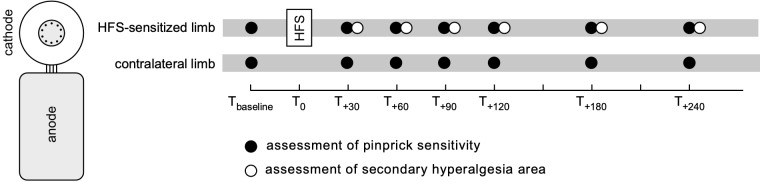
使用多针电极激活表皮伤害感受器的皮肤高频电刺激(HFS)用于探索人类脊髓中枢致敏。大多数先前的研究将HFS应用于前臂掌侧。为了为HFS在不同身体部位的临床应用做准备,本研究比较了32名健康志愿者刺激足背和前臂引起的继发性痛觉过敏。HFS由5列100 Hz脉冲组成(列间间隔10 s;强度:20倍检测阈值)通过一种新型电极传递,该电极针对不同身体部位的刺激进行了优化(10个0.25毫米的针在一个5毫米的圆圈中)。在HFS前和HFS后30-240分钟,在治疗部位和相应的对侧部位评估针刺敏感性。量化痛觉过敏的面积。足部HFS引起周围皮肤针刺敏感性的显著增加,其增加幅度与前臂相似,并且随着时间的推移类似地衰减(半衰期150 vs 221分钟)。继发性痛觉过敏的半径在足部(22 mm)比前臂(38 mm)小
Strength, extent and duration of secondary hyperalgesia induced by high-frequency electrical stimulation of the foot compared to the volar forearm of healthy human volunteers.
High-frequency electrical stimulation (HFS) of the skin using a multi-pin electrode activating epidermal nociceptors is used to explore spinal central sensitization in humans. Most previous studies applied HFS to the volar forearm. To prepare for clinical applications in which HFS could be applied to different body sites, this study compared the secondary hyperalgesia induced by stimulation of the foot dorsum vs. the forearm in 32 healthy volunteers. HFS consisted in five 1-s trains of 100 Hz pulses (inter-train interval: 10 s; intensity: 20x detection threshold) delivered via a novel electrode optimized for stimulation of different body sites (ten 0.25 mm pins in a 5-mm circle). Pinprick sensitivity was assessed before HFS and 30-240 minutes after HFS, at the treated site and the corresponding contralateral site. The area of hyperalgesia was quantified. HFS to the foot induced a significant increase in pinprick sensitivity of the surrounding skin, similar in magnitude to the increase at the forearm, and decaying similarly over time (half-lives 150 vs. 221 min). The radius of secondary hyperalgesia was smaller at the foot (22 mm) compared to the forearm (38 mm, p < 0.001), and decreased more rapidly over time (53 vs. 87 min, p < 0.01). Our results show that strength of HFS-induced secondary hyperalgesia can be used as indicator of spinal central sensitization across body sites, and thereby profile patients with localized or regional pain conditions. The size of the area of hyperalgesia may depend on innervation density and peripheral receptive field sizes.
期刊介绍:
PLOS ONE is an international, peer-reviewed, open-access, online publication. PLOS ONE welcomes reports on primary research from any scientific discipline. It provides:
* Open-access—freely accessible online, authors retain copyright
* Fast publication times
* Peer review by expert, practicing researchers
* Post-publication tools to indicate quality and impact
* Community-based dialogue on articles
* Worldwide media coverage







 京公网安备 11010802042870号
京ICP备2023020795号-1
京公网安备 11010802042870号
京ICP备2023020795号-1

 分享
分享
 求助内容:
求助内容: 应助结果提醒方式:
 扫码关注我们
