{"title":"YouTube作为深缘高程信息源:可靠性、准确性和质量分析。","authors":"Zeyneb Merve Ozdemir, Sevim Atılan Yavuz, Derya Gursel Surmelioglu","doi":"10.1371/journal.pone.0318568","DOIUrl":null,"url":null,"abstract":"<p><p>The objective of this research was to assess the accuracy, quality, content, and demographics of videos on YouTube concerning deep margin elevation (DME). Initially, 100 videos for each of the three keywords were analyzed. The content categories of these videos were diverse, encompassing educational materials, teaching techniques, advertisements, and other types of content. The evaluation of the videos was carried out based on the Global Quality Scale (GQS), the Journal of the American Medical Association (JAMA) benchmark, and the modified-DISCERN questionnaire (m-DISCERN). Non-distributed data were analyzed using the Kruskal Wallis test and the Spearman correlation coefficient. The JAMA score was 1 for four videos, 2-3 for 38, and 4 for 14 videos; the GQS score was 1-2 for 18 videos, 3 for 11 videos, and 4-5 for 27 videos; and the m-DISCERN score was < 3 for 39 videos, 3 for four videos, and > 3 for 13 (for a total of 56 videos). Statistically significant differences were observed only for the JAMA scores when comparing the video source groups (p = 0.001). There were significant positive correlations between the GQS and m-DISCERN and m-DISCERN and JAMA scores (p < 0.001 and p = 0.049, respectively). The findings indicated that YouTube videos related to DME generally exhibited high-quality content but only moderate accuracy and poor reliability.</p>","PeriodicalId":20189,"journal":{"name":"PLoS ONE","volume":"20 2","pages":"e0318568"},"PeriodicalIF":2.6000,"publicationDate":"2025-02-07","publicationTypes":"Journal Article","fieldsOfStudy":null,"isOpenAccess":false,"openAccessPdf":"https://www.ncbi.nlm.nih.gov/pmc/articles/PMC11805417/pdf/","citationCount":"0","resultStr":"{\"title\":\"YouTube as an information source in deep margin elevation: Reliability, accuracy and quality analysis.\",\"authors\":\"Zeyneb Merve Ozdemir, Sevim Atılan Yavuz, Derya Gursel Surmelioglu\",\"doi\":\"10.1371/journal.pone.0318568\",\"DOIUrl\":null,\"url\":null,\"abstract\":\"<p><p>The objective of this research was to assess the accuracy, quality, content, and demographics of videos on YouTube concerning deep margin elevation (DME). Initially, 100 videos for each of the three keywords were analyzed. The content categories of these videos were diverse, encompassing educational materials, teaching techniques, advertisements, and other types of content. The evaluation of the videos was carried out based on the Global Quality Scale (GQS), the Journal of the American Medical Association (JAMA) benchmark, and the modified-DISCERN questionnaire (m-DISCERN). Non-distributed data were analyzed using the Kruskal Wallis test and the Spearman correlation coefficient. The JAMA score was 1 for four videos, 2-3 for 38, and 4 for 14 videos; the GQS score was 1-2 for 18 videos, 3 for 11 videos, and 4-5 for 27 videos; and the m-DISCERN score was < 3 for 39 videos, 3 for four videos, and > 3 for 13 (for a total of 56 videos). Statistically significant differences were observed only for the JAMA scores when comparing the video source groups (p = 0.001). There were significant positive correlations between the GQS and m-DISCERN and m-DISCERN and JAMA scores (p < 0.001 and p = 0.049, respectively). The findings indicated that YouTube videos related to DME generally exhibited high-quality content but only moderate accuracy and poor reliability.</p>\",\"PeriodicalId\":20189,\"journal\":{\"name\":\"PLoS ONE\",\"volume\":\"20 2\",\"pages\":\"e0318568\"},\"PeriodicalIF\":2.6000,\"publicationDate\":\"2025-02-07\",\"publicationTypes\":\"Journal Article\",\"fieldsOfStudy\":null,\"isOpenAccess\":false,\"openAccessPdf\":\"https://www.ncbi.nlm.nih.gov/pmc/articles/PMC11805417/pdf/\",\"citationCount\":\"0\",\"resultStr\":null,\"platform\":\"Semanticscholar\",\"paperid\":null,\"PeriodicalName\":\"PLoS ONE\",\"FirstCategoryId\":\"103\",\"ListUrlMain\":\"https://doi.org/10.1371/journal.pone.0318568\",\"RegionNum\":3,\"RegionCategory\":\"综合性期刊\",\"ArticlePicture\":[],\"TitleCN\":null,\"AbstractTextCN\":null,\"PMCID\":null,\"EPubDate\":\"2025/1/1 0:00:00\",\"PubModel\":\"eCollection\",\"JCR\":\"Q1\",\"JCRName\":\"MULTIDISCIPLINARY SCIENCES\",\"Score\":null,\"Total\":0}","platform":"Semanticscholar","paperid":null,"PeriodicalName":"PLoS ONE","FirstCategoryId":"103","ListUrlMain":"https://doi.org/10.1371/journal.pone.0318568","RegionNum":3,"RegionCategory":"综合性期刊","ArticlePicture":[],"TitleCN":null,"AbstractTextCN":null,"PMCID":null,"EPubDate":"2025/1/1 0:00:00","PubModel":"eCollection","JCR":"Q1","JCRName":"MULTIDISCIPLINARY SCIENCES","Score":null,"Total":0}
YouTube as an information source in deep margin elevation: Reliability, accuracy and quality analysis.
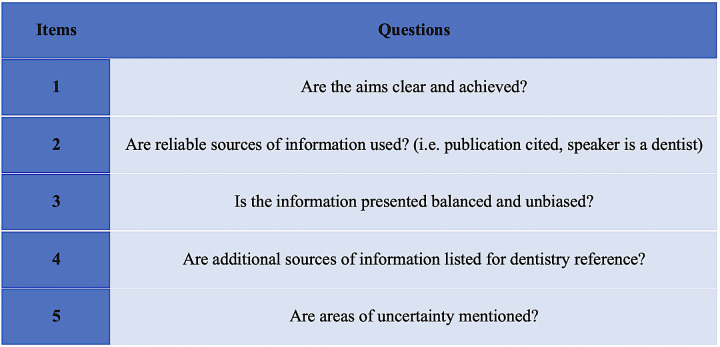
The objective of this research was to assess the accuracy, quality, content, and demographics of videos on YouTube concerning deep margin elevation (DME). Initially, 100 videos for each of the three keywords were analyzed. The content categories of these videos were diverse, encompassing educational materials, teaching techniques, advertisements, and other types of content. The evaluation of the videos was carried out based on the Global Quality Scale (GQS), the Journal of the American Medical Association (JAMA) benchmark, and the modified-DISCERN questionnaire (m-DISCERN). Non-distributed data were analyzed using the Kruskal Wallis test and the Spearman correlation coefficient. The JAMA score was 1 for four videos, 2-3 for 38, and 4 for 14 videos; the GQS score was 1-2 for 18 videos, 3 for 11 videos, and 4-5 for 27 videos; and the m-DISCERN score was < 3 for 39 videos, 3 for four videos, and > 3 for 13 (for a total of 56 videos). Statistically significant differences were observed only for the JAMA scores when comparing the video source groups (p = 0.001). There were significant positive correlations between the GQS and m-DISCERN and m-DISCERN and JAMA scores (p < 0.001 and p = 0.049, respectively). The findings indicated that YouTube videos related to DME generally exhibited high-quality content but only moderate accuracy and poor reliability.
期刊介绍:
PLOS ONE is an international, peer-reviewed, open-access, online publication. PLOS ONE welcomes reports on primary research from any scientific discipline. It provides:
* Open-access—freely accessible online, authors retain copyright
* Fast publication times
* Peer review by expert, practicing researchers
* Post-publication tools to indicate quality and impact
* Community-based dialogue on articles
* Worldwide media coverage






 京公网安备 11010802042870号
京ICP备2023020795号-1
京公网安备 11010802042870号
京ICP备2023020795号-1

 分享
分享
 求助内容:
求助内容: 应助结果提醒方式:
 扫码关注我们
