{"title":"生物炭与氧化石墨烯在多功能复合材料中的协同整合:从可持续合成到环境修复和储能","authors":"Dimitrios Kalderis , Peyman Gholami , Ioannis Pashalidis , Alireza Khataee","doi":"10.1016/j.jiec.2024.10.015","DOIUrl":null,"url":null,"abstract":"<div><div>Composite materials have gained significant attention due to their ability to combine distinct characteristics from two or more components, resulting in improved performance for various applications. This review paper examines the advancements made in the integration of two promising materials, biochar and graphene oxide (GO), in composite structures. Biochar, derived from biomass, offers unique physicochemical properties, while GO possesses a 2D structure with enhanced porosity and tunable electrical properties. However, there is a significant research gap in systematically understanding the combined effects of biochar and GO in composite materials, particularly concerning their synthesis techniques, environmental impact, and performance in diverse applications. This review addresses this gap by providing a comprehensive analysis of the state-of-the-art methodologies for synthesizing biochar-GO composites, their multifunctional properties, and their potential applications. Notably, biochar-GO composites exhibit exceptional efficiency in adsorbing heavy metal ions and organic contaminants due to their enhanced surface area and functional groups. The adsorption mechanisms involve a variety of physical and chemical interactions, leading to superior affinities compared to individual materials. Furthermore, biochar-GO composites demonstrate remarkable potential for utilization in electrochemical applications, serving as electrodes for supercapacitors and microbial fuel cells. These multifunctional materials show immense potential in tackling water pollution issues and promoting sustainable approaches. This review provides extensive insights into the synthesis techniques, properties, and applications of biochar-GO composites, highlighting their remarkable versatility as sustainable materials.</div></div>","PeriodicalId":363,"journal":{"name":"Journal of Industrial and Engineering Chemistry","volume":"144 ","pages":"Pages 210-227"},"PeriodicalIF":5.9000,"publicationDate":"2025-04-25","publicationTypes":"Journal Article","fieldsOfStudy":null,"isOpenAccess":false,"openAccessPdf":"","citationCount":"0","resultStr":"{\"title\":\"Synergistic integration of biochar and graphene oxide in multi-functional composites: From sustainable synthesis to environmental remediation and energy storage\",\"authors\":\"Dimitrios Kalderis , Peyman Gholami , Ioannis Pashalidis , Alireza Khataee\",\"doi\":\"10.1016/j.jiec.2024.10.015\",\"DOIUrl\":null,\"url\":null,\"abstract\":\"<div><div>Composite materials have gained significant attention due to their ability to combine distinct characteristics from two or more components, resulting in improved performance for various applications. This review paper examines the advancements made in the integration of two promising materials, biochar and graphene oxide (GO), in composite structures. Biochar, derived from biomass, offers unique physicochemical properties, while GO possesses a 2D structure with enhanced porosity and tunable electrical properties. However, there is a significant research gap in systematically understanding the combined effects of biochar and GO in composite materials, particularly concerning their synthesis techniques, environmental impact, and performance in diverse applications. This review addresses this gap by providing a comprehensive analysis of the state-of-the-art methodologies for synthesizing biochar-GO composites, their multifunctional properties, and their potential applications. Notably, biochar-GO composites exhibit exceptional efficiency in adsorbing heavy metal ions and organic contaminants due to their enhanced surface area and functional groups. The adsorption mechanisms involve a variety of physical and chemical interactions, leading to superior affinities compared to individual materials. Furthermore, biochar-GO composites demonstrate remarkable potential for utilization in electrochemical applications, serving as electrodes for supercapacitors and microbial fuel cells. These multifunctional materials show immense potential in tackling water pollution issues and promoting sustainable approaches. This review provides extensive insights into the synthesis techniques, properties, and applications of biochar-GO composites, highlighting their remarkable versatility as sustainable materials.</div></div>\",\"PeriodicalId\":363,\"journal\":{\"name\":\"Journal of Industrial and Engineering Chemistry\",\"volume\":\"144 \",\"pages\":\"Pages 210-227\"},\"PeriodicalIF\":5.9000,\"publicationDate\":\"2025-04-25\",\"publicationTypes\":\"Journal Article\",\"fieldsOfStudy\":null,\"isOpenAccess\":false,\"openAccessPdf\":\"\",\"citationCount\":\"0\",\"resultStr\":null,\"platform\":\"Semanticscholar\",\"paperid\":null,\"PeriodicalName\":\"Journal of Industrial and Engineering Chemistry\",\"FirstCategoryId\":\"5\",\"ListUrlMain\":\"https://www.sciencedirect.com/science/article/pii/S1226086X24006634\",\"RegionNum\":3,\"RegionCategory\":\"工程技术\",\"ArticlePicture\":[],\"TitleCN\":null,\"AbstractTextCN\":null,\"PMCID\":null,\"EPubDate\":\"2024/10/10 0:00:00\",\"PubModel\":\"Epub\",\"JCR\":\"Q1\",\"JCRName\":\"CHEMISTRY, MULTIDISCIPLINARY\",\"Score\":null,\"Total\":0}","platform":"Semanticscholar","paperid":null,"PeriodicalName":"Journal of Industrial and Engineering Chemistry","FirstCategoryId":"5","ListUrlMain":"https://www.sciencedirect.com/science/article/pii/S1226086X24006634","RegionNum":3,"RegionCategory":"工程技术","ArticlePicture":[],"TitleCN":null,"AbstractTextCN":null,"PMCID":null,"EPubDate":"2024/10/10 0:00:00","PubModel":"Epub","JCR":"Q1","JCRName":"CHEMISTRY, MULTIDISCIPLINARY","Score":null,"Total":0}
Synergistic integration of biochar and graphene oxide in multi-functional composites: From sustainable synthesis to environmental remediation and energy storage
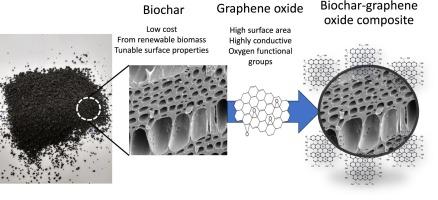
Composite materials have gained significant attention due to their ability to combine distinct characteristics from two or more components, resulting in improved performance for various applications. This review paper examines the advancements made in the integration of two promising materials, biochar and graphene oxide (GO), in composite structures. Biochar, derived from biomass, offers unique physicochemical properties, while GO possesses a 2D structure with enhanced porosity and tunable electrical properties. However, there is a significant research gap in systematically understanding the combined effects of biochar and GO in composite materials, particularly concerning their synthesis techniques, environmental impact, and performance in diverse applications. This review addresses this gap by providing a comprehensive analysis of the state-of-the-art methodologies for synthesizing biochar-GO composites, their multifunctional properties, and their potential applications. Notably, biochar-GO composites exhibit exceptional efficiency in adsorbing heavy metal ions and organic contaminants due to their enhanced surface area and functional groups. The adsorption mechanisms involve a variety of physical and chemical interactions, leading to superior affinities compared to individual materials. Furthermore, biochar-GO composites demonstrate remarkable potential for utilization in electrochemical applications, serving as electrodes for supercapacitors and microbial fuel cells. These multifunctional materials show immense potential in tackling water pollution issues and promoting sustainable approaches. This review provides extensive insights into the synthesis techniques, properties, and applications of biochar-GO composites, highlighting their remarkable versatility as sustainable materials.
期刊介绍:
Journal of Industrial and Engineering Chemistry is published monthly in English by the Korean Society of Industrial and Engineering Chemistry. JIEC brings together multidisciplinary interests in one journal and is to disseminate information on all aspects of research and development in industrial and engineering chemistry. Contributions in the form of research articles, short communications, notes and reviews are considered for publication. The editors welcome original contributions that have not been and are not to be published elsewhere. Instruction to authors and a manuscript submissions form are printed at the end of each issue. Bulk reprints of individual articles can be ordered. This publication is partially supported by Korea Research Foundation and the Korean Federation of Science and Technology Societies.




 京公网安备 11010802042870号
京ICP备2023020795号-1
京公网安备 11010802042870号
京ICP备2023020795号-1

 分享
分享
 求助内容:
求助内容: 应助结果提醒方式:
 扫码关注我们
