Zilu Lin, Yujia Li, Maloy Das, Caihong Liang, Xingchi Xiao, Zhihao Yen, Chandramouli Kulshreshtha, Luke Chia Wei Min, Aren Lim Junan, Kekeli N'konou, Tze Chien Sum, Nripan Mathews, Andrew C. Grimsdale, Leonard W. T. Ng
{"title":"直接集成生物质衍生呋喃聚合物以提高混合钙钛矿太阳能电池的稳定性和效率","authors":"Zilu Lin, Yujia Li, Maloy Das, Caihong Liang, Xingchi Xiao, Zhihao Yen, Chandramouli Kulshreshtha, Luke Chia Wei Min, Aren Lim Junan, Kekeli N'konou, Tze Chien Sum, Nripan Mathews, Andrew C. Grimsdale, Leonard W. T. Ng","doi":"10.1002/adfm.202423635","DOIUrl":null,"url":null,"abstract":"<p>This study introduces a novel, biomass-derived, furan-based conjugated polymer, PBDF-DFC, enabling a simplified direct precursor integration fabrication method for hybrid perovskite solar cells (HPSCs). Unlike traditional thiophene-based polymers, PBDF-DFC exhibits high solubility in perovskite precursor solvents, allowing direct incorporation into the precursor solution. This direct precursor integration approach significantly streamlines the fabrication process, reducing steps and potentially lowering production costs. The PBDF-DFC-modified HPSCs achieves a power conversion efficiency (PCE) of 21.39%, a 7.8% improvement over the 19.84% PCE of control devices. Moreover, these devices demonstrates enhanced stability under various environmental stresses, retaining 90% of their initial efficiency after over 1100 h of storage compared to 52% for control devices. X-ray diffraction, scanning electron microscopy, and transmission electron microscopy analyses reveals that PBDF-DFC accumulates at grain boundaries, improving film crystallization and reducing defects. This dual innovation of a new polymer and simplified fabrication process presents a promising pathway for more efficient, stable, and potentially more sustainable HPSCs. The successful integration of PBDF-DFC and the direct precursor integration method opens new avenues for streamlined production of high-performance perovskite solar cells, addressing key challenges in scalability and environmental impact.</p>","PeriodicalId":112,"journal":{"name":"Advanced Functional Materials","volume":"35 26","pages":""},"PeriodicalIF":19.0000,"publicationDate":"2025-02-09","publicationTypes":"Journal Article","fieldsOfStudy":null,"isOpenAccess":false,"openAccessPdf":"","citationCount":"0","resultStr":"{\"title\":\"Direct Integration of Biomass-Derived Furan Polymers for Enhanced Stability and Efficiency in Hybrid Perovskite Solar Cells\",\"authors\":\"Zilu Lin, Yujia Li, Maloy Das, Caihong Liang, Xingchi Xiao, Zhihao Yen, Chandramouli Kulshreshtha, Luke Chia Wei Min, Aren Lim Junan, Kekeli N'konou, Tze Chien Sum, Nripan Mathews, Andrew C. Grimsdale, Leonard W. T. Ng\",\"doi\":\"10.1002/adfm.202423635\",\"DOIUrl\":null,\"url\":null,\"abstract\":\"<p>This study introduces a novel, biomass-derived, furan-based conjugated polymer, PBDF-DFC, enabling a simplified direct precursor integration fabrication method for hybrid perovskite solar cells (HPSCs). Unlike traditional thiophene-based polymers, PBDF-DFC exhibits high solubility in perovskite precursor solvents, allowing direct incorporation into the precursor solution. This direct precursor integration approach significantly streamlines the fabrication process, reducing steps and potentially lowering production costs. The PBDF-DFC-modified HPSCs achieves a power conversion efficiency (PCE) of 21.39%, a 7.8% improvement over the 19.84% PCE of control devices. Moreover, these devices demonstrates enhanced stability under various environmental stresses, retaining 90% of their initial efficiency after over 1100 h of storage compared to 52% for control devices. X-ray diffraction, scanning electron microscopy, and transmission electron microscopy analyses reveals that PBDF-DFC accumulates at grain boundaries, improving film crystallization and reducing defects. This dual innovation of a new polymer and simplified fabrication process presents a promising pathway for more efficient, stable, and potentially more sustainable HPSCs. The successful integration of PBDF-DFC and the direct precursor integration method opens new avenues for streamlined production of high-performance perovskite solar cells, addressing key challenges in scalability and environmental impact.</p>\",\"PeriodicalId\":112,\"journal\":{\"name\":\"Advanced Functional Materials\",\"volume\":\"35 26\",\"pages\":\"\"},\"PeriodicalIF\":19.0000,\"publicationDate\":\"2025-02-09\",\"publicationTypes\":\"Journal Article\",\"fieldsOfStudy\":null,\"isOpenAccess\":false,\"openAccessPdf\":\"\",\"citationCount\":\"0\",\"resultStr\":null,\"platform\":\"Semanticscholar\",\"paperid\":null,\"PeriodicalName\":\"Advanced Functional Materials\",\"FirstCategoryId\":\"88\",\"ListUrlMain\":\"https://advanced.onlinelibrary.wiley.com/doi/10.1002/adfm.202423635\",\"RegionNum\":1,\"RegionCategory\":\"材料科学\",\"ArticlePicture\":[],\"TitleCN\":null,\"AbstractTextCN\":null,\"PMCID\":null,\"EPubDate\":\"\",\"PubModel\":\"\",\"JCR\":\"Q1\",\"JCRName\":\"CHEMISTRY, MULTIDISCIPLINARY\",\"Score\":null,\"Total\":0}","platform":"Semanticscholar","paperid":null,"PeriodicalName":"Advanced Functional Materials","FirstCategoryId":"88","ListUrlMain":"https://advanced.onlinelibrary.wiley.com/doi/10.1002/adfm.202423635","RegionNum":1,"RegionCategory":"材料科学","ArticlePicture":[],"TitleCN":null,"AbstractTextCN":null,"PMCID":null,"EPubDate":"","PubModel":"","JCR":"Q1","JCRName":"CHEMISTRY, MULTIDISCIPLINARY","Score":null,"Total":0}
Direct Integration of Biomass-Derived Furan Polymers for Enhanced Stability and Efficiency in Hybrid Perovskite Solar Cells
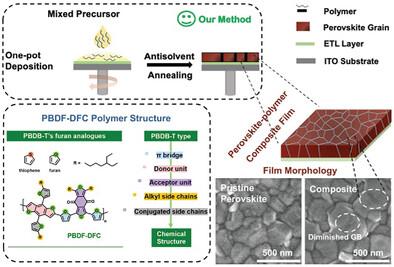
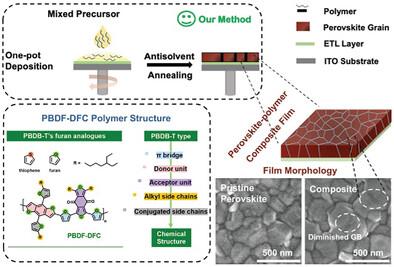
This study introduces a novel, biomass-derived, furan-based conjugated polymer, PBDF-DFC, enabling a simplified direct precursor integration fabrication method for hybrid perovskite solar cells (HPSCs). Unlike traditional thiophene-based polymers, PBDF-DFC exhibits high solubility in perovskite precursor solvents, allowing direct incorporation into the precursor solution. This direct precursor integration approach significantly streamlines the fabrication process, reducing steps and potentially lowering production costs. The PBDF-DFC-modified HPSCs achieves a power conversion efficiency (PCE) of 21.39%, a 7.8% improvement over the 19.84% PCE of control devices. Moreover, these devices demonstrates enhanced stability under various environmental stresses, retaining 90% of their initial efficiency after over 1100 h of storage compared to 52% for control devices. X-ray diffraction, scanning electron microscopy, and transmission electron microscopy analyses reveals that PBDF-DFC accumulates at grain boundaries, improving film crystallization and reducing defects. This dual innovation of a new polymer and simplified fabrication process presents a promising pathway for more efficient, stable, and potentially more sustainable HPSCs. The successful integration of PBDF-DFC and the direct precursor integration method opens new avenues for streamlined production of high-performance perovskite solar cells, addressing key challenges in scalability and environmental impact.
期刊介绍:
Firmly established as a top-tier materials science journal, Advanced Functional Materials reports breakthrough research in all aspects of materials science, including nanotechnology, chemistry, physics, and biology every week.
Advanced Functional Materials is known for its rapid and fair peer review, quality content, and high impact, making it the first choice of the international materials science community.






 京公网安备 11010802042870号
京ICP备2023020795号-1
京公网安备 11010802042870号
京ICP备2023020795号-1

 分享
分享
 求助内容:
求助内容: 应助结果提醒方式:
 扫码关注我们
